Showing posts with label death. Show all posts

Sunday, 19 March 2017

Remembering Chuck Berry

I saw Chuck Berry live twice – both times in the same year. The first time was at London’s Hackney Empire in July 2008. I almost never made it, having initially ordered my tickets through a hotline I saw advertised in a newspaper, which turned out to be a scam. I realised my blunder in time to halt the transaction but by then the show was largely sold out and only the very worst seats remained. I went to and fro over whether I wanted to watch Chuck from the nosebleed seats but eventually decided that I did and persuaded my friend Graham to come with me.

When I telephoned the theatre to book tickets, the lady in the box office was just about to reserve me some seats in the gallery when she paused. She said the system was showing that the theatre had just released some seats that morning, which it had previously been holding back. They were in the front row. Did I want those instead, she wondered. I didn’t need to be asked twice.

Graham and I caught a train and then a bus to Hackney for the show and took our seats in the front row, just right of the aisle, not really knowing what to expect from Chuck, now well into his old age. The theatre was beautiful and the audience filled with ageing Teddy Boys sporting elaborate hairdos.

The band kicked in a few seconds before the curtain rose to reveal Chuck already on stage, decked out in a glittery shirt and a white sailor’s cap. He launched straight into Roll Over Beethoven and, almost immediately, did his famous duck walk from one end of the stage to the other. He was fast and nimble. It was hard to believe this was a man of 81 and even harder to believe that the Chuck Berry was performing Roll Over Beethoven just a few metres away from us.
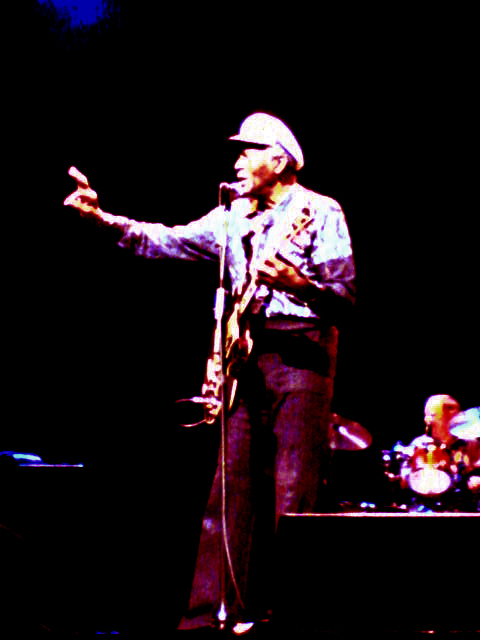
A grainy cellphone shot of Chuck Berry at the Hackney Empire (Charles Thomson).

In an hour-long set he blasted through hit after hit, from School Day (Ring Ring Goes The Bell) to Memphis Tennessee and Sweet Little Sixteen. He got the whole audience singing and laughing along with My Ding A Ling and invited some lucky women on stage to dance during Johnny B Goode. He had many more dancing in the aisles, too. Sadly, security were very heavy-handed and kept instructing people to sit back down, despite Chuck repeatedly shouting from the stage to let them dance.

Chuck was was so good that night that when, a few months later, Camden’s Jazz Café announced he was returning to London to play two shows at the venue, I told my friend James that we had to go. The Jazz Café was a favourite venue of mine at the time – small and incredibly intimate.

The choice of venue got me thinking. I had been to the Jazz Café enough times to know the artists usually entered through the same door as the ticketholders. I checked with a promoter friend who had booked artists into the venue and he confirmed the front door was also the artist entrance. James and I hatched a plan to get to the venue early and see if we could collar Chuck for an autograph on the way in.

Chuck, despite his many positive qualities, was not famed for his kindness towards fans. Musician Brian Johnson wrote in his autobiography that after Chuck toured with Johnson’s band Geordie for a week in 1975, using all their equipment for free, Johnson asked him: “Mr Berry, can I have your autograph?” Chuck replied: “I only sign one a day and I’ve already done it.”

If James and I were to get an autograph, we would have to be the first to ask that day. And so we arrived at the Jazz Café’s front doors at about 2pm, to make sure we didn’t miss him. By the time the doors opened about five hours later there was no sign of Chuck – we concluded he must have arrived about 10 hours early just so he wouldn’t have to sign his daily autograph – and we were cold and wet and our feet were sore.

On the plus side, we were numbers one and two in the queue and bagged ourselves a spot in the standing area, right in front of the stage.  Literally. It’s a tiny venue with a low stage and no barrier. When Chuck descended the metal staircase to the stage a few hours later and took his spot behind the microphone, we were perhaps four feet away from him. He was playing his guitar right in front of our faces.  

But he wasn’t playing it very well. Chuck was unrecognisable as the performer I had witnessed months earlier at the Hackney Empire. He seemed at times hesitant and confused.

An early sign that Chuck wasn’t altogether himself came when he started playing his hit song Maybellene but ended it singing the lyrics to Johnny B Goode. Later in the show he started playing Maybellene again.

His guitar playing was wonky throughout. He faltered at the beginning of Sweet Little Sixteen and had to start again. During South of the Border, he lost his place and announced, “Damn, I can’t think of the next line.” Apologising for his confusion at one point, he said, “I’m 81 years old, I’ve got no business being on this stage.” He was actually now 82. 

Chuck Berry on stage at the Jazz Café (James Newman).

Partway through the show – just before he played Nadine – he decided his guitar was out of tune (it wasn't) and began twisting knobs back and forth with abandon. The ensuing, lengthy, ham-fisted attempt to re-tune his guitar prompted an array of comical facial expressions from his alarmed band members, including his son, who after a while tried to step in and stop his dad fiddling with the strings. 

But it was too late for intervention, for by that time Chuck had begun walking to the opposite end of the stage and yelping at his young pianist, “Give me an E! Give me an E!” Alas, the pianist’s efforts did not appear to aid Chuck, who played the rest of the show with his guitar sounding rather peculiar.

Chuck Berry with his son at the Jazz Café (James Newman).

None of this is intended a criticism of Chuck, of course. As he had said, he was in his 80s and he didn’t have to be up on stage. We were lucky he was there at all and only a fool would expect a man of 82 to perform to the same standard as his younger self. Chuck was simply acting his age. But nonetheless, it was in stark contrast to his effervescent performance months earlier at the Hackney Empire, where he had defied his years.

Who knows what the problem was; Perhaps he was jetlagged. Maybe he hadn’t had a night off that week. Perhaps I had just caught him on uncharacteristically good form in Hackney.

Whatever the reason, it certainly didn’t diminish Chuck in the eyes of the audience, who laughed and cheered throughout the show. His confusion was endearing and he handled the situation with great humour. James and I look back on that evening extremely fondly. We have relived it several times, in hysterics as we recalled the sheer horror on the band’s faces as Chuck started meddling with his guitar. There is some video of the tuning incident on YouTube, although sadly incomplete and recorded from the side, missing the band's brilliant reactions.

A year later I learned Chuck was returning to the UK to play a show at one of my local theatres and bought tickets. However, the tour was later cancelled – apparently due to a dispute with the promoter – and he never returned to the UK.

He may have been well into his old age by the time I got to see him but it was a privilege to witness the man up close, even on an off day. Chuck Berry was one of music’s great pioneers, not to mention a phenomenal songwriter with a gift for musical storytelling which will likely never be rivalled.

More than that, though, he was a survivor. The obstacles he had to overcome were many and enormous. The genre he innovated was hijacked. Rock & Roll's creation was attributed to its white thieves instead of its black pioneers. Meanwhile, Chuck was maligned and mistreated by a racist justice system.

But despite everything, he soldiered on. He survived touring segregated America, he survived the theft of his music, he survived prison and he reached 90. He died a hero and a legend.

I am grateful that for a few brief hours we occupied the same space. My friends and I clapped and bobbed as he played the songs that changed the world. We laughed together. He duck walked past me, within touching distance, playing Johnny B Goode. I couldn’t ask for more than that.

Rest in Peace, Chuck Berry. The true King of Rock and Roll. 

Here is a video I took on my cellphone of Chuck performing Johnny B Goode at the Jazz Café: 


Tuesday, 11 November 2014

On Tom Sneddon

The death of former Santa Barbara District Attorney Tom Sneddon sparked jubilation among the Michael Jackson fan community. The DA who twice failed to convict the star on child abuse charges died on Saturday, November 1, with his family at his side, from complications following a cancer diagnosis.

It was Tom Sneddon who pursued Jackson in 1993 over the Chandler family’s sexual abuse accusations – a case which fell apart when the accusers solicited a pay-out and stopped cooperating with the authorities. Then, it was Sneddon who charged and personally prosecuted Jackson a decade later when Gavin Arvizo, who famously appeared alongside the singer in a Martin Bashir documentary, made similar accusations.

For many Jackson fans, Sneddon was evil personified; a larger-than-life boogieman who masterminded a conspiracy to destroy their idol’s career. Undeniably, his professional conduct was extremely poor in the Jackson trial. But just as images of Jackson’s bereft children after his death reminded us that despite his superstardom, he was a man with a family like anybody else, so too the thought of Tom Sneddon surrounded by loved ones on his deathbed should remind us of the same. Fans' remarks about the prosecutor ‘rotting in hell’ will not affect Tom Sneddon. He’s not here to read them. It is his loved ones who are left behind to cope with them – and there is no reason why they should have to. Such comments are tasteless in the extreme and do not reflect well on Jackson’s followers.

Of course, those followers would likely argue that it was Sneddon who made things personal. They would have a point, too. Sneddon seemed to relish persecuting the musician. In a series of gleeful media appearances in November 2003, to reveal the Arvizo accusations, he cracked jokes, mocked Jackson’s art and referred to him as ‘Jacko Wacko’ – behaviour for which he was later forced to apologise.

But there was more to it than that. Sneddon didn’t just seem to enjoy prosecuting Jackson; he appeared obsessed by it – so much so that he repeatedly acted beyond his brief in his zeal to bring down the star. He removed clearly-labelled, privileged defence documents from the home of Jackson’s personal assistant. He made ‘factual’ assertions in front of grand jurors when he shouldn’t have done. He tampered with his case to circumvent exculpatory evidence. He even seemingly tried to plant fingerprint evidence. He over-stepped the mark, time and again.

Jackson’s fans largely believe Sneddon knew Jackson was innocent all along; that he had a personal grudge against Jackson and fabricated the cases against him. I’ve never been totally convinced of his supposed motives. The fans' theory tends to be that Sneddon was desperate for prestige; that the prospect of convicting the world’s most famous musician became an egomaniacal obsession.

Admittedly, there is some evidence which supports that theory. In November 2003, Sneddon raided Jackson’s Neverland Ranch with a reported 70 sheriffs and multiple helicopters. What use is a helicopter when searching for evidence of child molestation? It was an obvious stunt. Reporters were on the scene before police even arrived. The entire operation was designed to generate attention. Sneddon’s behaviour in front of TV cameras at the time suggested he enjoyed the press attention, too; he seemed intoxicated by it. But was he basking in the limelight, or just displaying very poor judgement, as he later claimed?

What's certain is that poor judgement became a feature of the prosecution. The decision to proceed to trial was in itself highly questionable. In one of many troubling incidents, Sneddon and his team learned after Jackson was arraigned in January 2004 that he had an alibi for all the dates on the charge sheet. Realising the family’s current story could not be true, Sneddon - rather than reconsidering the validity of the prosecution - simply changed the dates on all the charges, even though it threw out the whole timeline. His case no longer made any sense, but he bullishly pursued it anyway.

The holes were gaping and plentiful. The accuser initially claimed he’d been molested up to six times, but later said it was ‘one or two’. He originally said Jackson instigated the molestation by telling him boys had to masturbate, or else they’d become rapists. He later conceded it was actually his grandmother who told him that.

The boy’s brother, who claimed to have witnessed the molestation, gave contradictory accounts. Originally, he claimed Jackson and the boy had laid on their sides as Jackson rubbed his penis on the boy’s buttocks. Later, he said they’d been side-by-side as Jackson fondled the boy’s genitals. By the time their mother took the stand and made a number of increasingly wild assertions about hot air balloon kidnap plots, Sneddon was reportedly seen with his head in his hands.

As the trial progressed, it is therefore unsurprising that Sneddon appeared to become less enamoured with the spotlight. The obvious assumption was that this was connected to his crumbling case, but others felt accusations of glory-hunting were untrue from the off. Rather, they contended aggressive prosecutions were simply his modus operandi – hence his nickname: ‘Mad Dog’.

In a November 2003 profile by Associated Press, acquaintances said Sneddon was always relentless in his pursuit of justice. The piece said he was ‘tenacious and tough, particularly when he has made up his mind about a case – sometimes to a fault’. Superior Court Judge James Slater supported that allegation, commenting, “There were times, and there still are, where his tenaciousness gets in the way of his better judgement and he has to step back.”

Jerry Roberts, editor of the Santa Barbara News Press, told CBS: “He’s a law-and-order guy who sees the world in black and white. There’s bad guys and good guys, and he sees himself as the good guy.”

But Jackson was not a ‘bad guy’, according to the jurors who heard all Sneddon’s evidence and then acquitted him unanimously on all charges. And therein lies the problem with prosecutors like Tom Sneddon.

Cop shows are obsessed with authority figures who don’t play by the rules. Due process is routinely depicted as an irritant; a bureaucratic box-ticking exercise. As viewers, we are manipulated into rooting for cops who play dirty to nail people they ‘know’ are guilty. We come to despair of laws which prevent the Government locking people up on the ‘technicality’ there there’s no evidence against them.

To achieve this blind trust of authority figures, the shows tend to portray the ‘baddies’ as cartoonish master-villians, sneering at the prosecutors and mocking their professional impotence. The writers place us in the shoes of the victim or their relatives, making it all too easy to fall into the trap of sympathising with the corrupt officials. We are less often encouraged to sympathise with the accused – ‘How would I feel if it was me, or my brother, that they were planting evidence against, or entrapping?’

Due process exists to protect the innocent, not the guilty. If we allow investigators to break the rules for a supposedly ‘good cause’, we set a precedent which will inevitably make it easier to lock up the innocent. Actions like Sneddon's - like stealing defence information, and tailoring a prosecution to circumvent objective evidence undermining the charges - compromise the integrity of the entire system.

After his death, current Santa Barbara DA Joyce Dudley called Sneddon ‘a pioneer in many areas of prosecution, especially crimes against vulnerable victims’. She added that he founded Santa Barbara’s Sexual Assault Response Team.  

I don’t doubt that’s true. Unquestionably, in his more than 20 years as DA, Sneddon will have secured justice for many victims.  It is unfortunate, therefore, that he persisted in his quest to convict Jackson. A case of that magnitude was destined to define his career – and it will stand forevermore as a monument to the very worst aspects of his professional conduct.

Less than 10 years after the trial concluded, both men are dead. In the eyes of many Jackson fans, Sneddon contributed significantly to Jackson’s demise. So traumatised he could not rest without the assistance of hospital grade anaesthetic, the singer was accidentally killed by his doctor in 2009. Now Sneddon is gone too. May they both rest in peace – but may Sneddon’s catalogue of misconduct be a lesson to all, in how not to spend taxpayers’ money. 

Thursday, 28 February 2013

RIP Richard Street (1942 - 2013)

I was very sad to learn yesterday that former Temptations singer Richard Street had passed away.

Some of you may remember that I interviewed Richard last September as he prepared for a lengthy UK tour. At the time I said I might post a longer version of our chat on my website, as it had to be cut so short to fit into the newspaper.

I have today uploaded a longer edit of the interview.

Click here to read it.

 The story as it appeared in the newspaper (click to enlarge).

Tuesday, 19 February 2013

VIDEO: The Godfather's Last Giveaway

A few weeks ago I published an article titled 'The Big Payback', all about James Brown's little-known humanitarian work and his family's efforts to carry it on since his death on Christmas Day 2006. In the article I wrote about how Mr Brown's last ever public appearance, three days before his death, was at his annual Christmas toy giveaway.

Yesterday my friend Ron sent me some footage I had never seen before of Mr Brown at the giveaway. Shot by an Augusta news station, it is the last known video of the Godfather of Soul.

I was struck by one poignant exchange.

"Mr Brown," says the reporter, "you've been doing this for 15 years and even when you're not well, you always come out and give back."

"Well," replies Mr Brown, "I come out because I want to do this. It's a duty as a human being, a duty as a citizen of this country."

As it turned out, Mr Brown wasn't just 'not well'. He was dying of pneumonia. Less than 72 hours later, the world had lost him. He had been visibly deteriorating for a number of months (in the video he looks unusually thin and sounds unwell, as he had done since October 2006) but despite his condition, he still made sure he was there to hand out those Christmas presents to the most needy children in his community.

I thought that was pretty inspiring. Here's the video.

Sunday, 10 June 2012

My Upcoming French TV Appearance: A Preview

On June 20th, French TV station France Ô will screen Conrad Murray's controversial documentary about the death of Michael Jackson - and a lot of Jackson's fans are less than happy about it. Largely shot during Murray's trial and shown around the world in the weeks after he was found guilty of Jackson's manslaughter, the documentary tells his version of what happened on June 25th 2009, the day Michael Jackson died in his care.

The documentary sparked outrage when it first aired in November last year. Jackson's fans organised a campaign and vowed to boycott, while his Estate publicly demanded that it be banned from the airwaves. In an open letter to Comcast, NBC and MSNBC, the Estate complained that Murray had 'refused to tell his story under penalty of perjury in a court of law' but had now, post-conviction, released a documentary in which he blamed Michael Jackson for his own death.

Ultimately, the documentary did Murray no favours. It actually became an aggravating factor in his sentencing hearing. In a witness impact statement, Jackson's mother Katherine wrote that Murray's comments in the documentary had added 'insult to injury' and showed that he was 'clearly not remorseful'. Judge Pastor, who presided over Murray's trial, agreed and sentenced him to the maximum possible jail term for Michael Jackson's manslaughter.

Fans have set up petitions and launched a huge campaign to have the documentary pulled from France Ô's schedule. Of course, the petitions will almost certainly be futile affairs. There's probably more chance of Conrad Murray releasing an album called Michael Jackson's Killer and outselling Michael Jackson's Thriller than there is of the show being pulled from the airwaves at this stage. If anything, the fans are most likely generating more buzz around the show, which will ultimately lead more people to switch on and see what all the fuss is about.

That's not necessarily a bad thing. A lot of these fans have never seen the documentary. I remember mentioning on Twitter that I'd watched it back in November and being sent a number of rude tweets, informing me that I should be ashamed of myself for tuning in. It was awful, the fans said, and they were boycotting it. But how did they know it was awful if they refused to watch it? How can one intelligently comment upon a documentary without having seen it?

If those fans had tuned in, they would know that for the vast majority of the show - currently on YouTube, for anyone interested in checking it out - Murray comes across as a deeply deluded individual, to whom telling lies comes as naturally as breathing. He constantly makes claims which were refuted by the evidence in his trial and the camera crew also films his defence team as they scheme to concoct outlandish theories around the prosecution's evidence.

In one scene, Murray's defence lawyers are seen wracking their brains for ways in which to counter the evidence of anesthetic expert Dr Steven Schafer, who quite literally wrote the instruction manual that comes inside every propofol box.  Lawyer Michael Flanagan is actually filmed suggesting that the defence needs to convince jurors that the coroner's verdict on Jackson's cause of death is incorrect. "We gotta get it to be a cardiac arrest," he says. The scene epitomises Murray's defence: 'Ok, our last harebrained theory hasn't panned out, what's our next one?'

In another scene, Murray - looking like a pay-per-view faith healer - closes his eyes and waves his arms in the air as he describes how the Holy Spirit came to him in a dream and promised to 'keep me safely in the secret chambers of his tabernacle'.

Any right-minded viewer watching the deranged doctor's ramblings will be left with the impression that this is a man they wouldn't leave in charge of their shopping cart, let alone their life. Far from painting Murray as a sympathetic figure, it only reinforces the perception of him as a charlatan. In the UK, it was screened under the title, The Man Who Killed Michael Jackson.

Amid all the controversy surrounding Murray's documentary, I was contacted a few weeks ago by a production company working for another French TV station called M6. The company was putting together a documentary to mark the third anniversary of Michael Jackson's death. The show would focus on the circumstances surrounding Jackson's death and, specifically, whether Conrad Murray was the only doctor to blame.

I am firmly of the opinion that Murray is the only doctor to blame for Jackson's death and thought taking part would be a good opportunity to make that point. The M6 documentary, titled Access Privé, is scheduled to air on June 25th, five days after the Murray documentary, and M6 scores far higher ratings than France Ô.

Picture: Angela Kande

I was interviewed for the show on Thursday, June 7th, at the Millennium Hotel in Knightsbridge, London - about a two-minute walk from Jackson's favourite London shopping centre, Harrods. I was interviewed for roughly an hour by Amal El Hachimi from Spica Production TV, the company making the report.

It wasn't the easiest of interviews. The documentary's aim is to explore whether any other doctors were at all culpable in Jackson's death. I was repeatedly asked about the actions of other doctors who treated Jackson over the years. Questions like that are a legal minefield. To even hint that a doctor may have behaved unethically when they have never been charged, let alone convicted, is extremely legally precarious.

I wasn't too put off by the line of questioning. Amal kept returning to the subject, but I remained resolute: Michael Jackson's cause of death was acute propofol intoxication. Ergo, the doctor who administered that propofol - Conrad Murray - is the only doctor legally culpable for Jackson's death. If other doctors gave him medication over the years which they shouldn't have done, they should certainly be prosecuted for that - but the fact is, Jackson died on Murray's watch and as a direct consequence of Murray's actions.

I was asked a lot of questions about demerol, but stated repeatedly that there had been no findings in Jackson's autopsy to indicate any demerol addiction. There was certainly never any implication that it played a role in his death.

Other topics covered included theories that Jackson was worth more dead than alive, speculation that his publishing catalogue was a motive for murder and the hotly debated subject of Jackson's well-being during This Is It rehearsals. Discussing the latter, I recounted evidence given throughout Murray's trial from both sides of the fence, including both Ortega's email about 'pulling the plug' and the coroner's assessment that Jackson was 'above average health for a man his age'.

Almost every topic discussed during the interview was legally questionable but I took extra care not to say anything dangerous. My interview lasted an hour but the entire show - which will feature other interviewees including Frank Cascio - will only last 15 minutes. My primary concern is that during the editing process my considered, legally sound responses will have vital sentences lopped off of their beginnings or ends.

J Randy Taraborrelli once told me about the dangers of giving TV interviews. He said that he always took care to be fair and balanced but often found that in the editing process, vital material was cut away and what was left in didn't accurately represent the totality of his answers. I hope I'm not left feeling that way on June 25th, although it may take a while for me to find out what's actually been included, as my voice will be over-dubbed in French!

I took extra care to be fair, balanced and honest. I hope that's reflected in the edit and that I don't piss off too many fans. I don't want to be the subject of their next petition.

Wednesday, 28 September 2011

Strange Fruit Still Falling In The Southern States; The Unjust Execution of Troy Davis


I spent much of Wednesday 21st September deliberating over whether or not to write something about the Troy Davis case. I, like many thousands of people around the world, was horrified by the prospect of his execution in the face of such overwhelming doubt over his guilt - but I was also aware that the case was already being covered all over the world.

For those who don't know, Troy Davis was convicted in 1991 of the 1989 murder of off-duty police officer Mark MacPhail. Jurors sentenced Davis to death based solely on eyewitness testimony, of which much has since been recanted with nine people signing affidavits stating that another man committed the murder. Despite this, Davis was executed in the state of Georgia on the evening of Wednesday 21st September 2011.

As Wednesday progressed, two main factors convinced me to write about the injustice which ultimately befell Troy Davis at just past 11PM (ET) last Wednesday.

First, I observed the right-wing media's biased reporting on the case. Some news stations completely ignored the wealth of evidence which undermined Troy Davis's conviction, instead echoing the MacPhail family's misguided cries for Davis's blood. Others told blatant lies, such as claiming that the recanted witness testimony was largely mythical (in fact all of the recantations are accounted for in this PDF on Amnesty's website).

Unsurprisingly, it was Anne Coulter who offered the most shocking commentary, relishing Troy's imminent death on her twitter feed ('One Troy Davis flame broiled please') and wrongly claiming on her website that there is no evidence to suggest an innocent person has been executed in the US for 60 years.

Then, shortly after Coulter published her disturbing diatribe, I received a four-word tweet from my friend Deborah Ffrench. It read, 'Strange Fruit Still Growing'. The tweet referenced one of the greatest and most haunting poems ever written; Strange Fruit by Abel Meeropol. Later turned into a song by Billie Holliday, the song recounts the lynching of black citizens in America in the 1930s.

Southern trees bear a strange fruit,
Blood on the leaves and blood on the root.
Black body swinging in the Southern breeze,
Strange fruit hanging from the poplar trees.
..

The title for my Troy Davis article came to me in a flash and I got to work. Over the next two days I set about creating what I hoped would come as close as possible to being the 'definitive' Troy Davis article. Tracking down the signed recantation affidavits which several journalists and media outlets had dismissed as fictitious, I included extensive quotes from witnesses who claimed they'd been bullied and threatened by police officers who forced them to falsely identify Davis as the shooter of Mark MacPhail in Davis's 1991 trial.

I had to shorten my article for the Huffington Post which, in recent months, is asking contributors to cap their contributions at roughly 1000 words, but I have uploaded the unedited version of my article on my personal website. So perhaps read the article on my website but leave your comment at the Huffington Post.

I am unashamedly opposed to capital punishment. The notion that it works as a deterrent is swiftly debunked by America's crime statistics and the idea that we can teach our children that murder is wrong by murdering murderers is clearly deranged. Moreover, the justice system gets it wrong far too often. If you put someone in a cell, you can take them back out again; the same can't be said after you've put them in the ground.

The Innocence Project estimates that between 2.3% and 5% of prisoners in America are innocent, meaning that, potentially, upwards of 150 American prisoners are currently awaiting execution for crimes that they didn't commit. How many more Troy Davis's must there be before America sees the light?


Click here
to visit my Huffington Post blog
about the Troy Davis case.


Click here
to read the uncut version,
featuring extensive quotes from witnesses
who claim police framed Davis for the murder.

Saturday, 28 August 2010

R.I.P Phelps 'Catfish' Collins

R.I.P Phelps 'Catfish' Collins, 1944-2010
(Photo: Flickriver)

I learned today from my friend Tony Wilson that Phelps Collins, the legendary James Brown and P-Funk guitarist, passed away earlier this month.

Phelps, best known as Catfish, passed away on August 6th after a battle with cancer. His death came while I was on vacation in Cyprus with scant internet access and so passed me by. It was with great sadness that I learned today, several weeks later, of his death.

Catfish Collins is a legend in the world of funk music. His stint playing guitar for James Brown was short but prolific. Alongside his brother, bassist Bootsy Collins, Catfish worked with Brown for only 11 months between 1970-1971. However, during that time he played many of the most famous funk guitar riffs of all time, working on tracks such as Sex Machine, Super Bad, Soul Power and Talkin' Loud and Sayin' Nothin'.

L to R: Bootsy Collins, James Brown and Catfish Collins live in 1971.
(Photos: Getty)

In 1972 Catfish joined George Clinton's group Funkadelic where he recorded even more funk classics, including numerous credits on the album America Eats Its Young and, perhaps most famously, playing the infectious guitar riff on timeless party anthem Flashlight.

Stints in brother Bootsy's 'Rubber Band' aside, Catfish largely avoided the spotlight in later years.

I met Catfish briefly at London's Cumberland Hotel in 2008 while he was on a rare tour with his brother, paying tribute to the late, great Godfather of Soul. While waiting for an interview with Bootsy that never materialised - a long story for another time - I chatted to Catfish about life on the road. He complained that he'd never really enjoyed touring and was sick of living out of a suitcase. This would be his last tour, he said.

My friend Ron Roelofsen, a James Brown archivist, met Catfish at another stop on the same tour and had much the same conversation. "I had the honour to meet [Catfish] in person in 2008 during the JB tribute tour in Holland and Belgium," Ron wrote on his website after hearing the sad news. "A very nice and also funny guy. I never forgot his answer to my question, 'What have you been doing for the last 30 years?' Catfish: 'Fishing'. 'And is there a chance that you will be making some new music again after this tour?' 'No, I go back fishing.'"

In losing Catfish we have lost one of the architects of funk music. Despite the brevity of his time with James Brown and Funkadelic, he leaves behind a tremendous legacy. James Brown is famously the most sampled artist of all time, but little credit is given to the musicians playing in those samples. Catfish is one of the most (if not the most) sampled guitarists in the history of recorded music. Long may his music live on.

Bootsy Collins is hosting a tribute concert for his brother on September 4th at the Madison Theater in Covington, Kentucky. For details and tickets, click here.

Monday, 13 July 2009

Ian Halperin: King of Plop

As the media frenzy over Michael Jackson's death enters its third week, stories are beginning to run out. The seemingly endless parade of Jackson 'friends' and 'insiders' is thinning and news outlets are stuck in limbo as they await the results of Jackson's autopsy. In the absence of any new or concrete information about Jackson's death, newspapers are becoming desperate for fodder. So desperate, in fact, that British red-top The Sun today publishes two separate 'Jacko' stories attributed to one Ian Halperin.

For those who don't know, Halperin is a celebrity blogger who has spent the last 8 months publicising an upcoming Jackson biography. He has done so by releasing a steady stream of fictitious stories about the popstar to any media outlet desperate or gullible enough to print them. In this era of cost-cutting, almost every media outlet in the Western world has swallowed and regurgitated his outlandish claims without hesitation.

Today's Halperin exclusives include revelations about Jackson's 'secret gay life'. The star, alleges Halperin, would disguise himself as a woman and sneak out to a motel to sleep with a male construction worker.

But here lies the problem: Halperin is a proven liar and a fantasist.

In November 2008 Halperin made headlines the world over when he claimed that Jackson had been struck down by a genetic lung condition known as Alpha 1, leaving him blind in one eye and unable to speak. In his blog entry he fabricated a confirmation from Jermaine Jackson and offered to provide proof of his findings the following week. That proof never materialised.

Halperin is now making much of the fact that he accurately predicted Jackson's untimely demise, carefully neglecting to mention that last month's tragic events were no more than a convenient coincidence. Halperin claimed Jackson would die within 6 months of a genetic lung disease... He died 8 months later of a suspected overdose.

Shortly after his lung disease story went global, Halperin claimed that Jackson had been booked to perform on the yacht of a Russian billionaire. This story also proved untrue.

In April 2009 Halperin appeared on British television claiming that the star hadn't shown up to any of the rehearsals for his London concerts. In actuality the star was rehearsing five days per week at Centre Staging Studios in Burbank, LA.

Halperin's credibility was further diminished when, in the wake of the lung disease fallout, he was exposed as having lied about receiving a prestigious award. The blogger's bio claimed that he had been awarded the 1985 Rolling Stone award for investigative journalism. But the magazine itself issued a statement saying that nobody of that name had been handed any such award, rather that the award had been given to an entire newspaper staff, in which Halperin had been a minor player.

In spite of his track record, Halperin's Jackson biography is sure to fly off of the shelves when it is released later this month. But why does the media continue to quote him as an authoritative source on Jackson when every story he has released about the star thus far has proven entirely false?

Halperin's ability to consistently sneak his fabricated Jackson stories past fact checkers and into newspapers the world over is churnalism in action. Too few reporters filling too many pages leaves too little time for fact checking. When a chancer like Halperin comes along and hands them a story on a plate, they thank their lucky stars, lay it on a page and move onto the next task. Everybody's happy - Halperin gets his publicity and the newspaper fills vital space.

The losers, though, are Jackson's family. His fans too and, when he was still around, Jackson himself. Not to mention the general public. Misinformation is rife at the best of times, but with this rush for Jackson material, less and less time is being dedicated to fact checking.

Reporting on Michael Jackson has always been less than ethical. The man is a target for bogus stories. AEG head honcho Randy Phillips said in an interview earlier this year, "I was sitting opposite Michael Jackson in a meeting one morning and suddenly a news alert popped up that he'd been struck down with a flesh eating virus."

Halperin's articles have been repeatedly proven false. His biography is certain to be littered with similar errors. Readers beware - in death Jackson will be an even bigger target for shoddy reporting than he was in life.

More on the Jackson situation as it develops.