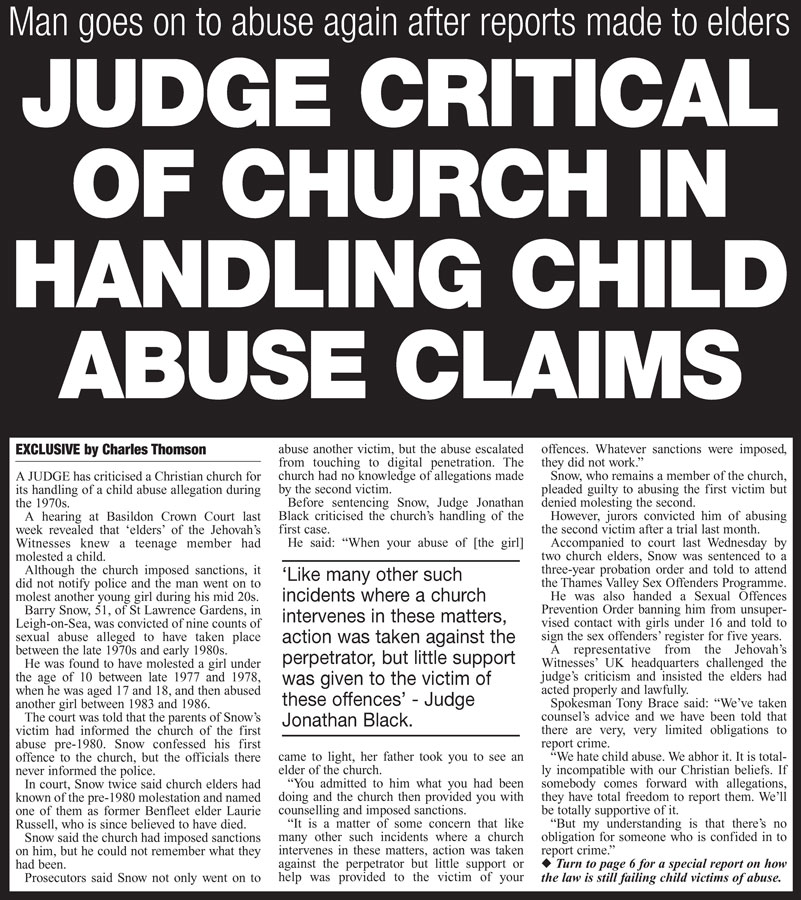
This week I covered the court case of Lewis Daynes, who was convicted of murdering 14-year-old schoolboy Breck Bednar. This was one of the most harrowing cases I have ever sat in. Some of the details were so distressing they could not be included in my newspaper coverage.
I will upload the full text of my five-page special report as soon as I am able. As far as I can ascertain, this is the most in-depth report which has been filed from the courtroom.
Click the below images, of the report as it appeared in the newspaper, to enlarge.
Showing posts with label court. Show all posts
Thursday, 15 January 2015
Sunday, 17 November 2013
Conjuring a Chorus of Boos; The Truth About Michael Jackson's UK Comeback
I feel compelled to write this blog today because as I sit here in front of my computer, it is seven years - to the day - since I experienced an epiphany of sorts about the media's coverage of Michael Jackson. I had followed his trial quite carefully, of course, comparing court transcripts to media coverage and being distressed by the horrendously biased reporting. But those reports were often at least rooted in fact. Journalists would misrepresent genuine testimony, in most cases simply 'lying' by omission.
What happened seven years ago was different. I witnessed firsthand the construction of a purely fabricated story; one which shot around the world, once again making Michael Jackson a global figure of ridicule, and became immediately accepted as 'fact'. To this day, I read occasional press reports which mention this fabricated event as though it were an objective truth. It has even been listed as a significant career event in Jackson biographies.
Witnessing the creation of the myth was an experience that has stayed with me ever since. For an enthusiastic journalism degree student, it was a shocking and saddening insight into the media's more sinister machinations.
On November 15, 2006, Michael Jackson attended the World Music Awards at London's Earls Court Arena. It was his first official appearance in the capital since his acquittal in June 2005 and I was fortunate enough to be there. Some fans queued all day to secure prime positions in front of the stage but I had to go to university and then travel into London in the evening. Nonetheless, my friends and I easily claimed a spot against the front barrier, just off to the side, immediately beside the mixing desk. We spent part of the evening chatting to the sound and security staff, who tipped us off that they'd been in rehearsals and heard Jackson rehearsing 'that save the world song'. We met Katie Melua and got an autograph as she watched some of the show from the side of the stage.
It seemed like everybody was there for Michael Jackson. At any gap in the ceremony, chants of his name would erupt around the arena. Other performers on the bill included Enya, Beyoncé and Andrea Bocelli, but they mostly received tepid responses and their performances were often book-ended by increasingly loud chants of 'Michael! Michael! Michael!'
The night was plagued by delays. Lindsay Lohan, on hosting duty, fluffed almost every line she spoke and had to record all of her links multiple times. The turnaround between acts was slow. At one point there was a half hour or more of just nothing at all: an empty stage.
When Michael Jackson eventually appeared, to collect a Diamond Award for album sales over 100million, the place exploded. I have seen Paul McCartney. I have seen Madonna. I have seen Prince. I have seen George Michael. I have never in my life, before or since, witnessed any artist provoke the response that Michael Jackson provoked that night. He received the most sustained, thunderous reception I've ever seen.
He remained on stage for several minutes to deliver two short acceptance speeches - one for his Diamond Award and one for a Guinness World Record presentation. For the duration of his speeches, I hardly heard a word he said, despite the booming sound system. Most artists receive a big cheer as they walk onstage, then the audience settles down. Michael Jackson provoked hysteria. Shrieking and crying. It didn't lull once from the moment he appeared on that balcony until the moment he disappeared backstage again. It was an unforgettable sight.
He emerged again later for a brief performance of sorts. He walked onstage to another cacophonous reception as his record-breaking humanitarian single We Are The World played over the speaker system. He sang a few lines and seemed to look pleadingly towards the mixing desk. My suspicion is that the fans were making such a din he couldn't hear himself. It was like one of his concerts from the 80s. I saw bodies pulled from the crowd and rushed away in wheelchairs.
A few minutes later the sound people bizarrely turned the track off just as he started singing again. No matter. The place just went even crazier. It was an emotional moment, watching him receive such a rapturous welcome after the previous summer's events. After standing for a while on the runway that jutted out from the stage into the crowd, he began to exit, but as the cheering swelled - the audience not wanting to lose sight of him so quickly - he stopped and turned around. Playfully, he lifted a finger to his lips as if to ask the question, 'Shall I stay or shall I go?' The shrieking intensified.
He stood for a while, smiling, and just soaking in the adulation, then raised his fist into a triumphant black power salute. With that, he turned and coolly strolled off-stage, the applause continuing fiercely as he disappeared from view. I have never seen a human being cause such chaos. It was deafening.
You can watch a video of the performance here:
The following day I was back at university. As I walked along the corridor towards my first lecture, I met two female classmates. Looking at me pityingly, they asked: "How did it go?" I began telling them about the awe-inspiring reaction Jackson had received; how shocked I was at the scale of the outpouring. It had been one of the most incredible spectacles I'd ever witnessed.
I noticed they were now looking at me as though I were a crazy person. I asked them what was wrong and it transpired that the media was not quite reporting the night's proceedings as they had happened. Once I gained access to the internet, I discovered multiple publications were claiming he had been booed offstage.
"Michael Jackson walked offstage to a chorus of boos last night," the Mirror's Tom Bryant wrote. "The crowd, expecting a proper version of his song, booed the star who then scuttled offstage."
Scuttled offstage.
Watch the above video. Jackson not only does not 'scuttle offstage' to 'a chorus of boos' - he remains onstage long after his performance ends, absorbing the most emphatically positive reaction I've ever observed at an awards ceremony.
The Daily Record's Julia Kuttner wrote an almost identical story: "Michael Jackson walked off stage to a chorus of boos last night - just four lines into his first performance in the UK for nine years. Jacko had picked up a gong at the World Music Awards in London minutes before. But after singing only the chorus to his charity single We Are The World, he stopped to repeatedly tell the audience: 'I love you'. Jackson scuttled off the stage after he was booed by the crowd, who were expecting a proper version of the song."
The Evening Standard also got in on the action. Reporters Chris Elwell-Sutton and Valentine Low wrote: "His much-vaunted reappearance turned into an embarrassing disaster. His entire performance consisted of one mangled line, several missed high notes and an exit to a chorus of boos from the audience. 'I love you', he told them - although whether the feeling was reciprocated is open to question."
I was in complete disbelief. Had one rogue reporter claimed Michael Jackson was booed offstage, I wouldn't have been so angry. Every profession has its bad apples. But for multiple reporters to have attended an event at which Michael Jackson demonstrably and categorically was not booed offstage, yet to all then write articles claiming he was, demonstrated a clear conspiracy between multiple parties to fabricate and perpetuate a bogus story.
That myth went around the world. Michael Jackson getting booed offstage became the biggest source of mirth on many a topical panel show and celebrity chat programme. It prompted further stories. The Guardian's Martin Hyde repeated the lies, declaring Jackson the 'ex-King of Pop' and claiming he had only managed a few lines 'before the booing began'. The Sunday Mirror captioned a follow-up story: "Plastic freak's comeback was truly diabolical."
Even celebrity publicist Max Clifford was hoodwinked into commenting on the bogus story, telling the Daily Record: "The one thing that always stood him in good stead was, as a performer, he was one of the greats. This week, he destroyed that image. The reports from the awards say he sang one mangled line, several messy high notes and exited to a chorus of boos. As a performer that was incredibly damaging, and that's all he's got left. I think Michael is probably beyond help."
Researching the story years later using newspaper archive service Infotrac, I discovered something very interesting; an earlier report from the Mirror which completely contradicted the fabricated version it later settled on. In at least one edition of the November 16 paper, a story by Eva Simpson and Caroline Hedley read: "He's back! Michael Jackson was the biggest winner at the awards where he gave his first public performance for nine years. The star was honoured with a Diamond Award for selling more than 100 million albums in his career. Hosted by Lindsay Lohan, the starstudded event at London's Earl's Court saw Jacko give a stunning performance of We Are The World. You sure are, Jacko."
So it would appear that at some point an editorial decision was taken that instead of continuing to report what had actually happened, the newspaper was going to rewrite the night's events to tell the exact opposite of the truth - and several other publications were going to do the same.
It seemed to me that the media had already decided what story it wanted to tell about Michael Jackson's appearance in London - it was just an irritation to them that he hadn't played ball. When his appearance prompted a powerful outpouring of adulation - fans being rushed away in wheelchairs like the tours of his heyday - it didn't suit the industry's preconceived narrative. Certain figures were intent on Jackson being the 'ex-King of Pop'. When Earls Court actually went just as crazy for him as it would have done 20 years prior, it didn't fit - so they simply ignored that inconvenient turn of events and conjured a 'chorus of boos' from thin air. If Jackson wouldn't play his 'ex-King of Pop' role like a good boy, they would attempt to manufacture it. It was classic British tabloid muscle-flexing.
The frustration and the sadness I felt that day when I observed this lie being willfully peddled, and the powerlessness I felt just watching TV presenter after TV presenter, comedian after comedian, recycle the nonsense for the consumption of millions who were not there and would never know it was all made up, bubbles back up whenever I remember the debacle. It was a sorry day for journalism - but the profession has had many of those where Michael Jackson is concerned.
I'm not sure why I've never written anything about it before, but a friend posted a video from the event on Facebook earlier today to mark the anniversary. It was the last time I saw Michael Jackson perform live, but the memory is always tinged with sadness and frustration for what happened in the following days. It's about time somebody set the record straight on this particular fallacy.
What happened seven years ago was different. I witnessed firsthand the construction of a purely fabricated story; one which shot around the world, once again making Michael Jackson a global figure of ridicule, and became immediately accepted as 'fact'. To this day, I read occasional press reports which mention this fabricated event as though it were an objective truth. It has even been listed as a significant career event in Jackson biographies.
Witnessing the creation of the myth was an experience that has stayed with me ever since. For an enthusiastic journalism degree student, it was a shocking and saddening insight into the media's more sinister machinations.
On November 15, 2006, Michael Jackson attended the World Music Awards at London's Earls Court Arena. It was his first official appearance in the capital since his acquittal in June 2005 and I was fortunate enough to be there. Some fans queued all day to secure prime positions in front of the stage but I had to go to university and then travel into London in the evening. Nonetheless, my friends and I easily claimed a spot against the front barrier, just off to the side, immediately beside the mixing desk. We spent part of the evening chatting to the sound and security staff, who tipped us off that they'd been in rehearsals and heard Jackson rehearsing 'that save the world song'. We met Katie Melua and got an autograph as she watched some of the show from the side of the stage.
It seemed like everybody was there for Michael Jackson. At any gap in the ceremony, chants of his name would erupt around the arena. Other performers on the bill included Enya, Beyoncé and Andrea Bocelli, but they mostly received tepid responses and their performances were often book-ended by increasingly loud chants of 'Michael! Michael! Michael!'
The night was plagued by delays. Lindsay Lohan, on hosting duty, fluffed almost every line she spoke and had to record all of her links multiple times. The turnaround between acts was slow. At one point there was a half hour or more of just nothing at all: an empty stage.
When Michael Jackson eventually appeared, to collect a Diamond Award for album sales over 100million, the place exploded. I have seen Paul McCartney. I have seen Madonna. I have seen Prince. I have seen George Michael. I have never in my life, before or since, witnessed any artist provoke the response that Michael Jackson provoked that night. He received the most sustained, thunderous reception I've ever seen.
He remained on stage for several minutes to deliver two short acceptance speeches - one for his Diamond Award and one for a Guinness World Record presentation. For the duration of his speeches, I hardly heard a word he said, despite the booming sound system. Most artists receive a big cheer as they walk onstage, then the audience settles down. Michael Jackson provoked hysteria. Shrieking and crying. It didn't lull once from the moment he appeared on that balcony until the moment he disappeared backstage again. It was an unforgettable sight.
He emerged again later for a brief performance of sorts. He walked onstage to another cacophonous reception as his record-breaking humanitarian single We Are The World played over the speaker system. He sang a few lines and seemed to look pleadingly towards the mixing desk. My suspicion is that the fans were making such a din he couldn't hear himself. It was like one of his concerts from the 80s. I saw bodies pulled from the crowd and rushed away in wheelchairs.
A few minutes later the sound people bizarrely turned the track off just as he started singing again. No matter. The place just went even crazier. It was an emotional moment, watching him receive such a rapturous welcome after the previous summer's events. After standing for a while on the runway that jutted out from the stage into the crowd, he began to exit, but as the cheering swelled - the audience not wanting to lose sight of him so quickly - he stopped and turned around. Playfully, he lifted a finger to his lips as if to ask the question, 'Shall I stay or shall I go?' The shrieking intensified.
He stood for a while, smiling, and just soaking in the adulation, then raised his fist into a triumphant black power salute. With that, he turned and coolly strolled off-stage, the applause continuing fiercely as he disappeared from view. I have never seen a human being cause such chaos. It was deafening.
You can watch a video of the performance here:
The following day I was back at university. As I walked along the corridor towards my first lecture, I met two female classmates. Looking at me pityingly, they asked: "How did it go?" I began telling them about the awe-inspiring reaction Jackson had received; how shocked I was at the scale of the outpouring. It had been one of the most incredible spectacles I'd ever witnessed.
I noticed they were now looking at me as though I were a crazy person. I asked them what was wrong and it transpired that the media was not quite reporting the night's proceedings as they had happened. Once I gained access to the internet, I discovered multiple publications were claiming he had been booed offstage.
"Michael Jackson walked offstage to a chorus of boos last night," the Mirror's Tom Bryant wrote. "The crowd, expecting a proper version of his song, booed the star who then scuttled offstage."
Scuttled offstage.
Watch the above video. Jackson not only does not 'scuttle offstage' to 'a chorus of boos' - he remains onstage long after his performance ends, absorbing the most emphatically positive reaction I've ever observed at an awards ceremony.
The Daily Record's Julia Kuttner wrote an almost identical story: "Michael Jackson walked off stage to a chorus of boos last night - just four lines into his first performance in the UK for nine years. Jacko had picked up a gong at the World Music Awards in London minutes before. But after singing only the chorus to his charity single We Are The World, he stopped to repeatedly tell the audience: 'I love you'. Jackson scuttled off the stage after he was booed by the crowd, who were expecting a proper version of the song."
The Evening Standard also got in on the action. Reporters Chris Elwell-Sutton and Valentine Low wrote: "His much-vaunted reappearance turned into an embarrassing disaster. His entire performance consisted of one mangled line, several missed high notes and an exit to a chorus of boos from the audience. 'I love you', he told them - although whether the feeling was reciprocated is open to question."
I was in complete disbelief. Had one rogue reporter claimed Michael Jackson was booed offstage, I wouldn't have been so angry. Every profession has its bad apples. But for multiple reporters to have attended an event at which Michael Jackson demonstrably and categorically was not booed offstage, yet to all then write articles claiming he was, demonstrated a clear conspiracy between multiple parties to fabricate and perpetuate a bogus story.
That myth went around the world. Michael Jackson getting booed offstage became the biggest source of mirth on many a topical panel show and celebrity chat programme. It prompted further stories. The Guardian's Martin Hyde repeated the lies, declaring Jackson the 'ex-King of Pop' and claiming he had only managed a few lines 'before the booing began'. The Sunday Mirror captioned a follow-up story: "Plastic freak's comeback was truly diabolical."
Even celebrity publicist Max Clifford was hoodwinked into commenting on the bogus story, telling the Daily Record: "The one thing that always stood him in good stead was, as a performer, he was one of the greats. This week, he destroyed that image. The reports from the awards say he sang one mangled line, several messy high notes and exited to a chorus of boos. As a performer that was incredibly damaging, and that's all he's got left. I think Michael is probably beyond help."
Researching the story years later using newspaper archive service Infotrac, I discovered something very interesting; an earlier report from the Mirror which completely contradicted the fabricated version it later settled on. In at least one edition of the November 16 paper, a story by Eva Simpson and Caroline Hedley read: "He's back! Michael Jackson was the biggest winner at the awards where he gave his first public performance for nine years. The star was honoured with a Diamond Award for selling more than 100 million albums in his career. Hosted by Lindsay Lohan, the starstudded event at London's Earl's Court saw Jacko give a stunning performance of We Are The World. You sure are, Jacko."
So it would appear that at some point an editorial decision was taken that instead of continuing to report what had actually happened, the newspaper was going to rewrite the night's events to tell the exact opposite of the truth - and several other publications were going to do the same.
It seemed to me that the media had already decided what story it wanted to tell about Michael Jackson's appearance in London - it was just an irritation to them that he hadn't played ball. When his appearance prompted a powerful outpouring of adulation - fans being rushed away in wheelchairs like the tours of his heyday - it didn't suit the industry's preconceived narrative. Certain figures were intent on Jackson being the 'ex-King of Pop'. When Earls Court actually went just as crazy for him as it would have done 20 years prior, it didn't fit - so they simply ignored that inconvenient turn of events and conjured a 'chorus of boos' from thin air. If Jackson wouldn't play his 'ex-King of Pop' role like a good boy, they would attempt to manufacture it. It was classic British tabloid muscle-flexing.
The frustration and the sadness I felt that day when I observed this lie being willfully peddled, and the powerlessness I felt just watching TV presenter after TV presenter, comedian after comedian, recycle the nonsense for the consumption of millions who were not there and would never know it was all made up, bubbles back up whenever I remember the debacle. It was a sorry day for journalism - but the profession has had many of those where Michael Jackson is concerned.
I'm not sure why I've never written anything about it before, but a friend posted a video from the event on Facebook earlier today to mark the anniversary. It was the last time I saw Michael Jackson perform live, but the memory is always tinged with sadness and frustration for what happened in the following days. It's about time somebody set the record straight on this particular fallacy.
Sunday, 19 May 2013
The sworn testimony that will come back to haunt Wade Robson
When you've been covering Michael Jackson for any significant period of time, you come to believe that nothing can shock you anymore. Since I began reporting on Michael Jackson for various media organisations, he has announced the biggest concert residency of all time and then died before he could complete it. A doctor has been jailed for his homicide and a posthumous album has caused international scandal by containing tracks allegedly sung by an imposter.
For many years, Michael Jackson's life (and after-life) has been a quagmire of scandal, controversy and legal wrangling. Presently, entertainment company AEG - which promoted Jackson's 'This Is It' concerts - is on trial over what the singer's family feels is a modicum of responsibility for his death. Already, witnesses have testified that Jackson was banned from the stage during some rehearsals for fear he would injure himself. A producer has testified to weeping as she saw Jackson rambling at rehearsals that God was speaking to him. She told jurors she had warned senior production members she believed he was dying and needed to be transported to hospital, only for her pleas to go ignored. Less than a week later, he was dead.
To a seasoned Jackson correspondent, none of this was surprising. It seems that not a week goes by without some drama or another engulfing the deceased music legend or those closely associated with him, from copyright disputes to kidnap allegations. But last week there was a development in the Michael Jackson sphere which truly did surprise me. Wade Robson, who has staunchly defended Michael Jackson for 20 years and even testified for him in his 2005 trial, filed papers against various organisations connected to the pop legend, seeking multiple pay-outs for alleged childhood abuse.
The choreographer claims he was sexually abused for seven years, from age seven to age 14. The news has rocked the Michael Jackson community. Those who loved him have sprung to his defence while those who built careers on attacking him have reacted with undisguised glee. Jackson's ex-wife Debbie Rowe has labeled the financial demands 'opportunistic' and Jermaine Jackson has branded the choreographer 'full of shit'.
Civil rights lawyer Tom Mesereau, who defended Jackson in his 2005 trial, has suggested the claims are 'suspicious' as their public filing coincided so neatly with the AEG trial. Indeed, the allegations broke as make-up artist Karen Faye testified that she and others had raised repeated concerns about Jackson's health but had received callous responses from those in charge. Robson's televised interview days later ensured little media attention was paid to testimony from an AEG employee that financial papers proved Murray was the company's employee, not Michael Jackson's. Wade Robson has repeatedly worked for AEG and apparently already has future work lined up with the corporation, but his lawyer has denied any connection between the court cases.
In light of Robson's sudden change of tune, I have dusted off my complete trial transcripts from the 2005 government prosecution of Michael Jackson. While many news reports have mentioned that Robson testified for Jackson in the case, few have made any particular effort to underscore the gravity of his testimony.
Wade Robson was such a compelling and assured witness that Michael Jackson chose him to open his defence case at trial. Under sustained and sometimes aggressive questioning by government prosecutor Ron Zonen, Robson not only denied any impropriety on Jackson's part, but did so repeatedly, vigorously and convincingly - even mocking prosecutors and describing the mere suggestion of sexual abuse at Jackson's hands as 'ridiculous'.
As a side-note, the idea that in a trial about alleged child sex abuse, a genuine abuser would choose somebody they had molested for seven years as their first witness to undergo unrelenting government cross-examination may seem somewhat far-fetched to the casual onlooker.
When viewed alongside some of the comments he made on the Today Show this week, Robson's testimony is likely to cast more than a reasonable doubt over his new claims. He answered clearly and competently to detailed questions about various examples of alleged misconduct. The testimony is so immensely damaging to his new legal demands for money that he and his lawyer have already floated two potential, but arguably equally unconvincing, explanations for the bizarre u-turn.
When the story about his demands for money went live last week, Robson's lawyer was quoted as saying the choreographer had recovered 'repressed memories', a story many suggested could have been designed to explain away Robson's strenuous denials in the 2005 trial without admitting to perjury. However, Robson's claim was met with such incredulity - many eminent psychologists do not even believe in repressed memories and even those who do took rather a dim view of Robson's somewhat extreme story - that he has since changed tact.
Robson claimed in his TV interview this week that the real reason he told jurors he was not molested was that he had not realised that what Jackson allegedly did to him was abusive - another claim guaranteed to raise many an eyebrow. He was a successful, professional 22-year-old man at the time of his testimony.
Under oath in 2005, Robson was asked repeatedly about particular acts and whether he knew Michael Jackson to have performed them upon any child. He responded vehemently that not only had he never witnessed any such behaviour, but he was steadfast in his opinion that Michael Jackson would never have engaged in it.
Looking back over the 2005 court documents, the latest explanation for his testimony simply does not stand up to scrutiny. For instance, he was asked specifically whether Jackson had touched his body. Regardless of whether he believed Jackson's conduct to constitute sexual abuse, if Jackson had indeed touched his body, the clear answer would have been 'yes'. But it wasn't 'yes'. It was 'no'. Over, and over, and over again.
He even testified that after what he now claims were several years of sexual abuse at Jackson's hands, he returned to the scene of the alleged crimes more than 20 times in later life, with friends and relatives in tow, for relaxing getaways. He also testified to remaining in touch with Jackson and still considering him a close friend. Indeed, several years after the trial, Robson continued to socialise with Jackson.
Shortly after Jackson's death was announced in 2009, Robson wrote that Jackson was 'one of the main reasons I believe in the pure goodness of humankind'. According to Jackson's brother Jermaine, Robson and his mother helped him pen portions of his autobiography about the media's unfair portrayal of his brother as a child molester. Indeed, since Jackson's death Robson has paid public tribute to the star repeatedly, as recently as 2012. He even applied last year for a job choreographing a tribute show to his alleged molester, but did not get the gig.
Wade Robson has filed a creditor's claim against Jackson's Estate, seeking a cash pay-out for alleged childhood abuse. He has also filed 50 civil lawsuits against various individuals and companies affiliated with Jackson, seeking further pay-outs for his alleged abuse.
He insisted this week that his new claims were 'not about money'.
The full transcript of Robson's testimony on May 5, 2005, totals almost 14,000 words and runs across 60 pages of A4. It includes lots of repetition and discussion about where he lived, when his parents separated and various other tangential asides. Below, I have extracted what I believe to be the key testimony. It is difficult to see how, given the existence of this sworn testimony, Robson could ever convince a jury beyond a reasonable doubt that Jackson had ever acted inappropriately in his presence.
A cynical person might therefore interpret Robson's high profile TV interview this week as an attempt to avoid ever getting into a courtroom and having a jury test his new claims. How many more high profile public attacks can Jackson's Estate suffer before it is forced to begin considering a settlement? At this stage, the ability to damage the Estate's earning potential is about all Robson has got on his side - because the evidence is firmly on Michael Jackson's.
Here is the testimony nobody else in the media is showing you. See for yourself.
Under direct examination by Michael Jackson's lawyer, Tom Mesereau:
Q. Do you consider Michael Jackson your friend?
A. Yes.
Q. Do you consider him a close friend?
A. Yes.
Q. You’re aware of the allegations in this case, are you not?
A. Yes.
Q. And are you aware, as you sit here today, that there’s been allegations that Mr. Jackson molested you?
A. Yes.
Q. Mr. Robson, did Michael Jackson ever molest you at any time?
A. Absolutely not.
Q. Mr. Robson, did Michael Jackson ever touch you in a sexual way?
A. Never, no.
Q. Mr. Robson, has Mr. Jackson ever inappropriately touched any part of your body at any time?
A. No.
* * * * *
Q. How many times do you think you’ve stayed in Mr. Jackson’s room at Neverland?
A. Same amount of times as I’ve been there. Well, no, that’s not true, I’m sorry. I’ve been there a bunch of times without Michael, just with other friends and family traveling there. But, I don’t know, maybe 15 to 20.
Q. And at no time has any sexual contact ever occurred between you and Mr. Jackson, right?
A. Never.
Q. Have you ever taken a shower with Mr. Jackson?
A. No.
Q. Have you ever gone swimming with Mr. Jackson?
A. Yes.
Q. And please explain what you mean.
A. One time with my sister and I, my sister and I and Michael, we went in the Jacuzzi at Neverland Ranch.
Q. And do you know approximately when that was?
A. I don’t. I can’t say for sure. I have a feeling that it was within that first trip in ‘89 when I went there.
Q. Do you recall what Mr. Jackson was wearing in the Jacuzzi?
A. From my recollection, he was wearing shorts. You know, like swimming shorts. And that was it.
Q. Did anything inappropriate ever happen in that Jacuzzi?
A. No.
Q. Has anything inappropriate ever happened in any shower with you and Mr. Jackson?
A. No. Never been in a shower with him.
* * * * *
Q. Mr. Robson, has anyone told you what to say in this courtroom today?
A. No.
Q. Is everything you’ve said the complete and honest truth?
A. Yes.
Q. Did Mr. Jackson ever do anything wrong with you?
A. No.
Under cross-examination by government prosecutor Ron Zonen:
Q. All right. Now, the first time that you slept with Mr. Jackson you were seven years old; is that correct?
A. I slept in the same bed with him. But, yes, I was seven.
Q. Did you understand my question to mean something other than that?
A. Sounded like it.
* * * * *
Q. Were there periods of time when you were at Neverland and working with Mr. Jackson on dance routines?
A. No. I mean, we would mess around and dance a little bit in the studio every now and then, yes.
Q. Was there ever an occasion where you were on the dance floor with Mr. Jackson and he was showing you a routine and he grabbed your crotch in a manner similar to how he would grab his own crotch while doing those performances?
A. No, that’s not true.
Q. You have no recollection of that?
A. No.
Q. That didn’t happen?
A. No.
* * * * *
Q. Now, at any time did you start to develop conversations with your mother about the propriety of sleeping with this man who’s now well into his 30s?
A. No.
Q. Did you consider it unusual at all?
A. No.
Q. Did your mother consider it unusual?
A. No.
Q. Did you ever talk to your father about it?
A. Yeah.
Q. You talked to your father about your sleeping with Michael Jackson?
A. No, I mean, you know, everybody knew, and nobody ever said that it was -- we never talked about it being unusual or anything like that.
Q. Did your mother ever ask you if anything inappropriate happened in bed with him?
A. No.
Q. Did she simply assume nothing happened?
A. Yes.
Q. You’re telling us nothing happened; is that right?
A. Yes.
Q. All right. What you’re really telling us is nothing happened while you were awake; isn’t that true?
A. I’m telling you that nothing ever happened.
Q. Mr. Robson, when you were asleep, you wouldn’t have known what had happened, particularly at age seven, would you have?
A. I would think something like that would wake me up.
* * * * *
Q. Was there, in fact, a shower at Neverland in the suite, the bedroom suite?
A. Yes.
Q. But you didn’t use it?
A. I used it by myself.
Q. Was he in the room while you were using it?
A. In the bedroom, not in the shower room, which had its own door.
* * * * *
Q. You haven’t gone back to Neverland since you were 13?
A. I have. Not with him.
Q. Have you gone back to Neverland since you were 13 and actually stayed overnight?
A. Yes.
Q. On how many occasions since you were 13?
A. A lot. Same thing. 20, 25. Something like that.
* * * * *
Q. Mr. Jackson would periodically kiss you, would he not?
A. No.
Q. Periodically hug you?
A. Yes.
Q. Touch you?
A. Hug me. That would be --
Q. Put his hands through your hair?
A. No.
Q. Touch you about the head and the face?
A. Yeah.
Q. Did he ever kiss you on the cheek?
A. Yeah.
Q. Did he ever kiss you on the lips?
A. No.
* * * * *
Q. Were there occasions that Mr. Jackson would summon you to Neverland Ranch?
A. Summon me?
Q. Yes. Call you up and ask you to come and be there; invite you to Neverland Ranch?
A. Invite us, yeah.
* * * * *
Q. On the occasions that you stayed in bed with Mr. Jackson, would you ever cuddle in bed?
A. No.
Q. Would you lie next to one another?
A. No.
Q. Would you touch?
A. No.
Q. Would you consider it to have been inappropriate to have cuddled in bed?
A. Sorry?
Q. Would you have considered it to be inappropriate to have cuddled in bed?
A. No.
Under re-direct by Tom Mesereau:
Q. Okay. The prosecutor asked you questions about whether or not you were considered family. Did you consider yourself to be part of Mr. Jackson’s family?
A. Yeah, I mean, in a friendship sort of way. Because we were that close. It was like family.
Q. And did you use the word “family” once in a while --
A. Yes.
Q. -- when you spoke to him?
A. Yes.
Q. Did you hear your mother or sister using the word “family”?
A. Yes.
Q. Did you think anything was strange about that?
A. No.
Q. The prosecutor for the government asked about Mr. Jackson giving you a kiss on the cheek.
A. Uh-huh.
Q. And you said that happened sometimes?
A. Yes.
Q. Did you think there was anything inappropriate about that?
A. No.
Q. Did you do it in front of your mom?
A. Yes.
Q. Did you do it in front of your sister?
A. Yes.
Q. Did your mother kiss him on the cheek?
A. Yes.
Q. Did your sister kiss him on the cheek?
A. Yes.
Q. Did you kiss Mr. Jackson on the cheek?
A. Yes.
Q. Did your mother used to hug Mr. Jackson?
A. Yes.
Q. Did Mr. Jackson used to hug your mother?
MR. ZONEN: I’ll object as irrelevant what happened with his mother.
THE COURT: Overruled. Go ahead.
Q. BY MR. MESEREAU: Did Mr. Jackson used to hug your mother?
A. Yes.
Q. Did your sister used to hug Mr. Jackson?
MR. ZONEN: I’ll object as leading as well.
THE COURT: Overruled.
Q. BY MR. MESEREAU: Did your sister used to hug Mr. Jackson?
A. Yes.
Q. And would you see Mr. Jackson hug your sister?
A. Yes.
Q. Did you ever think there was anything inappropriate about Mr. Jackson hugging any member of your family?
A. No.
Q. Did you ever think it was inappropriate to see any member of your family hug Mr. Jackson?
A. No.
Q. Now, you said your sister would sometimes stay in Mr. Jackson’s room, correct?
A. Yes.
Q. And how often do you recall that happening?
A. I remember it just within that first trip we were there. So it was -- it was, you know, three or four nights or something like that.
Q. And you mentioned Brandy. Is that who you mentioned?
A. Yes.
Q. Who was Brandy again?
A. She was Michael Jackson’s niece.
Q. You saw Brandy staying in his room?
A. Yeah.
Q. What’s the largest number of kids you ever saw stay in Mr. Jackson’s room, if you remember?
A. Yeah, probably four to five.
Q. And what do you recall the children doing in his room?
A. Well, before we went to sleep, same sort of things. We’d play video games, watch movies. Have pillow fights. You know, yeah.
Q. Did you ever see anything of a sexual nature between Mr. Jackson and any of those children?
A. Never.
* * * * *
Q. Have you seen Mr. Jackson hug other children at Neverland?
A. Yes.
Q. Have you seen other children hug Mr. Jackson at Neverland?
A. Yes.
Q. Have you ever thought any of this was inappropriate?
A. No.
Q. Have you seen Mr. Jackson kiss children at Neverland?
A. On the cheek, yes. Or on the head, or on the top of the head, something like that.
Q. Ever seen kids kiss Mr. Jackson?
A. Yes.
Q. Any of that ever look inappropriate to you?
A. No.
Q. Have you seen lots of children visit Neverland on occasion?
A. Yes.
Q. And what do you mean?
A. I think we were there once when he had one of his gatherings, like a Heal the World Foundation thing where he had a bunch of kids come up there and -- you know, and have the day there.
Q. And how many kids are you talking about, do you think?
A. Probably about 100 or 50. 75 to 100, something like that.
Q. Were there adults with those children?
A. Yes.
Q. And you said, “Heal the World.” What did that mean to you?
MR. ZONEN: I’m going to object as exceeding the scope of the direct examination, and irrelevant, and beyond the scope of his knowledge.
THE COURT: Overruled. You may answer.
THE WITNESS: Could you repeat the question?
Q. BY MR. MESEREAU: Yeah. What was “Heal the World,” as far as you remember?
A. As far as I knew, it was a foundation or a charity that Michael had created that, you know, raised money for kids with illnesses. I don’t know exactly what kind, but --
Q. Did you interact with any of these kids that visited that day?
A. I may have, yeah, I mean, waved at them or met a couple of them or something like that.
Q. Did you see Mr. Jackson hugging other children?
A. Yes.
Q. Did you see them hugging him?
A. Yes.
Q. Did you see Mr. Jackson kiss children?
A. Yeah.
Q. Have you seen them kiss him?
A. Yes.
Q. Ever seen anything inappropriate?
A. No.
Q. Did you see Mr. Jackson hug adults who were with those children?
A. Yes.
Q. Did you see adults hug Mr. Jackson who were with those children?
A. Yes.
Q. Ever think any of that was inappropriate?
A. No.
Q. Now, the prosecutor for the government asked you questions about whether he touched your hair.
A. Uh-huh.
Q. Do you recall Mr. Jackson ever touching your hair?
A. I can’t recall an exact thing, but it seems like something he might have done at some point.
Q. Do you ever recall Mr. Jackson doing anything inappropriate with your hair?
A. No.
Q. Ever seen Mr. Jackson touch another child on the head?
A. Yes.
Q. Have you seen that many times?
A. Many times.
Q. Did it ever seem like anything inappropriate was going on when you saw that?
A. No.
* * * * *
Q. Ever see Michael throw water balloons at kids?
A. Yes.
Q. Did you ever see Michael in golf carts with kids?
A. Yes.
Q. When you used to play at Neverland during the day, would Michael often be with you?
A. Yes.
Q. And what would Michael do with you?
A. We’d go on rides together, you know, where we’d drive around in the golf cart together, look at animals together, watch movies together.
Q. Did you see Mr. Jackson act in a similar way with other children?
A. Yes.
Q. Ever see anything inappropriate go on when he was doing any of these things?
A. No.
Q. Now, how often do you recall your mother going to Neverland with you?
A. It’s been every time except for that one time that I spoke of when I was there with Jordie Chandler and Macaulay and I.
Q. What do you recall seeing your mother do at Neverland?
A. A lot of the same things with us.
Q. Would she sometimes be with Mr. Jackson when all the kids were playing?
A. Oh, yes. She was playing along with us.
Q. Now, you mentioned visiting an apartment in Century City with Mr. Jackson, right?
A. Yes.
Q. And what do you recall doing in the apartment with Mr. Jackson?
A. Same sort of things. He had arcade games there. You know, candy. We’d eat, we’d watch, you know, T.V. shows, Stooges. Hang around, play games, you know.
Q. Did you ever see Mr. Jackson do anything inappropriate with any child at that apartment?
A. No.
Q. Where else have you been with Mr. Jackson?
A. Like I said, we covered Las Vegas. Westwood apartment, Century City apartment. Sheraton Hotel. He came and stayed at my place once.
Q. Where was that?
A. That was in Hollywood. It was -- my mother and I had a condo, and my sister.
Q. Did you see Mr. Jackson do anything inappropriate at any of these locations?
A. No.
Q. Ever seen Mr. Jackson touch any child in a sexual way at any of these locations?
A. Never.
Q. Did Mr. Jackson ever touch you inappropriately in any of these locations?
A. No.
Q. Now, have you been following media reporting in this case?
A. Yeah. On and off.
Q. You’re aware of allegations that were made that Mr. Jackson --
MR. ZONEN: I’m going to object as leading and exceeding the scope of the direct -- cross.
THE COURT: I don’t know what the question is yet.
Q. BY MR. MESEREAU: Okay. You’ve been following these reports that somehow Mr. Jackson was seen inappropriately touching you?
A. Yes.
Q. What do you think of them?
A. I think it’s --
MR. ZONEN: I’ll object. I’ll withdraw the objection.
THE WITNESS: I think it’s ridiculous.
MR. MESEREAU: No further questions.
Under re-cross by Ron Zonen:
[NB: Prosecutors showed Wade Robson a handful of legal art books found among tens of thousands of books at Jackson's home, which included a large library. Some of the art books, featuring work by respected photographers, depicted children, occasionally nude. Others featured adult men in 'homo-erotic' poses. Some were found bubble-wrapped and unread. Others featured inscriptions, showing they had been mailed to him by fans. All of the books remain legally available to purchase. Also found at Jackson's home were thousands of adult, heterosexual pornographic magazines, some of which were also shown to Robson.]
Q. Okay. You can go ahead and close that one right now. Mr. Robson, are you concerned about a man possessing these seven books being in bed with a 12-year-old boy?
A. If it was a man I didn’t know, maybe. But not Michael.
Q. Is that because you view Mr. Jackson as being, for the most part, asexual?
A. No.
Q. Because you believe that he doesn’t really have a sexual interest?
A. I believe that he has a sexual interest in women.
Q. Did you know that he possessed these magazines?
MR. MESEREAU: Objection, Your Honor, he didn’t let the witness complete his answer.
THE COURT: Sustained.
MR. MESEREAU: Could the witness complete his answer, Your Honor?
THE COURT: Yes.
THE WITNESS: I believe that he has a sexual interest in women.
Q. BY MR. ZONEN: In women?
A. Yes.
Q. These books don’t suggest otherwise?
A. Not necessarily.
* * * * *
Q. The collective material that you have just been shown does not cause you a moment of pause when you think about the prospect of this person who possesses all of this crawling into bed with a ten-year-old boy?
A. No.
Q. And you would allow a child to crawl into bed with such a person?
A. If I knew the person, yes.
Q. If you knew them?
A. Yes.
Q. Your own child, you’d have no problem sleeping with a 35-, 40-year-old man?
A. If I knew the person well, no.
MR. ZONEN: No further questions.
Under re-direct by Tom Mesereau:
Q. Mr. Robson?
A. Yes.
Q. That’s your fiancee right there, correct?
A. Yes.
Q. You are heterosexual, correct?
A. Yes.
Q. You are a close friend of Michael, correct?
A. Yes.
Q. By the way, did Michael Jackson ever -- oh, I’ll ask from there. When you were a young child, did Michael Jackson ever show you any sexually explicit material?
A. No.
Q. Did you ever see Michael Jackson show sexually explicit material to any child?
A. No.
* * * * *
Q. Okay. And let me show you again Exhibit No. 842, “A boy; A Photographic Essay,” okay? And that’s the one with the inscription, “To Michael, from your loving fan, Rhonda,” okay?
A. Yes.
Q. And have you had a chance to flip through that book?
A. Yes.
Q. In fact, you see young children with rather innocent photographs of young boys, correct?
MR. ZONEN: I’m going to object as leading, Your Honor.
THE COURT: Overruled.
Q. BY MR. MESEREAU: Innocent photographs of young boys in various situations, right?
A. Yes.
Q. Okay. You see a young boy hanging from a tree, right?
A. Yes.
Q. You see a young boy sitting outside a door, right?
A. Yes.
Q. See young boys on a beach, right?
A. Yes.
Q. Okay. Now, let’s go to -- quickly, to the material the prosecutor for the government showed you, okay? He showed you some magazines with heterosexual activity, correct?
A. Yes.
Q. Okay. Have you seen one book that depicts child pornography in that group?
A. No.
MR. ZONEN: I believe there was a Court restriction on the use of that word, Your Honor, one initiated by the defense. Unless that reservation is finished.
MR. MESEREAU: He’s correct. And I made a mistake using the word. I’ll withdraw it, and I apologize.
THE COURT: All right. The problem is that sometimes it’s an appropriate word to use and sometimes it’s not. But the jury’s been instructed on it. And so if you want to rephrase it, that’s fine.
MR. MESEREAU: Okay.
Q. In those books that the prosecutor for the government showed you, you see books about men, right?
15 A. Yes.
Q. You see one book that says, “A Study of Male Sexuality” and shows some sexual acts between men, correct?
A. Yes.
Q. And he showed you a number of magazines involving sexual activity between men and women, correct?
A. Yes.
Q. Okay. Has he shown you one book involving children having sex?
A. No.
Q. Has he shown you one book where a man is having sex with a child?
A. No.
Q. The prosecutor tried to suggest that Mr. Jackson is asexual. Do you remember that question?
A. Yes.
Q. Do you believe he’s asexual?
A. No.
Q. Have you seen Mr. Jackson with women in your lifetime?
A. With what kind of woman? A woman that he’s in a relationship with?
Q. That he’s been married to.
A. Yeah, with Lisa Marie.
Q. When you were at Neverland, did you ever see anything that suggested pedophilia?
A. No.
Q. Ever see any magazine or poster that suggested pedophilia?
A. Never.
* * * * *
Q. Has anything this prosecutor for the government has said to you changed your opinion of Michael Jackson?
A. Not at all.
Q. Does it change your opinion as to whether or not he ever did anything inappropriate with a child?
A. Not at all.
MR. MESEREAU: No further questions.
MR. ZONEN: I have no questions.
THE COURT: Thank you. You may step down
ENDS
For many years, Michael Jackson's life (and after-life) has been a quagmire of scandal, controversy and legal wrangling. Presently, entertainment company AEG - which promoted Jackson's 'This Is It' concerts - is on trial over what the singer's family feels is a modicum of responsibility for his death. Already, witnesses have testified that Jackson was banned from the stage during some rehearsals for fear he would injure himself. A producer has testified to weeping as she saw Jackson rambling at rehearsals that God was speaking to him. She told jurors she had warned senior production members she believed he was dying and needed to be transported to hospital, only for her pleas to go ignored. Less than a week later, he was dead.
To a seasoned Jackson correspondent, none of this was surprising. It seems that not a week goes by without some drama or another engulfing the deceased music legend or those closely associated with him, from copyright disputes to kidnap allegations. But last week there was a development in the Michael Jackson sphere which truly did surprise me. Wade Robson, who has staunchly defended Michael Jackson for 20 years and even testified for him in his 2005 trial, filed papers against various organisations connected to the pop legend, seeking multiple pay-outs for alleged childhood abuse.
The choreographer claims he was sexually abused for seven years, from age seven to age 14. The news has rocked the Michael Jackson community. Those who loved him have sprung to his defence while those who built careers on attacking him have reacted with undisguised glee. Jackson's ex-wife Debbie Rowe has labeled the financial demands 'opportunistic' and Jermaine Jackson has branded the choreographer 'full of shit'.
Civil rights lawyer Tom Mesereau, who defended Jackson in his 2005 trial, has suggested the claims are 'suspicious' as their public filing coincided so neatly with the AEG trial. Indeed, the allegations broke as make-up artist Karen Faye testified that she and others had raised repeated concerns about Jackson's health but had received callous responses from those in charge. Robson's televised interview days later ensured little media attention was paid to testimony from an AEG employee that financial papers proved Murray was the company's employee, not Michael Jackson's. Wade Robson has repeatedly worked for AEG and apparently already has future work lined up with the corporation, but his lawyer has denied any connection between the court cases.
In light of Robson's sudden change of tune, I have dusted off my complete trial transcripts from the 2005 government prosecution of Michael Jackson. While many news reports have mentioned that Robson testified for Jackson in the case, few have made any particular effort to underscore the gravity of his testimony.
Wade Robson was such a compelling and assured witness that Michael Jackson chose him to open his defence case at trial. Under sustained and sometimes aggressive questioning by government prosecutor Ron Zonen, Robson not only denied any impropriety on Jackson's part, but did so repeatedly, vigorously and convincingly - even mocking prosecutors and describing the mere suggestion of sexual abuse at Jackson's hands as 'ridiculous'.
As a side-note, the idea that in a trial about alleged child sex abuse, a genuine abuser would choose somebody they had molested for seven years as their first witness to undergo unrelenting government cross-examination may seem somewhat far-fetched to the casual onlooker.
When viewed alongside some of the comments he made on the Today Show this week, Robson's testimony is likely to cast more than a reasonable doubt over his new claims. He answered clearly and competently to detailed questions about various examples of alleged misconduct. The testimony is so immensely damaging to his new legal demands for money that he and his lawyer have already floated two potential, but arguably equally unconvincing, explanations for the bizarre u-turn.
When the story about his demands for money went live last week, Robson's lawyer was quoted as saying the choreographer had recovered 'repressed memories', a story many suggested could have been designed to explain away Robson's strenuous denials in the 2005 trial without admitting to perjury. However, Robson's claim was met with such incredulity - many eminent psychologists do not even believe in repressed memories and even those who do took rather a dim view of Robson's somewhat extreme story - that he has since changed tact.
Robson claimed in his TV interview this week that the real reason he told jurors he was not molested was that he had not realised that what Jackson allegedly did to him was abusive - another claim guaranteed to raise many an eyebrow. He was a successful, professional 22-year-old man at the time of his testimony.
Under oath in 2005, Robson was asked repeatedly about particular acts and whether he knew Michael Jackson to have performed them upon any child. He responded vehemently that not only had he never witnessed any such behaviour, but he was steadfast in his opinion that Michael Jackson would never have engaged in it.
Looking back over the 2005 court documents, the latest explanation for his testimony simply does not stand up to scrutiny. For instance, he was asked specifically whether Jackson had touched his body. Regardless of whether he believed Jackson's conduct to constitute sexual abuse, if Jackson had indeed touched his body, the clear answer would have been 'yes'. But it wasn't 'yes'. It was 'no'. Over, and over, and over again.
He even testified that after what he now claims were several years of sexual abuse at Jackson's hands, he returned to the scene of the alleged crimes more than 20 times in later life, with friends and relatives in tow, for relaxing getaways. He also testified to remaining in touch with Jackson and still considering him a close friend. Indeed, several years after the trial, Robson continued to socialise with Jackson.
Shortly after Jackson's death was announced in 2009, Robson wrote that Jackson was 'one of the main reasons I believe in the pure goodness of humankind'. According to Jackson's brother Jermaine, Robson and his mother helped him pen portions of his autobiography about the media's unfair portrayal of his brother as a child molester. Indeed, since Jackson's death Robson has paid public tribute to the star repeatedly, as recently as 2012. He even applied last year for a job choreographing a tribute show to his alleged molester, but did not get the gig.
Wade Robson has filed a creditor's claim against Jackson's Estate, seeking a cash pay-out for alleged childhood abuse. He has also filed 50 civil lawsuits against various individuals and companies affiliated with Jackson, seeking further pay-outs for his alleged abuse.
He insisted this week that his new claims were 'not about money'.
The full transcript of Robson's testimony on May 5, 2005, totals almost 14,000 words and runs across 60 pages of A4. It includes lots of repetition and discussion about where he lived, when his parents separated and various other tangential asides. Below, I have extracted what I believe to be the key testimony. It is difficult to see how, given the existence of this sworn testimony, Robson could ever convince a jury beyond a reasonable doubt that Jackson had ever acted inappropriately in his presence.
A cynical person might therefore interpret Robson's high profile TV interview this week as an attempt to avoid ever getting into a courtroom and having a jury test his new claims. How many more high profile public attacks can Jackson's Estate suffer before it is forced to begin considering a settlement? At this stage, the ability to damage the Estate's earning potential is about all Robson has got on his side - because the evidence is firmly on Michael Jackson's.
Here is the testimony nobody else in the media is showing you. See for yourself.
Under direct examination by Michael Jackson's lawyer, Tom Mesereau:
Q. Do you consider Michael Jackson your friend?
A. Yes.
Q. Do you consider him a close friend?
A. Yes.
Q. You’re aware of the allegations in this case, are you not?
A. Yes.
Q. And are you aware, as you sit here today, that there’s been allegations that Mr. Jackson molested you?
A. Yes.
Q. Mr. Robson, did Michael Jackson ever molest you at any time?
A. Absolutely not.
Q. Mr. Robson, did Michael Jackson ever touch you in a sexual way?
A. Never, no.
Q. Mr. Robson, has Mr. Jackson ever inappropriately touched any part of your body at any time?
A. No.
* * * * *
Q. How many times do you think you’ve stayed in Mr. Jackson’s room at Neverland?
A. Same amount of times as I’ve been there. Well, no, that’s not true, I’m sorry. I’ve been there a bunch of times without Michael, just with other friends and family traveling there. But, I don’t know, maybe 15 to 20.
Q. And at no time has any sexual contact ever occurred between you and Mr. Jackson, right?
A. Never.
Q. Have you ever taken a shower with Mr. Jackson?
A. No.
Q. Have you ever gone swimming with Mr. Jackson?
A. Yes.
Q. And please explain what you mean.
A. One time with my sister and I, my sister and I and Michael, we went in the Jacuzzi at Neverland Ranch.
Q. And do you know approximately when that was?
A. I don’t. I can’t say for sure. I have a feeling that it was within that first trip in ‘89 when I went there.
Q. Do you recall what Mr. Jackson was wearing in the Jacuzzi?
A. From my recollection, he was wearing shorts. You know, like swimming shorts. And that was it.
Q. Did anything inappropriate ever happen in that Jacuzzi?
A. No.
Q. Has anything inappropriate ever happened in any shower with you and Mr. Jackson?
A. No. Never been in a shower with him.
* * * * *
Q. Mr. Robson, has anyone told you what to say in this courtroom today?
A. No.
Q. Is everything you’ve said the complete and honest truth?
A. Yes.
Q. Did Mr. Jackson ever do anything wrong with you?
A. No.
Under cross-examination by government prosecutor Ron Zonen:
Q. All right. Now, the first time that you slept with Mr. Jackson you were seven years old; is that correct?
A. I slept in the same bed with him. But, yes, I was seven.
Q. Did you understand my question to mean something other than that?
A. Sounded like it.
* * * * *
Q. Were there periods of time when you were at Neverland and working with Mr. Jackson on dance routines?
A. No. I mean, we would mess around and dance a little bit in the studio every now and then, yes.
Q. Was there ever an occasion where you were on the dance floor with Mr. Jackson and he was showing you a routine and he grabbed your crotch in a manner similar to how he would grab his own crotch while doing those performances?
A. No, that’s not true.
Q. You have no recollection of that?
A. No.
Q. That didn’t happen?
A. No.
* * * * *
Q. Now, at any time did you start to develop conversations with your mother about the propriety of sleeping with this man who’s now well into his 30s?
A. No.
Q. Did you consider it unusual at all?
A. No.
Q. Did your mother consider it unusual?
A. No.
Q. Did you ever talk to your father about it?
A. Yeah.
Q. You talked to your father about your sleeping with Michael Jackson?
A. No, I mean, you know, everybody knew, and nobody ever said that it was -- we never talked about it being unusual or anything like that.
Q. Did your mother ever ask you if anything inappropriate happened in bed with him?
A. No.
Q. Did she simply assume nothing happened?
A. Yes.
Q. You’re telling us nothing happened; is that right?
A. Yes.
Q. All right. What you’re really telling us is nothing happened while you were awake; isn’t that true?
A. I’m telling you that nothing ever happened.
Q. Mr. Robson, when you were asleep, you wouldn’t have known what had happened, particularly at age seven, would you have?
A. I would think something like that would wake me up.
* * * * *
Q. Was there, in fact, a shower at Neverland in the suite, the bedroom suite?
A. Yes.
Q. But you didn’t use it?
A. I used it by myself.
Q. Was he in the room while you were using it?
A. In the bedroom, not in the shower room, which had its own door.
* * * * *
Q. You haven’t gone back to Neverland since you were 13?
A. I have. Not with him.
Q. Have you gone back to Neverland since you were 13 and actually stayed overnight?
A. Yes.
Q. On how many occasions since you were 13?
A. A lot. Same thing. 20, 25. Something like that.
* * * * *
Q. Mr. Jackson would periodically kiss you, would he not?
A. No.
Q. Periodically hug you?
A. Yes.
Q. Touch you?
A. Hug me. That would be --
Q. Put his hands through your hair?
A. No.
Q. Touch you about the head and the face?
A. Yeah.
Q. Did he ever kiss you on the cheek?
A. Yeah.
Q. Did he ever kiss you on the lips?
A. No.
* * * * *
Q. Were there occasions that Mr. Jackson would summon you to Neverland Ranch?
A. Summon me?
Q. Yes. Call you up and ask you to come and be there; invite you to Neverland Ranch?
A. Invite us, yeah.
* * * * *
Q. On the occasions that you stayed in bed with Mr. Jackson, would you ever cuddle in bed?
A. No.
Q. Would you lie next to one another?
A. No.
Q. Would you touch?
A. No.
Q. Would you consider it to have been inappropriate to have cuddled in bed?
A. Sorry?
Q. Would you have considered it to be inappropriate to have cuddled in bed?
A. No.
Under re-direct by Tom Mesereau:
Q. Okay. The prosecutor asked you questions about whether or not you were considered family. Did you consider yourself to be part of Mr. Jackson’s family?
A. Yeah, I mean, in a friendship sort of way. Because we were that close. It was like family.
Q. And did you use the word “family” once in a while --
A. Yes.
Q. -- when you spoke to him?
A. Yes.
Q. Did you hear your mother or sister using the word “family”?
A. Yes.
Q. Did you think anything was strange about that?
A. No.
Q. The prosecutor for the government asked about Mr. Jackson giving you a kiss on the cheek.
A. Uh-huh.
Q. And you said that happened sometimes?
A. Yes.
Q. Did you think there was anything inappropriate about that?
A. No.
Q. Did you do it in front of your mom?
A. Yes.
Q. Did you do it in front of your sister?
A. Yes.
Q. Did your mother kiss him on the cheek?
A. Yes.
Q. Did your sister kiss him on the cheek?
A. Yes.
Q. Did you kiss Mr. Jackson on the cheek?
A. Yes.
Q. Did your mother used to hug Mr. Jackson?
A. Yes.
Q. Did Mr. Jackson used to hug your mother?
MR. ZONEN: I’ll object as irrelevant what happened with his mother.
THE COURT: Overruled. Go ahead.
Q. BY MR. MESEREAU: Did Mr. Jackson used to hug your mother?
A. Yes.
Q. Did your sister used to hug Mr. Jackson?
MR. ZONEN: I’ll object as leading as well.
THE COURT: Overruled.
Q. BY MR. MESEREAU: Did your sister used to hug Mr. Jackson?
A. Yes.
Q. And would you see Mr. Jackson hug your sister?
A. Yes.
Q. Did you ever think there was anything inappropriate about Mr. Jackson hugging any member of your family?
A. No.
Q. Did you ever think it was inappropriate to see any member of your family hug Mr. Jackson?
A. No.
Q. Now, you said your sister would sometimes stay in Mr. Jackson’s room, correct?
A. Yes.
Q. And how often do you recall that happening?
A. I remember it just within that first trip we were there. So it was -- it was, you know, three or four nights or something like that.
Q. And you mentioned Brandy. Is that who you mentioned?
A. Yes.
Q. Who was Brandy again?
A. She was Michael Jackson’s niece.
Q. You saw Brandy staying in his room?
A. Yeah.
Q. What’s the largest number of kids you ever saw stay in Mr. Jackson’s room, if you remember?
A. Yeah, probably four to five.
Q. And what do you recall the children doing in his room?
A. Well, before we went to sleep, same sort of things. We’d play video games, watch movies. Have pillow fights. You know, yeah.
Q. Did you ever see anything of a sexual nature between Mr. Jackson and any of those children?
A. Never.
* * * * *
Q. Have you seen Mr. Jackson hug other children at Neverland?
A. Yes.
Q. Have you seen other children hug Mr. Jackson at Neverland?
A. Yes.
Q. Have you ever thought any of this was inappropriate?
A. No.
Q. Have you seen Mr. Jackson kiss children at Neverland?
A. On the cheek, yes. Or on the head, or on the top of the head, something like that.
Q. Ever seen kids kiss Mr. Jackson?
A. Yes.
Q. Any of that ever look inappropriate to you?
A. No.
Q. Have you seen lots of children visit Neverland on occasion?
A. Yes.
Q. And what do you mean?
A. I think we were there once when he had one of his gatherings, like a Heal the World Foundation thing where he had a bunch of kids come up there and -- you know, and have the day there.
Q. And how many kids are you talking about, do you think?
A. Probably about 100 or 50. 75 to 100, something like that.
Q. Were there adults with those children?
A. Yes.
Q. And you said, “Heal the World.” What did that mean to you?
MR. ZONEN: I’m going to object as exceeding the scope of the direct examination, and irrelevant, and beyond the scope of his knowledge.
THE COURT: Overruled. You may answer.
THE WITNESS: Could you repeat the question?
Q. BY MR. MESEREAU: Yeah. What was “Heal the World,” as far as you remember?
A. As far as I knew, it was a foundation or a charity that Michael had created that, you know, raised money for kids with illnesses. I don’t know exactly what kind, but --
Q. Did you interact with any of these kids that visited that day?
A. I may have, yeah, I mean, waved at them or met a couple of them or something like that.
Q. Did you see Mr. Jackson hugging other children?
A. Yes.
Q. Did you see them hugging him?
A. Yes.
Q. Did you see Mr. Jackson kiss children?
A. Yeah.
Q. Have you seen them kiss him?
A. Yes.
Q. Ever seen anything inappropriate?
A. No.
Q. Did you see Mr. Jackson hug adults who were with those children?
A. Yes.
Q. Did you see adults hug Mr. Jackson who were with those children?
A. Yes.
Q. Ever think any of that was inappropriate?
A. No.
Q. Now, the prosecutor for the government asked you questions about whether he touched your hair.
A. Uh-huh.
Q. Do you recall Mr. Jackson ever touching your hair?
A. I can’t recall an exact thing, but it seems like something he might have done at some point.
Q. Do you ever recall Mr. Jackson doing anything inappropriate with your hair?
A. No.
Q. Ever seen Mr. Jackson touch another child on the head?
A. Yes.
Q. Have you seen that many times?
A. Many times.
Q. Did it ever seem like anything inappropriate was going on when you saw that?
A. No.
* * * * *
Q. Ever see Michael throw water balloons at kids?
A. Yes.
Q. Did you ever see Michael in golf carts with kids?
A. Yes.
Q. When you used to play at Neverland during the day, would Michael often be with you?
A. Yes.
Q. And what would Michael do with you?
A. We’d go on rides together, you know, where we’d drive around in the golf cart together, look at animals together, watch movies together.
Q. Did you see Mr. Jackson act in a similar way with other children?
A. Yes.
Q. Ever see anything inappropriate go on when he was doing any of these things?
A. No.
Q. Now, how often do you recall your mother going to Neverland with you?
A. It’s been every time except for that one time that I spoke of when I was there with Jordie Chandler and Macaulay and I.
Q. What do you recall seeing your mother do at Neverland?
A. A lot of the same things with us.
Q. Would she sometimes be with Mr. Jackson when all the kids were playing?
A. Oh, yes. She was playing along with us.
Q. Now, you mentioned visiting an apartment in Century City with Mr. Jackson, right?
A. Yes.
Q. And what do you recall doing in the apartment with Mr. Jackson?
A. Same sort of things. He had arcade games there. You know, candy. We’d eat, we’d watch, you know, T.V. shows, Stooges. Hang around, play games, you know.
Q. Did you ever see Mr. Jackson do anything inappropriate with any child at that apartment?
A. No.
Q. Where else have you been with Mr. Jackson?
A. Like I said, we covered Las Vegas. Westwood apartment, Century City apartment. Sheraton Hotel. He came and stayed at my place once.
Q. Where was that?
A. That was in Hollywood. It was -- my mother and I had a condo, and my sister.
Q. Did you see Mr. Jackson do anything inappropriate at any of these locations?
A. No.
Q. Ever seen Mr. Jackson touch any child in a sexual way at any of these locations?
A. Never.
Q. Did Mr. Jackson ever touch you inappropriately in any of these locations?
A. No.
Q. Now, have you been following media reporting in this case?
A. Yeah. On and off.
Q. You’re aware of allegations that were made that Mr. Jackson --
MR. ZONEN: I’m going to object as leading and exceeding the scope of the direct -- cross.
THE COURT: I don’t know what the question is yet.
Q. BY MR. MESEREAU: Okay. You’ve been following these reports that somehow Mr. Jackson was seen inappropriately touching you?
A. Yes.
Q. What do you think of them?
A. I think it’s --
MR. ZONEN: I’ll object. I’ll withdraw the objection.
THE WITNESS: I think it’s ridiculous.
MR. MESEREAU: No further questions.
Under re-cross by Ron Zonen:
[NB: Prosecutors showed Wade Robson a handful of legal art books found among tens of thousands of books at Jackson's home, which included a large library. Some of the art books, featuring work by respected photographers, depicted children, occasionally nude. Others featured adult men in 'homo-erotic' poses. Some were found bubble-wrapped and unread. Others featured inscriptions, showing they had been mailed to him by fans. All of the books remain legally available to purchase. Also found at Jackson's home were thousands of adult, heterosexual pornographic magazines, some of which were also shown to Robson.]
Q. Okay. You can go ahead and close that one right now. Mr. Robson, are you concerned about a man possessing these seven books being in bed with a 12-year-old boy?
A. If it was a man I didn’t know, maybe. But not Michael.
Q. Is that because you view Mr. Jackson as being, for the most part, asexual?
A. No.
Q. Because you believe that he doesn’t really have a sexual interest?
A. I believe that he has a sexual interest in women.
Q. Did you know that he possessed these magazines?
MR. MESEREAU: Objection, Your Honor, he didn’t let the witness complete his answer.
THE COURT: Sustained.
MR. MESEREAU: Could the witness complete his answer, Your Honor?
THE COURT: Yes.
THE WITNESS: I believe that he has a sexual interest in women.
Q. BY MR. ZONEN: In women?
A. Yes.
Q. These books don’t suggest otherwise?
A. Not necessarily.
* * * * *
Q. The collective material that you have just been shown does not cause you a moment of pause when you think about the prospect of this person who possesses all of this crawling into bed with a ten-year-old boy?
A. No.
Q. And you would allow a child to crawl into bed with such a person?
A. If I knew the person, yes.
Q. If you knew them?
A. Yes.
Q. Your own child, you’d have no problem sleeping with a 35-, 40-year-old man?
A. If I knew the person well, no.
MR. ZONEN: No further questions.
Under re-direct by Tom Mesereau:
Q. Mr. Robson?
A. Yes.
Q. That’s your fiancee right there, correct?
A. Yes.
Q. You are heterosexual, correct?
A. Yes.
Q. You are a close friend of Michael, correct?
A. Yes.
Q. By the way, did Michael Jackson ever -- oh, I’ll ask from there. When you were a young child, did Michael Jackson ever show you any sexually explicit material?
A. No.
Q. Did you ever see Michael Jackson show sexually explicit material to any child?
A. No.
* * * * *
Q. Okay. And let me show you again Exhibit No. 842, “A boy; A Photographic Essay,” okay? And that’s the one with the inscription, “To Michael, from your loving fan, Rhonda,” okay?
A. Yes.
Q. And have you had a chance to flip through that book?
A. Yes.
Q. In fact, you see young children with rather innocent photographs of young boys, correct?
MR. ZONEN: I’m going to object as leading, Your Honor.
THE COURT: Overruled.
Q. BY MR. MESEREAU: Innocent photographs of young boys in various situations, right?
A. Yes.
Q. Okay. You see a young boy hanging from a tree, right?
A. Yes.
Q. You see a young boy sitting outside a door, right?
A. Yes.
Q. See young boys on a beach, right?
A. Yes.
Q. Okay. Now, let’s go to -- quickly, to the material the prosecutor for the government showed you, okay? He showed you some magazines with heterosexual activity, correct?
A. Yes.
Q. Okay. Have you seen one book that depicts child pornography in that group?
A. No.
MR. ZONEN: I believe there was a Court restriction on the use of that word, Your Honor, one initiated by the defense. Unless that reservation is finished.
MR. MESEREAU: He’s correct. And I made a mistake using the word. I’ll withdraw it, and I apologize.
THE COURT: All right. The problem is that sometimes it’s an appropriate word to use and sometimes it’s not. But the jury’s been instructed on it. And so if you want to rephrase it, that’s fine.
MR. MESEREAU: Okay.
Q. In those books that the prosecutor for the government showed you, you see books about men, right?
15 A. Yes.
Q. You see one book that says, “A Study of Male Sexuality” and shows some sexual acts between men, correct?
A. Yes.
Q. And he showed you a number of magazines involving sexual activity between men and women, correct?
A. Yes.
Q. Okay. Has he shown you one book involving children having sex?
A. No.
Q. Has he shown you one book where a man is having sex with a child?
A. No.
Q. The prosecutor tried to suggest that Mr. Jackson is asexual. Do you remember that question?
A. Yes.
Q. Do you believe he’s asexual?
A. No.
Q. Have you seen Mr. Jackson with women in your lifetime?
A. With what kind of woman? A woman that he’s in a relationship with?
Q. That he’s been married to.
A. Yeah, with Lisa Marie.
Q. When you were at Neverland, did you ever see anything that suggested pedophilia?
A. No.
Q. Ever see any magazine or poster that suggested pedophilia?
A. Never.
* * * * *
Q. Has anything this prosecutor for the government has said to you changed your opinion of Michael Jackson?
A. Not at all.
Q. Does it change your opinion as to whether or not he ever did anything inappropriate with a child?
A. Not at all.
MR. MESEREAU: No further questions.
MR. ZONEN: I have no questions.
THE COURT: Thank you. You may step down
ENDS
Monday, 4 March 2013
"Highly Commended"
"Judges described Charles Thomson as having a good writing style and being 'a credit to the newsroom', but also a livewire who at times must 'turn his editor's hair white'."
I was honoured this month to receive a 'Highly Commended' award in the 'Newcomer of the Year' category at the EDF Regional Media Awards. I was handed the prize for a portfolio of stories produced within the last year.
The collection included a series of interviews with Lord Hanningfield, detailing his life after being convicted and jailed for expenses fraud in 2011. I was also nominated for a gonzo piece detailing my thwarted attempt to interview former TV star Michael Barrymore, who instead turned the tables on me, pulled me on-air and grilled me on the radio.
The judges nominated me also for two court stories - one in which I single-handedly challenged and overturned a ruling which blocked the identification of a criminal who downloaded over 100,000 child sex abuse images, and another in which I uncovered a child abuse cover-up by the Jehovah's Witness church.
I love my job and to receive this commendation was simply the cherry on top of a fantastic year.
The collection included a series of interviews with Lord Hanningfield, detailing his life after being convicted and jailed for expenses fraud in 2011. I was also nominated for a gonzo piece detailing my thwarted attempt to interview former TV star Michael Barrymore, who instead turned the tables on me, pulled me on-air and grilled me on the radio.
The judges nominated me also for two court stories - one in which I single-handedly challenged and overturned a ruling which blocked the identification of a criminal who downloaded over 100,000 child sex abuse images, and another in which I uncovered a child abuse cover-up by the Jehovah's Witness church.
I love my job and to receive this commendation was simply the cherry on top of a fantastic year.
Thursday, 10 January 2013
Award Nomination
A happy topic for my first blog of 2013.
I received a text message from my editor this afternoon - I was crossing the River Thames from Gravesend to Tilbury on a dilapidated ferry at the time (long story) - to tell me I had been nominated in the Best Newcomer category at the EDF regional press awards. Although I have worked as a freelance reporter since 2008, I only began full time work on a regional newspaper in late 2011.
I've been nominated for a trio of stories. The first was a gonzo account of my thwarted attempt to interview controversial former TV presenter Michael Barrymore. Barrymore, for those who don't know, was the king of British primetime TV in the 1990s but his career was left in tatters when a dead man was found floating in his swimming pool after a drug-fuelled party. DNA cleared Barrymore of any involvement in the man's death but the scandal was sufficient to ruin him.
I arrived at a secret location, where Barrymore was recording a guest show for a local radio station, under the impression that he had agreed to an interview. He denied ever agreeing to any such thing and seemed quite perturbed by my arrival, but allowed me to stay on the condition that I sat quietly and didn't ask him any questions. That didn't last long.
About a third of the way into the recording he began interrogating me on-air. "I'm interviewing a journalist!" he declared. His refusal to give me an interview became a running joke throughout the broadcast and his antics were perfect fodder for a first-person feature. The icing on the cake was that after our radio chatter he did give me a few exclusive nuggets for the newspaper after all.
The second piece I've been nominated for was a court story about a local man who had been caught in possession of more than 100,000 images of child sex abuse. Several hundred were considered to depict the most shocking and sadistic level of abuse. There were videos too.
Sadly, that is not a particularly uncommon story. What made this scenario unusual was that I arrived at the courthouse to discover that a magistrates court had slapped a bizarre reporting restriction on the case in a previous hearing. They had banned any publication of the man's address because he did not live alone and they said his family could suffer from vigilantism.
UK libel laws dictated that preventing the publication of the man's address amounted to a blanket ban on all reporting of the case. In a large town it is highly likely that somebody will have at least one namesake. There will be lots of John Smiths, for example. If I put in the paper that John Smith has been convicted of possessing child porn - but don't include his address - every other John Smith in town can sue me and my newspaper for defamation by claiming the report caused their neighbours to think they were the convicted pervert.
In my view, the reporting restriction was a nonsense. Firstly, making court orders to prevent vigilantism is like putting signs up in car parks reminding people that it is illegal to steal cars. People don't need to be reminded that it is wrong. Everybody knows that it is wrong. It is already regulated by existing laws.
But more importantly, I was alarmed by the potential precedent of a ruling which said that because a child porn collector did not live on his own, he should not be held publicly accountable for his crimes. What of future cases? Could all paedophiles ensure their anonymity by simply moving in with somebody?
I raised the issue with the court clerk, who in turn agreed to pass my concerns to the judge. However, the clerk forgot and the hearing concluded. Just as the judge was about to rise, I stood and addressed him. He sat back down.
The defence barrister and I swapped legal arguments and the judge deliberated. He sided with me, concluding that the restriction set a disturbing precedent. He ordered that it be lifted so I could publish details of the man's crimes. It turned out I was the first reporter at our newspaper to ever overturn a reporting restriction completely off the cuff - reporters are usually aware of them and able to plan their arguments for days before the hearing.
Three months later I stumbled across the story that would lead to my third nominated article - again at the local courthouse and again involving child abuse. I knew that a man called Barry Snow was due in court over alleged child abuse. I didn't know that the circumstances of his offending would lead the presiding judge to publicly criticise the Jehovah's Witness church over its handling of child sex abuse cases.
Snow had repeatedly molested a girl under the age of 10 in the late 1970s, when he was in his late teens. His crimes were reported to the Jehovah's Witness church, where he was a dedicated member. Instead of reporting the abuse to police, church elders handled the matter internally. Snow went on to molest several more children.
At first I assumed that the church elders had committed a criminal offence by failing to report the abuse to police. But after a little digging I discovered that this was not the case. Counter-intuitive though it may seem, in the UK there is no statutory obligation for anybody - even a school - to report suspected child abuse. If you sign your child up to a scouts group or a football team or a nursery and they suffer abuse while they are there, they have no statutory right to have that abuse reported to the authorities.
The result was a news feature which used the Barry Snow case as a springboard to explore the ongoing but little-known campaign in the UK to introduce laws requiring schools and other children's organisations to report suspected child abuse to police. Just a few weeks after it was published, the Jimmy Savile scandal erupted and sent shockwaves around the country, bringing this very subject to the forefront of popular debate.
I haven't yet heard where or when the ceremony will be held. I have no idea what articles any of the other nominees have been shortlisted for and I certainly won't go in the expectation of winning. I didn't even think I'd be nominated. But it is an honour that I have been, and I am most grateful.
I received a text message from my editor this afternoon - I was crossing the River Thames from Gravesend to Tilbury on a dilapidated ferry at the time (long story) - to tell me I had been nominated in the Best Newcomer category at the EDF regional press awards. Although I have worked as a freelance reporter since 2008, I only began full time work on a regional newspaper in late 2011.
I've been nominated for a trio of stories. The first was a gonzo account of my thwarted attempt to interview controversial former TV presenter Michael Barrymore. Barrymore, for those who don't know, was the king of British primetime TV in the 1990s but his career was left in tatters when a dead man was found floating in his swimming pool after a drug-fuelled party. DNA cleared Barrymore of any involvement in the man's death but the scandal was sufficient to ruin him.
I arrived at a secret location, where Barrymore was recording a guest show for a local radio station, under the impression that he had agreed to an interview. He denied ever agreeing to any such thing and seemed quite perturbed by my arrival, but allowed me to stay on the condition that I sat quietly and didn't ask him any questions. That didn't last long.
About a third of the way into the recording he began interrogating me on-air. "I'm interviewing a journalist!" he declared. His refusal to give me an interview became a running joke throughout the broadcast and his antics were perfect fodder for a first-person feature. The icing on the cake was that after our radio chatter he did give me a few exclusive nuggets for the newspaper after all.
The second piece I've been nominated for was a court story about a local man who had been caught in possession of more than 100,000 images of child sex abuse. Several hundred were considered to depict the most shocking and sadistic level of abuse. There were videos too.
Sadly, that is not a particularly uncommon story. What made this scenario unusual was that I arrived at the courthouse to discover that a magistrates court had slapped a bizarre reporting restriction on the case in a previous hearing. They had banned any publication of the man's address because he did not live alone and they said his family could suffer from vigilantism.
UK libel laws dictated that preventing the publication of the man's address amounted to a blanket ban on all reporting of the case. In a large town it is highly likely that somebody will have at least one namesake. There will be lots of John Smiths, for example. If I put in the paper that John Smith has been convicted of possessing child porn - but don't include his address - every other John Smith in town can sue me and my newspaper for defamation by claiming the report caused their neighbours to think they were the convicted pervert.
In my view, the reporting restriction was a nonsense. Firstly, making court orders to prevent vigilantism is like putting signs up in car parks reminding people that it is illegal to steal cars. People don't need to be reminded that it is wrong. Everybody knows that it is wrong. It is already regulated by existing laws.
But more importantly, I was alarmed by the potential precedent of a ruling which said that because a child porn collector did not live on his own, he should not be held publicly accountable for his crimes. What of future cases? Could all paedophiles ensure their anonymity by simply moving in with somebody?
I raised the issue with the court clerk, who in turn agreed to pass my concerns to the judge. However, the clerk forgot and the hearing concluded. Just as the judge was about to rise, I stood and addressed him. He sat back down.
The defence barrister and I swapped legal arguments and the judge deliberated. He sided with me, concluding that the restriction set a disturbing precedent. He ordered that it be lifted so I could publish details of the man's crimes. It turned out I was the first reporter at our newspaper to ever overturn a reporting restriction completely off the cuff - reporters are usually aware of them and able to plan their arguments for days before the hearing.
Three months later I stumbled across the story that would lead to my third nominated article - again at the local courthouse and again involving child abuse. I knew that a man called Barry Snow was due in court over alleged child abuse. I didn't know that the circumstances of his offending would lead the presiding judge to publicly criticise the Jehovah's Witness church over its handling of child sex abuse cases.
Snow had repeatedly molested a girl under the age of 10 in the late 1970s, when he was in his late teens. His crimes were reported to the Jehovah's Witness church, where he was a dedicated member. Instead of reporting the abuse to police, church elders handled the matter internally. Snow went on to molest several more children.
At first I assumed that the church elders had committed a criminal offence by failing to report the abuse to police. But after a little digging I discovered that this was not the case. Counter-intuitive though it may seem, in the UK there is no statutory obligation for anybody - even a school - to report suspected child abuse. If you sign your child up to a scouts group or a football team or a nursery and they suffer abuse while they are there, they have no statutory right to have that abuse reported to the authorities.
The result was a news feature which used the Barry Snow case as a springboard to explore the ongoing but little-known campaign in the UK to introduce laws requiring schools and other children's organisations to report suspected child abuse to police. Just a few weeks after it was published, the Jimmy Savile scandal erupted and sent shockwaves around the country, bringing this very subject to the forefront of popular debate.
I haven't yet heard where or when the ceremony will be held. I have no idea what articles any of the other nominees have been shortlisted for and I certainly won't go in the expectation of winning. I didn't even think I'd be nominated. But it is an honour that I have been, and I am most grateful.
Friday, 28 September 2012
How I Stumbled Upon A Religious Sex Abuse Scandal
Last Wednesday afternoon I headed to court, as I often do, to sit in on an afternoon sentencing hearing. I had checked the court listings that morning - which I do every day - and spotted a name which had been on the lists a lot in recent months. Barry Snow. I had some vague awareness that it was a sex abuse case but couldn't remember the details, so I rang the Crown Prosecution Service (CPS) press office for the charges.
Nine counts of indecent assault, I was told. 'On children?' I asked. The press officer said they didn't think they were supposed to say either way. That was a nonsense, of course - all charges are public information - but the press officer's reticence told me everything I needed to know.
It was lucky that I headed to court that day, because the prosecution of Barry Snow highlighted an appalling oversight in the British legal system - and I was the only journalist in court to hear about it.
In the late 1970s, Barry Snow - a member of the Jehovah's Witness church - repeatedly molested a girl under the age of 10. When the girl's parents, who had connections to the religion, discovered the abuse, they reported Snow to the church as Jehovah's Witnesses are often encouraged to do. When the church confronted Barry Snow, he confessed everything.
The church, now aware that multiple crimes had been committed against a child, did not report these crimes to the police. Instead, the church dealt with Barry Snow internally. It gave him counseling and imposed 'sanctions' on him - although nobody remembers what they were. The sanctions didn't work. Roughly three years later, Barry Snow repeatedly molested another girl. His abuse this time around was more invasive than in the previous case. He had escalated.
Snow's crimes only came to police attention in recent years when his two victims found out about each other's abuse through mutual acquaintances and decided to report him. As a result of Snow's prosecution, his first victim's report to the church in the late 1970s was made public. Summing up before he sentenced Barry Snow, Judge Jonathan Black criticised the church's handling of the allegations. I wondered whether anybody would be prosecuted over their failure to report the abuse at the time.
This led me to a shocking discovery. Under UK law, there is no legal obligation for any organisation - be it a school, a church or a football club - to report child abuse to police. If a teacher witnesses your child being molested by another teacher and fails to report the discovery, they may be sacked but they cannot be prosecuted. Or, as child abuse campaigner Tom Perry put it to me, when your child attends any sort of school, club or church and a staff member sees them being abused, your child has no statutory right to have that abuse reported to anybody.
Campaigners, charities and lawyers are fighting to introduce a law which criminalises the willful withholding of information about child abuse, but some told me that the government simply refuses to listen to them - perhaps too embarrassed to acknowledge that the law has not existed for all these years. Most people assume - as I assumed - that such a law would exist. It seems like a no-brainer.
My reports on Barry Snow and how Britain's legal system is failing child sex abuse victims have sparked some debate. Articles on our website very rarely generate comments, with most contributors favouring our Letters Page, but these stories have attracted international attention. Here they are as they appeared in the newspaper, splashed across the front page and continued inside.
To join the debate, visit the online versions here and here.
Nine counts of indecent assault, I was told. 'On children?' I asked. The press officer said they didn't think they were supposed to say either way. That was a nonsense, of course - all charges are public information - but the press officer's reticence told me everything I needed to know.
It was lucky that I headed to court that day, because the prosecution of Barry Snow highlighted an appalling oversight in the British legal system - and I was the only journalist in court to hear about it.
In the late 1970s, Barry Snow - a member of the Jehovah's Witness church - repeatedly molested a girl under the age of 10. When the girl's parents, who had connections to the religion, discovered the abuse, they reported Snow to the church as Jehovah's Witnesses are often encouraged to do. When the church confronted Barry Snow, he confessed everything.
The church, now aware that multiple crimes had been committed against a child, did not report these crimes to the police. Instead, the church dealt with Barry Snow internally. It gave him counseling and imposed 'sanctions' on him - although nobody remembers what they were. The sanctions didn't work. Roughly three years later, Barry Snow repeatedly molested another girl. His abuse this time around was more invasive than in the previous case. He had escalated.
Snow's crimes only came to police attention in recent years when his two victims found out about each other's abuse through mutual acquaintances and decided to report him. As a result of Snow's prosecution, his first victim's report to the church in the late 1970s was made public. Summing up before he sentenced Barry Snow, Judge Jonathan Black criticised the church's handling of the allegations. I wondered whether anybody would be prosecuted over their failure to report the abuse at the time.
This led me to a shocking discovery. Under UK law, there is no legal obligation for any organisation - be it a school, a church or a football club - to report child abuse to police. If a teacher witnesses your child being molested by another teacher and fails to report the discovery, they may be sacked but they cannot be prosecuted. Or, as child abuse campaigner Tom Perry put it to me, when your child attends any sort of school, club or church and a staff member sees them being abused, your child has no statutory right to have that abuse reported to anybody.
Campaigners, charities and lawyers are fighting to introduce a law which criminalises the willful withholding of information about child abuse, but some told me that the government simply refuses to listen to them - perhaps too embarrassed to acknowledge that the law has not existed for all these years. Most people assume - as I assumed - that such a law would exist. It seems like a no-brainer.
My reports on Barry Snow and how Britain's legal system is failing child sex abuse victims have sparked some debate. Articles on our website very rarely generate comments, with most contributors favouring our Letters Page, but these stories have attracted international attention. Here they are as they appeared in the newspaper, splashed across the front page and continued inside.
To join the debate, visit the online versions here and here.
Wednesday, 28 September 2011
Strange Fruit Still Falling In The Southern States; The Unjust Execution of Troy Davis

I spent much of Wednesday 21st September deliberating over whether or not to write something about the Troy Davis case. I, like many thousands of people around the world, was horrified by the prospect of his execution in the face of such overwhelming doubt over his guilt - but I was also aware that the case was already being covered all over the world.
For those who don't know, Troy Davis was convicted in 1991 of the 1989 murder of off-duty police officer Mark MacPhail. Jurors sentenced Davis to death based solely on eyewitness testimony, of which much has since been recanted with nine people signing affidavits stating that another man committed the murder. Despite this, Davis was executed in the state of Georgia on the evening of Wednesday 21st September 2011.
As Wednesday progressed, two main factors convinced me to write about the injustice which ultimately befell Troy Davis at just past 11PM (ET) last Wednesday.
First, I observed the right-wing media's biased reporting on the case. Some news stations completely ignored the wealth of evidence which undermined Troy Davis's conviction, instead echoing the MacPhail family's misguided cries for Davis's blood. Others told blatant lies, such as claiming that the recanted witness testimony was largely mythical (in fact all of the recantations are accounted for in this PDF on Amnesty's website).
Unsurprisingly, it was Anne Coulter who offered the most shocking commentary, relishing Troy's imminent death on her twitter feed ('One Troy Davis flame broiled please') and wrongly claiming on her website that there is no evidence to suggest an innocent person has been executed in the US for 60 years.
Then, shortly after Coulter published her disturbing diatribe, I received a four-word tweet from my friend Deborah Ffrench. It read, 'Strange Fruit Still Growing'. The tweet referenced one of the greatest and most haunting poems ever written; Strange Fruit by Abel Meeropol. Later turned into a song by Billie Holliday, the song recounts the lynching of black citizens in America in the 1930s.
Southern trees bear a strange fruit,
Blood on the leaves and blood on the root.
Black body swinging in the Southern breeze,
Strange fruit hanging from the poplar trees...
The title for my Troy Davis article came to me in a flash and I got to work. Over the next two days I set about creating what I hoped would come as close as possible to being the 'definitive' Troy Davis article. Tracking down the signed recantation affidavits which several journalists and media outlets had dismissed as fictitious, I included extensive quotes from witnesses who claimed they'd been bullied and threatened by police officers who forced them to falsely identify Davis as the shooter of Mark MacPhail in Davis's 1991 trial.
I had to shorten my article for the Huffington Post which, in recent months, is asking contributors to cap their contributions at roughly 1000 words, but I have uploaded the unedited version of my article on my personal website. So perhaps read the article on my website but leave your comment at the Huffington Post.
I am unashamedly opposed to capital punishment. The notion that it works as a deterrent is swiftly debunked by America's crime statistics and the idea that we can teach our children that murder is wrong by murdering murderers is clearly deranged. Moreover, the justice system gets it wrong far too often. If you put someone in a cell, you can take them back out again; the same can't be said after you've put them in the ground.
The Innocence Project estimates that between 2.3% and 5% of prisoners in America are innocent, meaning that, potentially, upwards of 150 American prisoners are currently awaiting execution for crimes that they didn't commit. How many more Troy Davis's must there be before America sees the light?
Click here
to visit my Huffington Post blog
about the Troy Davis case.
Click here
to read the uncut version,
featuring extensive quotes from witnesses
who claim police framed Davis for the murder.
to visit my Huffington Post blog
about the Troy Davis case.
Click here
to read the uncut version,
featuring extensive quotes from witnesses
who claim police framed Davis for the murder.
Thursday, 26 May 2011
Radio Silence
It's been more than eight weeks since I last blogged and this is only my fourth entry since January. The reason is that I've thrown myself into my work of late - albeit a different type of work to what many of you are familiar with.
For the last five months I've been spending, on average, between three and five days per week at my local courthouse. During this time I've witnessed pretty much every stage of the legal process - arraignments, trials, sentences, appeals and more. The trials I've sat through have encompassed everything from rape to child molestation, domestic violence to perverting the course of justice, indecent exposure to actual bodily harm.
The idea came to me during dinner with a friend who is ensconced in his exams to become a barrister. As part of his course he'd spent a period of time shadowing a judge at the local courthouse and was telling me about the interesting cases he'd witnessed.
It occurred to me that the courthouse was potentially an untapped source of local and national news stories; who knew what was going on inside that building? I certainly wasn't reading anything about any of the cases my friend had observed in either the local or the national press. I decided that if nobody else was going to write about them, I'd give it a shot.
Often fascinating and occasionally disturbing, the past five months have been revelatory, to say the least. I've embarked on an exploration not only of the court system and its workings but also the courts' relationship with the media and, sadly, the media's failings which it comes to reporting on our justice system.
I've seen prosecutors force defendants to stand trial on the flimsiest of evidence and not be held to account for their arrogance. I've seen judges let off paedophiles with minor sentences when their offences could easily have merited several years behind bars.
I've seen one person convicted of a crime which I saw no evidence that they'd committed. I also witnessed 'churnalism' in action when a news agency journalist showed up for twenty minutes of a three week trial and then had their story circulated internationally.
The first trial I sat through was a fascinating introduction. A local man stood accused of domestic violence resulting in actual bodily harm to his then pregnant girlfriend. Giving evidence for the prosecution, the claimant sobbed repeatedly as she claimed that the defendant had attacked her and attempted to kill her unborn baby. But as she underwent cross-examination it became clear that her claims just didn't stack up.
Photographs of her injuries didn't tally with her description of the alleged assault. She claimed to have had her head smashed repeatedly against a wall and a door, as well as receiving numerous blows to the head and face from the defendant's fists. She even said that the defendant had bitten her hard on the cheek - but police photographs showed only two or three small marks on her face; no large bruises, no cuts and no bite marks.
Her version of events changed repeatedly between her police interview, a deposition she gave in order to prevent the defendant from visiting his child and then her courtroom testimony during his trial. On the stand she seemed to strategically omit certain claims she'd earlier made to police, which she knew were unsupported by any evidence.
These included a claim that the defendant had torn her nipple during the alleged assault and her shirt had been 'covered in blood'. The nipple injury was neither noted nor photographed by police and the bloodied shirt was nowhere to be found, even though she'd gone to the police within hours of the attack having supposedly taken place.
Her allegations were further undermined when a police officer took the stand and testified that the defendant had been helpful in his police interview and his story, unlike the claimant's, had remained consistent. He had not only waved his right to remain silent but also his right to a lawyer, telling police he'd done nothing wrong so he didn't need one. He even volunteered his mobile phone to officers for analysis and police found that the confused text messages he'd sent the claimant tallied with his claim that he didn't know why she'd disappeared with all her stuff that morning.
Significantly, the police officer noted upon the defendant's arrest, less than 24 hours after the alleged incident, that he had no cuts, bruises or markings to his fists or any other part of his body.
Two defence witnesses testified that the claimant had a history of self-harming and could have self-inflicted the handful of injuries she actually exhibited when she contacted police. Both testified that the claimant had told them she'd previously spent time in the Priory Clinic receiving treatment for drugs, alcohol and self-harm issues.
Attempts to obtain the claimant's Priory records were derailed when the clinic informed police that they'd recently switched to a new computer filing system and couldn't look far back enough to check whether she'd been a patient before the alleged attack. It emerged, though, that she had been treated for self-harm issues at the Priory after the alleged incident.
Further doubt was shed on the claimant's version of events when a defence witness testified that she'd seen the claimant on the morning after the alleged attack but before she went to police. The witness testified that the claimant's hair had been tied back that morning and she hadn't displayed any visible injuries.
The defendant's belief, he said on the stand, was that his girlfriend had decided that she didn't want to be in a relationship with him anymore but knew that the child would ensure his continued presence in her life. Her solution, he posited, was to fabricate the assault because it allowed her to obtain a court order preventing him from seeing his child and therefore from seeing her. In the months since she'd left, his child had been born and he had no idea what it was called or even what sex it was or whether it was healthy.
A jury of six men and six women took roughly one hour to acquit the defendant on the third day of his trial - but he was less concerned with the verdict than he was with the health of his 80-year-old grandmother, who was in hospital after crashing her car that morning on her way to court to support him; a journey she'd never have embarked on if the borderline deranged prosecution hadn't gone forward in the first place.
I was relieved to see the defendant acquitted because the doubt in that case was beyond reasonable. At the very least, the claimant appeared to have fabricated aspects of the alleged assault but some evidence, such as the defendant's lack of injuries, strongly suggested that the incident was simply the product of her imagination.
It could easily have gone the other way, though. Some crimes - particularly crimes against women and children - are emotive. You have only to mention them and the jury is already horrified. All it takes is a good prosecutor (or a bad defender) or even for the jury to simply look the defendant up and down and decide that he looks like the type - and things can go awry.
During my first few weeks at the courthouse I realised that I was, generally, the only journalist in the building. If I hadn't been sitting in that courtroom and the verdict had gone the other way, nobody would have known that a miscarriage of justice had occurred. Moreover, there are five courtrooms at my local courthouse so for every trial I watched, up to four more were potentially going ahead with nobody present to keep an eye on proceedings.
My next trial showed me that even when journalists do show up to watch a trial, they're not necessarily fulfilling their role properly. The defendant was Emma Smiter, a former Police Community Support Officer who stood accused of leaking sensitive information, including the name of a sex assault victim, to a journalist and then perverting the course of justice.
Smiter's first trial for misconduct in a public office had begun in 2010 but was disbanded after documents she produced as part of her defence - namely two blogs which she claimed were the source of her information, as opposed to police computers - were found to have been faked.
A subsequent investigation found that the blogs had been created just days before her trial began but were backdated to the time of the leaks, and that they'd been created on a computer in Smiter's home under a user profile called 'Emma'. She was charged with perverting the course of justice and her trial was rescheduled for late February 2011. She was convicted on March 16th and sentenced in April to twelve months in jail, of which she will serve six.
I sat in the courtroom for almost the entirety of that trial, missing only the first day or two because I was watching another case down the corridor. For the overwhelming majority of the trial, I was the only journalist in the courtroom.
I was the only journalist to sit through Smiter's testimony from beginning to end. I was the only journalist to witness the key testimony of her father, a senior police officer. I was the only journalist to sit through the closing speeches and the judge's summing up. But despite having sat through more of the trial than any other journalist and despite the national interest in the trial, I couldn't sell a story on it. Why? Because I was scooped by a news agency who scarcely attended any of the proceedings.
The news agency was present for perhaps three days out of the three week trial, covering the opening of the prosecution case and the opening of the defence case but none of the evidence. By the time the verdict was handed down on March 16th the news agency hadn't been on the scene for roughly a week. However, when the case was called for verdict, a journalist from the organisation - who hadn't attended a single other day of the trial - appeared in the courtroom just for the twenty-minute verdict reading. On the way out of the courtroom, she stopped me and asked, "Sorry - do you know what the charges are in this case?"
Despite the fact that this journalist had witnessed a grand total of twenty minutes of Emma Smiter's three week trial and didn't even know what charges Smiter had been convicted on, her copy was syndicated internationally. Meanwhile I, having witnessed the trial almost from beginning to end, couldn't sell a story. Here's why.
Newspapers pay subscription to news agencies or 'wires', whose copy arrives in the newsroom electronically and is technically already bought and paid for, whether they choose to use it or not. In an era of falling circulations, downsizing and dwindling freelance budgets some newspapers, when confronted with a choice between detailed freelance copy or superficial wire copy, will choose the wire copy for budgetary reasons. Why buy a freelancer's version of the story when you've already paid for the wire copy?
The wire copy didn't do the trial justice. The case was fascinating and the news agency didn't have even 10% of the information I had. I even had an exclusive post-trial briefing with the head of Hertfordshire Constabulary's Anti-Corruption Department. None of it got published.
In his book Flat Earth News, Nick Davies discusses in detail how freelance reporters have suffered as a direct consequence of the increasing corporate ownership of newspapers. The knock-on effect has been that the quality of journalism has suffered, particularly the coverage of Britain's court network.
Just twenty years ago, most courthouses in the country would have had a reporter in them most days filing copy with news agencies and newspapers. Now entire regions are covered by just one or two freelancers dividing their time between dozens of courthouses.
This is alarming. It is absolutely vital that our courts operate openly and transparently. That's why members of the public can walk in off of the street and sit in on almost any trial in any courthouse in the country. Scrutiny is supposed to keep prosecutors and judges in check but with nobody documenting what's going on inside our courthouses, innocent people could be convicted on a daily basis and we'd never know anything about it.
In the past few months I've seen prosecutors pursue cases which were flimsy to the point of being farcical. Prosecutors shouldn't be allowed to just pursue anybody they like by virtue of their status. Every person is innocent until proven guilty but I've seen prosecutors put people on trial with literally no compelling evidence of their guilt - and in one of those trials, they won (more on that shortly).
I've seen judges get away with some pretty bizarre behavior too. On two occasions I've had stories published in national newspapers about judges letting off child sex offenders with ridiculously light sentences.
A teacher who downloaded child porn onto a school laptop and then ferried it between school and home got off without even an hour's community service, despite a previous judge recommending custody. Another man with almost 5million child porn images, who described collecting the pictures as his 'hobby', was eligible for more than five years in prison but was sentenced to just thirty months, of which he will serve only fifteen. That story made front page of the local paper.
By far the most disturbing experience thus far, though, has been the case of Terence Ruddigan. Mr Ruddigan was 21 years old when a jury at my local courthouse convicted him of seriously assaulting a doorman at a local bar. I believe Mr Ruddigan's conviction was a miscarriage of justice. I sat through his trial from beginning to end and didn't see the prosecutor offer up one piece of evidence or one reliable witness proving Mr Ruddigan's guilt.
Police failed to conduct vital forensic analysis which could have cleared Ruddigan, but the necessary tests were never carried out and no explanation was offered as to why. On grounds of 'hearsay', prosecutors were allowed to cover up evidence in a police officer's statement that a witness had told police Ruddigan wasn't responsible for the altercation, but police failed to take the witness's details or follow up that lead. The jurors never got to hear about that.
The only witnesses who fingered Ruddigan as the attacker all gave completely contradictory versions of events. The only 'eyewitness' whose testimony stood up to scrutiny was the victim, who never saw his attacker.
One witness claimed to have had a conversation with Mr Ruddigan while he was locked in the back of a police car with the window rolled up - a nonsensical claim which Ruddigan legitimately blasted as untrue. Another witness said he had absolutely no recollection of ever attending the identity parade and picking out Ruddigan as the culprit - a bizarre claim that nobody in the court had ever heard from any witness in any previous trial.
The identification evidence itself was tainted. The ID parade was held a full three months after the attack happened and events in the interim seriously called into question its validity. Just days after the assault - before Ruddigan had even been charged with a crime - police attached his mugshot to a 'Behave Or Be Banned' poster and circulated it to all local bars - including the scene of the crime. At that bar, staff were required to observe the poster before work every day and memorise the faces so they knew who to pay attention to during opening hours.
In other words, before attending the ID parade the eyewitnesses spent several minutes every day for three months staring at Mr Ruddigan's face and memorising it as that of a troublemaker. When they eventually attended the ID parade - which was based on pictures rather than a line-up - the mugshot they saw was the same mugshot that appeared on the poster.
Ruddigan took a further blow when it turned out that his previous solicitors had omitted vital information from his defence case statement, which made it appear that he was making up his defence on the spot. It was later shown via legal documents that Ruddigan's testimony had indeed been consistent and the fault was that of his solicitors, but by that time he'd already taken a beating from the prosecutor during cross-examination.
Outside court Ruddigan also told me that his previous solicitor had obtained and showed him CCTV of another person fleeing the bar after the attack, but he had no idea where it was now that he'd hired new counsel.
A predominantly middle-aged/elderly jury took several hours to convict 21-year-old Ruddigan of smashing a glass into the head of the doorman. The conviction was, in my opinion, unjust. Ruddigan was convicted in the absence of any CCTV or physical evidence connecting him to the crime and therefore solely on the highly questionable testimony of several bar staff members whose evidence was at best contradictory and at worst outlandish.
Miss Recorder Hudson, who presided over Ruddigan's trial, seemed aware that the prosecution was a flimsy one. The usual sentence for similar assaults tends to be around eighteen months in prison but when it came to sentencing Terence Ruddigan on April 5th 2011, Hudson commended his 'dignified' manner and gave him a suspended sentence and a community service order.
Nonetheless, this conviction will remain on Mr Ruddigan's police record for life. Moreover, for the next eight years he will be forced to disclose this conviction to prospective employers, which could severely impede his job prospects. But at least Terence Ruddigan was lucky enough to be sentenced by his trial judge. Another judge, not knowing the details of the case, might easily have sent him to jail.
How many Terence Ruddigans passed through my local courthouse before I started attending? How many pass through right under my nose every week while I'm sitting down the corridor in another courtroom? How many pass through our unwatched court system every week because corporate ownership and shrinking circulations are chaining newspaper reporters to their desks and forcing hardworking freelancers out of the industry? How many every year?
It's a genuinely troubling question and one which will hang in the air until corporate newspaper owners see fit to begin reinvesting in good journalism and unshackling reporters from their desks so they can venture out into the world and start fulfilling their most vital function - scrutiny. In a world where prosecutors are publicly embarrassed for pursuing pathetic prosecutions, we'll see a lot less of them.
For the last five months I've been spending, on average, between three and five days per week at my local courthouse. During this time I've witnessed pretty much every stage of the legal process - arraignments, trials, sentences, appeals and more. The trials I've sat through have encompassed everything from rape to child molestation, domestic violence to perverting the course of justice, indecent exposure to actual bodily harm.
The idea came to me during dinner with a friend who is ensconced in his exams to become a barrister. As part of his course he'd spent a period of time shadowing a judge at the local courthouse and was telling me about the interesting cases he'd witnessed.
It occurred to me that the courthouse was potentially an untapped source of local and national news stories; who knew what was going on inside that building? I certainly wasn't reading anything about any of the cases my friend had observed in either the local or the national press. I decided that if nobody else was going to write about them, I'd give it a shot.
Often fascinating and occasionally disturbing, the past five months have been revelatory, to say the least. I've embarked on an exploration not only of the court system and its workings but also the courts' relationship with the media and, sadly, the media's failings which it comes to reporting on our justice system.
I've seen prosecutors force defendants to stand trial on the flimsiest of evidence and not be held to account for their arrogance. I've seen judges let off paedophiles with minor sentences when their offences could easily have merited several years behind bars.
I've seen one person convicted of a crime which I saw no evidence that they'd committed. I also witnessed 'churnalism' in action when a news agency journalist showed up for twenty minutes of a three week trial and then had their story circulated internationally.
The first trial I sat through was a fascinating introduction. A local man stood accused of domestic violence resulting in actual bodily harm to his then pregnant girlfriend. Giving evidence for the prosecution, the claimant sobbed repeatedly as she claimed that the defendant had attacked her and attempted to kill her unborn baby. But as she underwent cross-examination it became clear that her claims just didn't stack up.
Photographs of her injuries didn't tally with her description of the alleged assault. She claimed to have had her head smashed repeatedly against a wall and a door, as well as receiving numerous blows to the head and face from the defendant's fists. She even said that the defendant had bitten her hard on the cheek - but police photographs showed only two or three small marks on her face; no large bruises, no cuts and no bite marks.
Her version of events changed repeatedly between her police interview, a deposition she gave in order to prevent the defendant from visiting his child and then her courtroom testimony during his trial. On the stand she seemed to strategically omit certain claims she'd earlier made to police, which she knew were unsupported by any evidence.
These included a claim that the defendant had torn her nipple during the alleged assault and her shirt had been 'covered in blood'. The nipple injury was neither noted nor photographed by police and the bloodied shirt was nowhere to be found, even though she'd gone to the police within hours of the attack having supposedly taken place.
Her allegations were further undermined when a police officer took the stand and testified that the defendant had been helpful in his police interview and his story, unlike the claimant's, had remained consistent. He had not only waved his right to remain silent but also his right to a lawyer, telling police he'd done nothing wrong so he didn't need one. He even volunteered his mobile phone to officers for analysis and police found that the confused text messages he'd sent the claimant tallied with his claim that he didn't know why she'd disappeared with all her stuff that morning.
Significantly, the police officer noted upon the defendant's arrest, less than 24 hours after the alleged incident, that he had no cuts, bruises or markings to his fists or any other part of his body.
Two defence witnesses testified that the claimant had a history of self-harming and could have self-inflicted the handful of injuries she actually exhibited when she contacted police. Both testified that the claimant had told them she'd previously spent time in the Priory Clinic receiving treatment for drugs, alcohol and self-harm issues.
Attempts to obtain the claimant's Priory records were derailed when the clinic informed police that they'd recently switched to a new computer filing system and couldn't look far back enough to check whether she'd been a patient before the alleged attack. It emerged, though, that she had been treated for self-harm issues at the Priory after the alleged incident.
Further doubt was shed on the claimant's version of events when a defence witness testified that she'd seen the claimant on the morning after the alleged attack but before she went to police. The witness testified that the claimant's hair had been tied back that morning and she hadn't displayed any visible injuries.
The defendant's belief, he said on the stand, was that his girlfriend had decided that she didn't want to be in a relationship with him anymore but knew that the child would ensure his continued presence in her life. Her solution, he posited, was to fabricate the assault because it allowed her to obtain a court order preventing him from seeing his child and therefore from seeing her. In the months since she'd left, his child had been born and he had no idea what it was called or even what sex it was or whether it was healthy.
A jury of six men and six women took roughly one hour to acquit the defendant on the third day of his trial - but he was less concerned with the verdict than he was with the health of his 80-year-old grandmother, who was in hospital after crashing her car that morning on her way to court to support him; a journey she'd never have embarked on if the borderline deranged prosecution hadn't gone forward in the first place.
I was relieved to see the defendant acquitted because the doubt in that case was beyond reasonable. At the very least, the claimant appeared to have fabricated aspects of the alleged assault but some evidence, such as the defendant's lack of injuries, strongly suggested that the incident was simply the product of her imagination.
It could easily have gone the other way, though. Some crimes - particularly crimes against women and children - are emotive. You have only to mention them and the jury is already horrified. All it takes is a good prosecutor (or a bad defender) or even for the jury to simply look the defendant up and down and decide that he looks like the type - and things can go awry.
During my first few weeks at the courthouse I realised that I was, generally, the only journalist in the building. If I hadn't been sitting in that courtroom and the verdict had gone the other way, nobody would have known that a miscarriage of justice had occurred. Moreover, there are five courtrooms at my local courthouse so for every trial I watched, up to four more were potentially going ahead with nobody present to keep an eye on proceedings.
My next trial showed me that even when journalists do show up to watch a trial, they're not necessarily fulfilling their role properly. The defendant was Emma Smiter, a former Police Community Support Officer who stood accused of leaking sensitive information, including the name of a sex assault victim, to a journalist and then perverting the course of justice.
Smiter's first trial for misconduct in a public office had begun in 2010 but was disbanded after documents she produced as part of her defence - namely two blogs which she claimed were the source of her information, as opposed to police computers - were found to have been faked.
A subsequent investigation found that the blogs had been created just days before her trial began but were backdated to the time of the leaks, and that they'd been created on a computer in Smiter's home under a user profile called 'Emma'. She was charged with perverting the course of justice and her trial was rescheduled for late February 2011. She was convicted on March 16th and sentenced in April to twelve months in jail, of which she will serve six.
I sat in the courtroom for almost the entirety of that trial, missing only the first day or two because I was watching another case down the corridor. For the overwhelming majority of the trial, I was the only journalist in the courtroom.
I was the only journalist to sit through Smiter's testimony from beginning to end. I was the only journalist to witness the key testimony of her father, a senior police officer. I was the only journalist to sit through the closing speeches and the judge's summing up. But despite having sat through more of the trial than any other journalist and despite the national interest in the trial, I couldn't sell a story on it. Why? Because I was scooped by a news agency who scarcely attended any of the proceedings.
The news agency was present for perhaps three days out of the three week trial, covering the opening of the prosecution case and the opening of the defence case but none of the evidence. By the time the verdict was handed down on March 16th the news agency hadn't been on the scene for roughly a week. However, when the case was called for verdict, a journalist from the organisation - who hadn't attended a single other day of the trial - appeared in the courtroom just for the twenty-minute verdict reading. On the way out of the courtroom, she stopped me and asked, "Sorry - do you know what the charges are in this case?"
Despite the fact that this journalist had witnessed a grand total of twenty minutes of Emma Smiter's three week trial and didn't even know what charges Smiter had been convicted on, her copy was syndicated internationally. Meanwhile I, having witnessed the trial almost from beginning to end, couldn't sell a story. Here's why.
Newspapers pay subscription to news agencies or 'wires', whose copy arrives in the newsroom electronically and is technically already bought and paid for, whether they choose to use it or not. In an era of falling circulations, downsizing and dwindling freelance budgets some newspapers, when confronted with a choice between detailed freelance copy or superficial wire copy, will choose the wire copy for budgetary reasons. Why buy a freelancer's version of the story when you've already paid for the wire copy?
The wire copy didn't do the trial justice. The case was fascinating and the news agency didn't have even 10% of the information I had. I even had an exclusive post-trial briefing with the head of Hertfordshire Constabulary's Anti-Corruption Department. None of it got published.
In his book Flat Earth News, Nick Davies discusses in detail how freelance reporters have suffered as a direct consequence of the increasing corporate ownership of newspapers. The knock-on effect has been that the quality of journalism has suffered, particularly the coverage of Britain's court network.
Just twenty years ago, most courthouses in the country would have had a reporter in them most days filing copy with news agencies and newspapers. Now entire regions are covered by just one or two freelancers dividing their time between dozens of courthouses.
This is alarming. It is absolutely vital that our courts operate openly and transparently. That's why members of the public can walk in off of the street and sit in on almost any trial in any courthouse in the country. Scrutiny is supposed to keep prosecutors and judges in check but with nobody documenting what's going on inside our courthouses, innocent people could be convicted on a daily basis and we'd never know anything about it.
In the past few months I've seen prosecutors pursue cases which were flimsy to the point of being farcical. Prosecutors shouldn't be allowed to just pursue anybody they like by virtue of their status. Every person is innocent until proven guilty but I've seen prosecutors put people on trial with literally no compelling evidence of their guilt - and in one of those trials, they won (more on that shortly).
I've seen judges get away with some pretty bizarre behavior too. On two occasions I've had stories published in national newspapers about judges letting off child sex offenders with ridiculously light sentences.
A teacher who downloaded child porn onto a school laptop and then ferried it between school and home got off without even an hour's community service, despite a previous judge recommending custody. Another man with almost 5million child porn images, who described collecting the pictures as his 'hobby', was eligible for more than five years in prison but was sentenced to just thirty months, of which he will serve only fifteen. That story made front page of the local paper.
By far the most disturbing experience thus far, though, has been the case of Terence Ruddigan. Mr Ruddigan was 21 years old when a jury at my local courthouse convicted him of seriously assaulting a doorman at a local bar. I believe Mr Ruddigan's conviction was a miscarriage of justice. I sat through his trial from beginning to end and didn't see the prosecutor offer up one piece of evidence or one reliable witness proving Mr Ruddigan's guilt.
Police failed to conduct vital forensic analysis which could have cleared Ruddigan, but the necessary tests were never carried out and no explanation was offered as to why. On grounds of 'hearsay', prosecutors were allowed to cover up evidence in a police officer's statement that a witness had told police Ruddigan wasn't responsible for the altercation, but police failed to take the witness's details or follow up that lead. The jurors never got to hear about that.
The only witnesses who fingered Ruddigan as the attacker all gave completely contradictory versions of events. The only 'eyewitness' whose testimony stood up to scrutiny was the victim, who never saw his attacker.
One witness claimed to have had a conversation with Mr Ruddigan while he was locked in the back of a police car with the window rolled up - a nonsensical claim which Ruddigan legitimately blasted as untrue. Another witness said he had absolutely no recollection of ever attending the identity parade and picking out Ruddigan as the culprit - a bizarre claim that nobody in the court had ever heard from any witness in any previous trial.
The identification evidence itself was tainted. The ID parade was held a full three months after the attack happened and events in the interim seriously called into question its validity. Just days after the assault - before Ruddigan had even been charged with a crime - police attached his mugshot to a 'Behave Or Be Banned' poster and circulated it to all local bars - including the scene of the crime. At that bar, staff were required to observe the poster before work every day and memorise the faces so they knew who to pay attention to during opening hours.
In other words, before attending the ID parade the eyewitnesses spent several minutes every day for three months staring at Mr Ruddigan's face and memorising it as that of a troublemaker. When they eventually attended the ID parade - which was based on pictures rather than a line-up - the mugshot they saw was the same mugshot that appeared on the poster.
Ruddigan took a further blow when it turned out that his previous solicitors had omitted vital information from his defence case statement, which made it appear that he was making up his defence on the spot. It was later shown via legal documents that Ruddigan's testimony had indeed been consistent and the fault was that of his solicitors, but by that time he'd already taken a beating from the prosecutor during cross-examination.
Outside court Ruddigan also told me that his previous solicitor had obtained and showed him CCTV of another person fleeing the bar after the attack, but he had no idea where it was now that he'd hired new counsel.
A predominantly middle-aged/elderly jury took several hours to convict 21-year-old Ruddigan of smashing a glass into the head of the doorman. The conviction was, in my opinion, unjust. Ruddigan was convicted in the absence of any CCTV or physical evidence connecting him to the crime and therefore solely on the highly questionable testimony of several bar staff members whose evidence was at best contradictory and at worst outlandish.
Miss Recorder Hudson, who presided over Ruddigan's trial, seemed aware that the prosecution was a flimsy one. The usual sentence for similar assaults tends to be around eighteen months in prison but when it came to sentencing Terence Ruddigan on April 5th 2011, Hudson commended his 'dignified' manner and gave him a suspended sentence and a community service order.
Nonetheless, this conviction will remain on Mr Ruddigan's police record for life. Moreover, for the next eight years he will be forced to disclose this conviction to prospective employers, which could severely impede his job prospects. But at least Terence Ruddigan was lucky enough to be sentenced by his trial judge. Another judge, not knowing the details of the case, might easily have sent him to jail.
How many Terence Ruddigans passed through my local courthouse before I started attending? How many pass through right under my nose every week while I'm sitting down the corridor in another courtroom? How many pass through our unwatched court system every week because corporate ownership and shrinking circulations are chaining newspaper reporters to their desks and forcing hardworking freelancers out of the industry? How many every year?
It's a genuinely troubling question and one which will hang in the air until corporate newspaper owners see fit to begin reinvesting in good journalism and unshackling reporters from their desks so they can venture out into the world and start fulfilling their most vital function - scrutiny. In a world where prosecutors are publicly embarrassed for pursuing pathetic prosecutions, we'll see a lot less of them.
Labels:
charles,
court,
journalism,
journalist,
reporter,
thomson,
trial,
trials
Subscribe to:
Posts (Atom)