In September 2010 I received an email from an aspiring writer called Danielle, asking me to take part in a Q&A about journalism ethics and practices. My heavy work load meant that I didn't complete the interview - carried out via correspondence - until June 2011. By that point Danielle was busy with her own journalism degree and publication was delayed a couple of times. Until tonight, I had forgotten about it.
But I just received an email from Danielle to tell me that at long last - almost 18 months after it was completed - our interview has gone live. Looking over it, I had forgotten how much depth I went into for some of the questions - they are like essays on particular areas of journalism ethics.
Amongst many other issues, I talk to her about why objectivity in journalism is actually often a bad thing, the institutional problems which can lead to farcical reporting and the journalists inspired me - and still inspire me - to do what I do.
Thursday, 11 October 2012
Monday, 8 October 2012
Meeting Michael Bush: Update
As I signed off my previous blog about my exclusive preview of the new Michael Jackson exhibition, I promised to post the article as soon as it was published. Here it is as it appeared in the Yellow Advertiser, Britain's biggest regional newspaper.

The interview, which lasted roughly half an hour, produced a 4,000 word transcript. Limited space in the newspaper meant it had to be cut to 600 words. I may post an extended version of the piece online in the future.

(Click to enlarge)
The interview, which lasted roughly half an hour, produced a 4,000 word transcript. Limited space in the newspaper meant it had to be cut to 600 words. I may post an extended version of the piece online in the future.

Fear and Loathing at the London Film Festival
On Friday, the morning after my advance tour of the Michael Jackson exhibition, I set about trying to arrange another interview. The London Film Festival begins this week and I knew that a documentary was screening about Ralph Steadman.
Mr Steadman is probably best known for his collaborations with Hunter S Thompson and I am a huge fan of their work together. I even wrote my university dissertation on Hunter's gonzo journalism and to what extent its influence could still be felt in contemporary journalism.
While the pair's most famous collaboration is probably Fear and Loathing in Las Vegas, I have two favourites; one from the early years and one from the latter. The first was their debut, 'The Kentucky Derby Is Decadent and Depraved', written for short-lived magazine Scanlan's. The second is a giant coffee table book, 'The Curse of Lono', in which Hunter drags Ralph to Hawaii to observe a marathon, setting in motion a chain of catastrophic events.
Knowing the Steadman documentary - 'For No Good Reason' - was screening at the film festival a week later, I called the press office on Friday morning to see whether Mr Steadman might be in town giving interviews at any point.
To my surprise, I was told Mr Steadman was at the BFI National Film Theatre at that very moment. At midday I received an email telling me I had been allocated a slot at 2pm. I had nothing with me - no dictaphone, no camera - so had to leg it home, gather my equipment and dash to the train station.
I made it to the BFI with just ten minutes to spare but that didn't matter in the end. The gentleman before me was still waiting and we were told there was a backlog. As time wore on - and 2pm became 3pm - we were approached, variously, by PR workers, the film's executive producer and its director, all of whom explained that Ralph had a tendency to veer off on wild tangents and his interviews were all overrunning as a consequence.

Eventually, Mr Steadman loomed over me, grinning maniacally and claiming I shouldn't ask him any questions because he was a 'moron'. It was a strange beginning to a strange interview, which should be published later this week.
Before we parted ways, I asked Mr Steadman if he'd do me the honour of signing my copy of 'Fear and Loathing in Las Vegas' ('The Curse of Lono' wouldn't fit in my bag). He went a step further, drawing Hunter's face - complete with cigarette holder - then raising his fountain pen above his head and flicking it downwards, splurting ink all over the book (and my dictaphone and the BFI's table). We had a few pictures taken and then I headed home.
It was certainly not an encounter I'll forget in a hurry. As soon as the article is published, I will post it here.

Mr Steadman is probably best known for his collaborations with Hunter S Thompson and I am a huge fan of their work together. I even wrote my university dissertation on Hunter's gonzo journalism and to what extent its influence could still be felt in contemporary journalism.
While the pair's most famous collaboration is probably Fear and Loathing in Las Vegas, I have two favourites; one from the early years and one from the latter. The first was their debut, 'The Kentucky Derby Is Decadent and Depraved', written for short-lived magazine Scanlan's. The second is a giant coffee table book, 'The Curse of Lono', in which Hunter drags Ralph to Hawaii to observe a marathon, setting in motion a chain of catastrophic events.
Knowing the Steadman documentary - 'For No Good Reason' - was screening at the film festival a week later, I called the press office on Friday morning to see whether Mr Steadman might be in town giving interviews at any point.
To my surprise, I was told Mr Steadman was at the BFI National Film Theatre at that very moment. At midday I received an email telling me I had been allocated a slot at 2pm. I had nothing with me - no dictaphone, no camera - so had to leg it home, gather my equipment and dash to the train station.
I made it to the BFI with just ten minutes to spare but that didn't matter in the end. The gentleman before me was still waiting and we were told there was a backlog. As time wore on - and 2pm became 3pm - we were approached, variously, by PR workers, the film's executive producer and its director, all of whom explained that Ralph had a tendency to veer off on wild tangents and his interviews were all overrunning as a consequence.

(Click to enlarge)
Photo property of Charles Thomson
Photo property of Charles Thomson
Eventually, Mr Steadman loomed over me, grinning maniacally and claiming I shouldn't ask him any questions because he was a 'moron'. It was a strange beginning to a strange interview, which should be published later this week.
Before we parted ways, I asked Mr Steadman if he'd do me the honour of signing my copy of 'Fear and Loathing in Las Vegas' ('The Curse of Lono' wouldn't fit in my bag). He went a step further, drawing Hunter's face - complete with cigarette holder - then raising his fountain pen above his head and flicking it downwards, splurting ink all over the book (and my dictaphone and the BFI's table). We had a few pictures taken and then I headed home.
It was certainly not an encounter I'll forget in a hurry. As soon as the article is published, I will post it here.

(Click to enlarge)
Photo property of Charles Thomson
Photo property of Charles Thomson
Friday, 5 October 2012
The Michael Jackson FBI Files Revisited
Several months ago I gave an interview to Dancing With The Elephant - a blog which takes an academic look at the life and work of Michael Jackson. The blog owners Willa and Joie, who I have taken part in round table discussions with in the past, wanted to talk to me about my work on Jackson's trial and, in particular, my involvement in the release of his FBI files.
The interview finally went online today and can be read here.
The interview finally went online today and can be read here.
Meeting Michael Bush
Tonight was the official press launch of 'The Collection of Tompkins and Bush: Michael Jackson Wardrobe'. The exhibition - which will run at the Westfield Shopping Centre in Stratford, London, until early next month - features an array of iconic outfits from all of Jackson's world tours as well as his music videos and other public appearances. Each of the costumes on display was designed by Michael Jackson's costume designers of 25 years - Dennis Tompkins and Michael Bush.
This evening I had the great honour of being the first journalist in Britain to be taken on a tour of the exhibition. My tour guide? Michael Bush.
The press launch officially began at 5.30 this evening, but I met Mr Bush outside at 5pm, where I chatted to him for about 15 minutes while we waited for the lights inside the gallery to be switched on. When everything was up and running we continued our interview inside as he led me around his favourite exhibits.
The exhibition, which coincides with the imminent publication of Mr Bush's book 'The King of Style: Dressing Michael Jackson', is definitely an exercise in quality over quantity. The space isn't enormous, but it is teeming with historic designs. You will see the suit Michael Jackson wore for the Smooth Criminal short film. The outfit he wore in the Scream music video. The patented shoes he invented with Bush and Tompkins so he could lean forward 45 degrees live on-stage. The outfit he wore during his 1993 Superbowl performance. The costume he used to open his Bad World Tour. And a whole lot more.

Michael Jackson's Bad Tour costume. Click to enlarge. Photo property of Charles Thomson.
The collection is not complete. Some items displayed at previous incarnations of the exhibition are nowhere to be seen in London. They include Jackson's gold costume from the HIStory World Tour, the suit he wore in 2002 for his last ever live performance in front of an audience and the jacket he wore in his Leave Me Alone music video. Also missing are various signed sketches demonstrating Jackson's involvement in the design process.
This could be because the collection has been split. According to the tour schedule, it opens in Tokyo before it closes in London - so it follows that the missing items are probably on their way to Japan. That said, I've been told that some items will be switched over on October 14th to change things up, so perhaps these missing items will manifest themselves then.
After Tokyo, the collection will go on display in Los Angeles. Then, across three days in November and December, the items will be auctioned off. A portion of the proceeds will be donated to charity. Mr Bush explained to me his decision to sell off the items in our interview, which will be published next week.
Our discussion ranged from how certain costumes were conceived and created to why Michael Jackson took such a long break from touring between 1997 and 2009. Mr Bush also spoke to me about his work on This Is It in the months before Jackson passed away and, at one point, became choked up as he explained how the death of his partner Dennis Tompkins last December reaffirmed his decision to write the book and take the costumes around the world.
As soon as the interview is published, I will post it here.

Charles Thomson and Michael Bush pose in front of two of Michael Jackson's Bad Tour jackets. Click to enlarge. Photo property of Charles Thomson.
Friday, 28 September 2012
How I Stumbled Upon A Religious Sex Abuse Scandal
Last Wednesday afternoon I headed to court, as I often do, to sit in on an afternoon sentencing hearing. I had checked the court listings that morning - which I do every day - and spotted a name which had been on the lists a lot in recent months. Barry Snow. I had some vague awareness that it was a sex abuse case but couldn't remember the details, so I rang the Crown Prosecution Service (CPS) press office for the charges.
Nine counts of indecent assault, I was told. 'On children?' I asked. The press officer said they didn't think they were supposed to say either way. That was a nonsense, of course - all charges are public information - but the press officer's reticence told me everything I needed to know.
It was lucky that I headed to court that day, because the prosecution of Barry Snow highlighted an appalling oversight in the British legal system - and I was the only journalist in court to hear about it.
In the late 1970s, Barry Snow - a member of the Jehovah's Witness church - repeatedly molested a girl under the age of 10. When the girl's parents, who had connections to the religion, discovered the abuse, they reported Snow to the church as Jehovah's Witnesses are often encouraged to do. When the church confronted Barry Snow, he confessed everything.
The church, now aware that multiple crimes had been committed against a child, did not report these crimes to the police. Instead, the church dealt with Barry Snow internally. It gave him counseling and imposed 'sanctions' on him - although nobody remembers what they were. The sanctions didn't work. Roughly three years later, Barry Snow repeatedly molested another girl. His abuse this time around was more invasive than in the previous case. He had escalated.
Snow's crimes only came to police attention in recent years when his two victims found out about each other's abuse through mutual acquaintances and decided to report him. As a result of Snow's prosecution, his first victim's report to the church in the late 1970s was made public. Summing up before he sentenced Barry Snow, Judge Jonathan Black criticised the church's handling of the allegations. I wondered whether anybody would be prosecuted over their failure to report the abuse at the time.
This led me to a shocking discovery. Under UK law, there is no legal obligation for any organisation - be it a school, a church or a football club - to report child abuse to police. If a teacher witnesses your child being molested by another teacher and fails to report the discovery, they may be sacked but they cannot be prosecuted. Or, as child abuse campaigner Tom Perry put it to me, when your child attends any sort of school, club or church and a staff member sees them being abused, your child has no statutory right to have that abuse reported to anybody.
Campaigners, charities and lawyers are fighting to introduce a law which criminalises the willful withholding of information about child abuse, but some told me that the government simply refuses to listen to them - perhaps too embarrassed to acknowledge that the law has not existed for all these years. Most people assume - as I assumed - that such a law would exist. It seems like a no-brainer.
My reports on Barry Snow and how Britain's legal system is failing child sex abuse victims have sparked some debate. Articles on our website very rarely generate comments, with most contributors favouring our Letters Page, but these stories have attracted international attention. Here they are as they appeared in the newspaper, splashed across the front page and continued inside.


To join the debate, visit the online versions here and here.
Nine counts of indecent assault, I was told. 'On children?' I asked. The press officer said they didn't think they were supposed to say either way. That was a nonsense, of course - all charges are public information - but the press officer's reticence told me everything I needed to know.
It was lucky that I headed to court that day, because the prosecution of Barry Snow highlighted an appalling oversight in the British legal system - and I was the only journalist in court to hear about it.
In the late 1970s, Barry Snow - a member of the Jehovah's Witness church - repeatedly molested a girl under the age of 10. When the girl's parents, who had connections to the religion, discovered the abuse, they reported Snow to the church as Jehovah's Witnesses are often encouraged to do. When the church confronted Barry Snow, he confessed everything.
The church, now aware that multiple crimes had been committed against a child, did not report these crimes to the police. Instead, the church dealt with Barry Snow internally. It gave him counseling and imposed 'sanctions' on him - although nobody remembers what they were. The sanctions didn't work. Roughly three years later, Barry Snow repeatedly molested another girl. His abuse this time around was more invasive than in the previous case. He had escalated.
Snow's crimes only came to police attention in recent years when his two victims found out about each other's abuse through mutual acquaintances and decided to report him. As a result of Snow's prosecution, his first victim's report to the church in the late 1970s was made public. Summing up before he sentenced Barry Snow, Judge Jonathan Black criticised the church's handling of the allegations. I wondered whether anybody would be prosecuted over their failure to report the abuse at the time.
This led me to a shocking discovery. Under UK law, there is no legal obligation for any organisation - be it a school, a church or a football club - to report child abuse to police. If a teacher witnesses your child being molested by another teacher and fails to report the discovery, they may be sacked but they cannot be prosecuted. Or, as child abuse campaigner Tom Perry put it to me, when your child attends any sort of school, club or church and a staff member sees them being abused, your child has no statutory right to have that abuse reported to anybody.
Campaigners, charities and lawyers are fighting to introduce a law which criminalises the willful withholding of information about child abuse, but some told me that the government simply refuses to listen to them - perhaps too embarrassed to acknowledge that the law has not existed for all these years. Most people assume - as I assumed - that such a law would exist. It seems like a no-brainer.
My reports on Barry Snow and how Britain's legal system is failing child sex abuse victims have sparked some debate. Articles on our website very rarely generate comments, with most contributors favouring our Letters Page, but these stories have attracted international attention. Here they are as they appeared in the newspaper, splashed across the front page and continued inside.
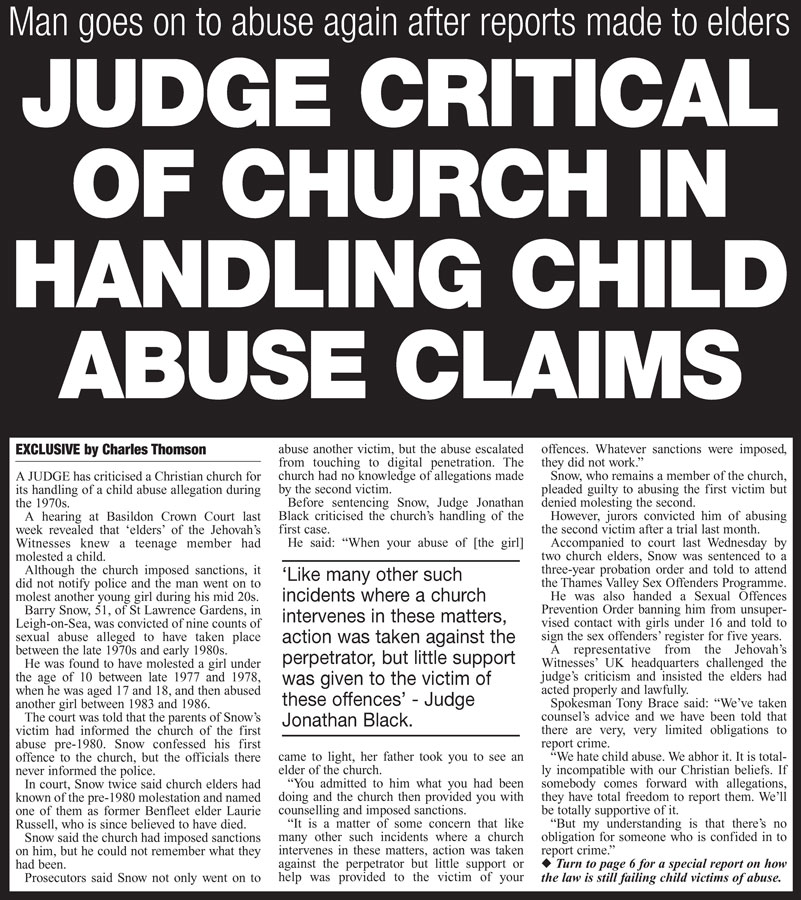

To join the debate, visit the online versions here and here.
"I had Michael Jackson on my knee at 10 years old!"
One of the best things about my job is that it brings me into contact with a lot of interesting people - from Lords of the land to legends of the music industry. Last week brought me into contact with one of the latter - former Temptations singer Richard Street.
Richard, who will be 70 years old next week, is currently on an extended UK tour and will soon roll up in Essex. As such, I managed to wangle a 40-minute telephone interview to promote his upcoming gig. During our chat he told me an extremely condensed version of his life story - and it was truly inspiring.
Richard's story could have been far less inspiring. It could have been deeply tragic. In fact, he could have become Motown's answer to the Fifth Beatle - for in the early 1960s, after having been a member of Detroit vocal group The Distants for a number of years, Richard was forced to quit the band in order to help support his mother. Months after he left, the Distants were signed to Motown and rechristened the Temptations. As his former bandmates shot to fame, Richard worked in a nightclub.
But, determined not to be left behind, Richard soon found his way into Motown, invited by producer friend Norman Whitfield to join the company's quality control department. There his job was to listen to all the artists' cuts for any flaws in the recordings. If he found any, they were re-recorded. If he didn't, they were passed to Berry Gordy and the other label heads, who would decide which were worthy of release.
The job also brought Richard into contact with the label's stars, from former girlfriend Diana Ross to future King of Pop Michael Jackson, who Richard recalled mentoring and playing basketball with.
By the early 1970s, Richard had worked his way back into the Temptations, just in time to record what would become their most critically acclaimed song: triple-Grammy winner Papa Was A Rolling Stone. He and his bandmates went on to win several American Music Awards and were later inducted into the Rock and Roll Hall of Fame.
Editing for newspapers is a ruthless business. The article has to be chopped until it fits into the space available on the page. As such, my 40-minute interview was trimmed to just 600 words. Perhaps I will upload an extended cut onto my website soon. In the meantime, though, here's the published version. Click to enlarge.

Click here to add comments.
Richard, who will be 70 years old next week, is currently on an extended UK tour and will soon roll up in Essex. As such, I managed to wangle a 40-minute telephone interview to promote his upcoming gig. During our chat he told me an extremely condensed version of his life story - and it was truly inspiring.
Richard's story could have been far less inspiring. It could have been deeply tragic. In fact, he could have become Motown's answer to the Fifth Beatle - for in the early 1960s, after having been a member of Detroit vocal group The Distants for a number of years, Richard was forced to quit the band in order to help support his mother. Months after he left, the Distants were signed to Motown and rechristened the Temptations. As his former bandmates shot to fame, Richard worked in a nightclub.
But, determined not to be left behind, Richard soon found his way into Motown, invited by producer friend Norman Whitfield to join the company's quality control department. There his job was to listen to all the artists' cuts for any flaws in the recordings. If he found any, they were re-recorded. If he didn't, they were passed to Berry Gordy and the other label heads, who would decide which were worthy of release.
The job also brought Richard into contact with the label's stars, from former girlfriend Diana Ross to future King of Pop Michael Jackson, who Richard recalled mentoring and playing basketball with.
By the early 1970s, Richard had worked his way back into the Temptations, just in time to record what would become their most critically acclaimed song: triple-Grammy winner Papa Was A Rolling Stone. He and his bandmates went on to win several American Music Awards and were later inducted into the Rock and Roll Hall of Fame.
Editing for newspapers is a ruthless business. The article has to be chopped until it fits into the space available on the page. As such, my 40-minute interview was trimmed to just 600 words. Perhaps I will upload an extended cut onto my website soon. In the meantime, though, here's the published version. Click to enlarge.

Click here to add comments.
Subscribe to:
Posts (Atom)