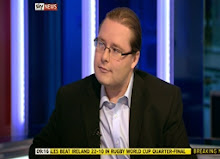
I am very proud and honoured to report that today I was named 'Weekly Print Journalist of the Year' at the Regional Media Awards.
As I reported a few weeks ago, I was nominated for a portfolio of work which included a long-running road safety campaign after the death of a 23-year-old man, and two one-off investigative articles.
The first investigative piece revealed that hundreds of teachers accused of sexual abuse had never been reported to police by the education authority, despite dozens of them having the complaints upheld and receiving professional sanctions. I obtained the data by taking legal action against the Government.
The second told how a Government Jobcentre had unwittingly signed up an escaped life sentence prisoner, fleeing a jail term imposed for a brutal attack with an iron bar, and sent him to work for a local company. Despite using a known alias, his identity was only discovered when he threatened to murder his new boss over a pay dispute, at which his boss Googled his name and discovered him on a Crimestoppers 'Most Wanted' list. Jobcentre staff then refused to give police the dangerous criminal's address, claiming it was 'personal information'.
I was surprised and humbled to win, and must thank my editor Mick Ferris and my mentor and news editor Steve Neale, as well as the whole team at the Yellow Advertiser and all those who have supported me in my career to date.
A short note to say I am extremely flattered and grateful to have been nominated for two Regional Media Awards.
I have been nominated for 'Print Journalist of the Year' on a weekly newspaper, and a road safety campaign I ran following the death of a young musician has been shortlisted for 'Community Campaign of the Year'.
Among the articles for which my 'Print Journalist' nomination was awarded were two investigative pieces and one campaigning piece about the above road death.
The first investigative piece was the revelation that hundreds of teachers accused of sexual abuse had never been reported to police by the education authority, despite dozens of them having the complaints upheld and receiving professional sanctions.
The second told how a Government Jobcentre had unwittingly signed up an escaped con, fleeing a life sentence for a brutal attack with an iron bar, and sent him to work for a local company. Despite using a known alias, his identity was only discovered when he threatened to murder his new boss over a pay dispute, at which his boss Googled his name and discovered him on a Crimestoppers 'Most Wanted' list. Jobcentre staff then refused to give police the dangerous criminal's address, claiming it was 'personal information'.
I will find out whether I have won at a ceremony in late February, although just to be nominated is very rewarding, as the shortlist is selected by a panel of experienced journalists.
The response to yesterday's blog has been overwhelming. My blog stats tell me that thousands of people from all over the world - UK, USA, France, Germany, Italy, Poland, Russia, Canada, Australia and more - have read my memories of Michael Jackson's appearance at the 2006 World Music Awards. My Facebook, Twitter and email accounts have been inundated with messages of thanks, many from people who were at the WMAs ceremony and had never seen anyone tell the truth about the night's events before. It is a wonderful feeling, to be told that your work has moved somebody. It has been a very humbling day.
My friend Damien also messaged me, to say that the video I posted of the World Music Awards appeared to have been doctored; Jackson's vocals were quieter than they should have been. I had thought when I watched it that they were quieter than I remembered. He sent me an earlier edit of the ceremony, with different camera angles, in which Jackson's vocals are far louder. Listening to them with more volume and clarity serves only to further dispel the nonsense stories I quoted in yesterday's blog, which claimed he had 'mangled' the song and missed his high notes.
I feel compelled to write this blog today because as I sit here in front of my computer, it is seven years - to the day - since I experienced an epiphany of sorts about the media's coverage of Michael Jackson. I had followed his trial quite carefully, of course, comparing court transcripts to media coverage and being distressed by the horrendously biased reporting. But those reports were often at least rooted in fact. Journalists would misrepresent genuine testimony, in most cases simply 'lying' by omission.
What happened seven years ago was different. I witnessed firsthand the construction of a purely fabricated story; one which shot around the world, once again making Michael Jackson a global figure of ridicule, and became immediately accepted as 'fact'. To this day, I read occasional press reports which mention this fabricated event as though it were an objective truth. It has even been listed as a significant career event in Jackson biographies.
Witnessing the creation of the myth was an experience that has stayed with me ever since. For an enthusiastic journalism degree student, it was a shocking and saddening insight into the media's more sinister machinations.
On November 15, 2006, Michael Jackson attended the World Music Awards at London's Earls Court Arena. It was his first official appearance in the capital since his acquittal in June 2005 and I was fortunate enough to be there. Some fans queued all day to secure prime positions in front of the stage but I had to go to university and then travel into London in the evening. Nonetheless, my friends and I easily claimed a spot against the front barrier, just off to the side, immediately beside the mixing desk. We spent part of the evening chatting to the sound and security staff, who tipped us off that they'd been in rehearsals and heard Jackson rehearsing 'that save the world song'. We met Katie Melua and got an autograph as she watched some of the show from the side of the stage.
It seemed like everybody was there for Michael Jackson. At any gap in the ceremony, chants of his name would erupt around the arena. Other performers on the bill included Enya, Beyoncé and Andrea Bocelli, but they mostly received tepid responses and their performances were often book-ended by increasingly loud chants of 'Michael! Michael! Michael!'
The night was plagued by delays. Lindsay Lohan, on hosting duty, fluffed almost every line she spoke and had to record all of her links multiple times. The turnaround between acts was slow. At one point there was a half hour or more of just nothing at all: an empty stage.
When Michael Jackson eventually appeared, to collect a Diamond Award for album sales over 100million, the place exploded. I have seen Paul McCartney. I have seen Madonna. I have seen Prince. I have seen George Michael. I have never in my life, before or since, witnessed any artist provoke the response that Michael Jackson provoked that night. He received the most sustained, thunderous reception I've ever seen.
He remained on stage for several minutes to deliver two short acceptance speeches - one for his Diamond Award and one for a Guinness World Record presentation. For the duration of his speeches, I hardly heard a word he said, despite the booming sound system. Most artists receive a big cheer as they walk onstage, then the audience settles down. Michael Jackson provoked hysteria. Shrieking and crying. It didn't lull once from the moment he appeared on that balcony until the moment he disappeared backstage again. It was an unforgettable sight.
He emerged again later for a brief performance of sorts. He walked onstage to another cacophonous reception as his record-breaking humanitarian single We Are The World played over the speaker system. He sang a few lines and seemed to look pleadingly towards the mixing desk. My suspicion is that the fans were making such a din he couldn't hear himself. It was like one of his concerts from the 80s. I saw bodies pulled from the crowd and rushed away in wheelchairs.
A few minutes later the sound people bizarrely turned the track off just as he started singing again. No matter. The place just went even crazier. It was an emotional moment, watching him receive such a rapturous welcome after the previous summer's events. After standing for a while on the runway that jutted out from the stage into the crowd, he began to exit, but as the cheering swelled - the audience not wanting to lose sight of him so quickly - he stopped and turned around. Playfully, he lifted a finger to his lips as if to ask the question, 'Shall I stay or shall I go?' The shrieking intensified.
He stood for a while, smiling, and just soaking in the adulation, then raised his fist into a triumphant black power salute. With that, he turned and coolly strolled off-stage, the applause continuing fiercely as he disappeared from view. I have never seen a human being cause such chaos. It was deafening.
You can watch a video of the performance here:
The following day I was back at university. As I walked along the corridor towards my first lecture, I met two female classmates. Looking at me pityingly, they asked: "How did it go?" I began telling them about the awe-inspiring reaction Jackson had received; how shocked I was at the scale of the outpouring. It had been one of the most incredible spectacles I'd ever witnessed.
I noticed they were now looking at me as though I were a crazy person. I asked them what was wrong and it transpired that the media was not quite reporting the night's proceedings as they had happened. Once I gained access to the internet, I discovered multiple publications were claiming he had been booed offstage.
"Michael Jackson walked offstage to a chorus of boos last night," the Mirror's Tom Bryant wrote. "The crowd, expecting a proper version of his song, booed the star who then scuttled offstage."
Scuttled offstage.
Watch the above video. Jackson not only does not 'scuttle offstage' to 'a chorus of boos' - he remains onstage long after his performance ends, absorbing the most emphatically positive reaction I've ever observed at an awards ceremony.
The Daily Record's Julia Kuttner wrote an almost identical story: "Michael Jackson walked off stage to a chorus of boos last night - just four
lines into his first performance in the UK for nine years. Jacko had
picked up a gong at the World Music Awards in London minutes before. But
after singing only the chorus to his
charity single We Are The World, he stopped to repeatedly tell the
audience: 'I love you'. Jackson scuttled off the stage after he was
booed by the crowd, who were expecting a proper version of the song."
The Evening Standard also got in on the action. Reporters Chris Elwell-Sutton and Valentine Low wrote: "His
much-vaunted reappearance turned into an embarrassing disaster. His
entire performance consisted of one mangled line, several missed high
notes and an exit to a chorus of boos from the audience. 'I love you',
he told them - although whether the feeling was reciprocated is open to
question."
I was in complete disbelief. Had one rogue reporter claimed Michael Jackson was booed offstage, I wouldn't have been so angry. Every profession has its bad apples. But for multiple reporters to have attended an event at which Michael Jackson demonstrably and categorically was not booed offstage, yet to all then write articles claiming he was, demonstrated a clear conspiracy between multiple parties to fabricate and perpetuate a bogus story.
That myth went around the world. Michael Jackson getting booed offstage became the biggest source of mirth on many a topical panel show and celebrity chat programme. It prompted further stories. The Guardian's Martin Hyde repeated the lies, declaring Jackson the 'ex-King of Pop' and claiming he had only managed a few lines 'before the booing began'. The Sunday Mirror captioned a follow-up story: "Plastic freak's comeback was truly diabolical." Even celebrity publicist Max Clifford was hoodwinked into commenting on the bogus story, telling the Daily Record: "The one thing that always stood him in good stead was, as a performer, he was one of the greats. This week, he destroyed that image. The reports from the awards say he sang one mangled line, several messy high notes and exited to a chorus of boos. As a performer that was incredibly damaging, and that's all he's got left. I think Michael is probably beyond help."
Researching the story years later using newspaper archive service Infotrac, I discovered something very interesting; an earlier report from the Mirror which completely contradicted the fabricated version it later settled on. In at least one edition of the November 16 paper, a story by Eva Simpson and Caroline Hedley read: "He's back! Michael Jackson was the biggest winner at the awards where he gave his first public
performance for nine years. The star was honoured with a Diamond Award
for selling more than 100 million albums in his career. Hosted by
Lindsay Lohan, the starstudded event at London's Earl's Court saw Jacko
give a stunning performance of We Are The World. You sure are, Jacko."
So it would appear that at some point an editorial decision was taken that instead of continuing to report what had actually happened, the newspaper was going to rewrite the night's events to tell the exact opposite of the truth - and several other publications were going to do the same.
It seemed to me that the media had already decided what story it wanted to tell about Michael Jackson's appearance in London - it was just an irritation to them that he hadn't played ball. When his appearance prompted a powerful outpouring of adulation - fans being rushed away in wheelchairs like the tours of his heyday - it didn't suit the industry's preconceived narrative. Certain figures were intent on Jackson being the 'ex-King of Pop'. When Earls Court actually went just as crazy for him as it would have done 20 years prior, it didn't fit - so they simply ignored that inconvenient turn of events and conjured a 'chorus of boos' from thin air. If Jackson wouldn't play his 'ex-King of Pop' role like a good boy, they would attempt to manufacture it. It was classic British tabloid muscle-flexing.
The frustration and the sadness I felt that day when I observed this lie being willfully peddled, and the powerlessness I felt just watching TV presenter after TV presenter, comedian after comedian, recycle the nonsense for the consumption of millions who were not there and would never know it was all made up, bubbles back up whenever I remember the debacle. It was a sorry day for journalism - but the profession has had many of those where Michael Jackson is concerned.
I'm not sure why I've never written anything about it before, but a friend posted a video from the event on Facebook earlier today to mark the anniversary. It was the last time I saw Michael Jackson perform live, but the memory is always tinged with sadness and frustration for what happened in the following days. It's about time somebody set the record straight on this particular fallacy.
"Judges described Charles Thomson as having a good writing style and being 'a credit to the newsroom', but also a livewire who at times must 'turn his editor's hair white'."
I was honoured this month to receive a 'Highly Commended' award in the 'Newcomer of the Year' category at the EDF Regional Media Awards. I was handed the prize for a portfolio of stories produced within the last year.
The collection included a series of interviews with Lord Hanningfield, detailing his life after being convicted and jailed for expenses fraud in 2011. I was also nominated for a gonzo piece detailing my thwarted attempt to interview former TV star Michael Barrymore, who instead turned the tables on me, pulled me on-air and grilled me on the radio.
The judges nominated me also for two court stories - one in which I single-handedly challenged and overturned a ruling which blocked the identification of a criminal who downloaded over 100,000 child sex abuse images, and another in which I uncovered a child abuse cover-up by the Jehovah's Witness church.
I love my job and to receive this commendation was simply the cherry on top of a fantastic year.
I received a text message from my editor this afternoon - I was crossing the River Thames from Gravesend to Tilbury on a dilapidated ferry at the time (long story) - to tell me I had been nominated in the Best Newcomer category at the EDF regional press awards. Although I have worked as a freelance reporter since 2008, I only began full time work on a regional newspaper in late 2011.
I've been nominated for a trio of stories. The first was a gonzo account of my thwarted attempt to interview controversial former TV presenter Michael Barrymore. Barrymore, for those who don't know, was the king of British primetime TV in the 1990s but his career was left in tatters when a dead man was found floating in his swimming pool after a drug-fuelled party. DNA cleared Barrymore of any involvement in the man's death but the scandal was sufficient to ruin him.
I arrived at a secret location, where Barrymore was recording a guest show for a local radio station, under the impression that he had agreed to an interview. He denied ever agreeing to any such thing and seemed quite perturbed by my arrival, but allowed me to stay on the condition that I sat quietly and didn't ask him any questions. That didn't last long.
About a third of the way into the recording he began interrogating me on-air. "I'm interviewing a journalist!" he declared. His refusal to give me an interview became a running joke throughout the broadcast and his antics were perfect fodder for a first-person feature. The icing on the cake was that after our radio chatter he did give me a few exclusive nuggets for the newspaper after all.
The second piece I've been nominated for was a court story about a local man who had been caught in possession of more than 100,000 images of child sex abuse. Several hundred were considered to depict the most shocking and sadistic level of abuse. There were videos too.
Sadly, that is not a particularly uncommon story. What made this scenario unusual was that I arrived at the courthouse to discover that a magistrates court had slapped a bizarre reporting restriction on the case in a previous hearing. They had banned any publication of the man's address because he did not live alone and they said his family could suffer from vigilantism.
UK libel laws dictated that preventing the publication of the man's address amounted to a blanket ban on all reporting of the case. In a large town it is highly likely that somebody will have at least one namesake. There will be lots of John Smiths, for example. If I put in the paper that John Smith has been convicted of possessing child porn - but don't include his address - every other John Smith in town can sue me and my newspaper for defamation by claiming the report caused their neighbours to think they were the convicted pervert.
In my view, the reporting restriction was a nonsense. Firstly, making court orders to prevent vigilantism is like putting signs up in car parks reminding people that it is illegal to steal cars. People don't need to be reminded that it is wrong. Everybody knows that it is wrong. It is already regulated by existing laws.
But more importantly, I was alarmed by the potential precedent of a ruling which said that because a child porn collector did not live on his own, he should not be held publicly accountable for his crimes. What of future cases? Could all paedophiles ensure their anonymity by simply moving in with somebody?
I raised the issue with the court clerk, who in turn agreed to pass my concerns to the judge. However, the clerk forgot and the hearing concluded. Just as the judge was about to rise, I stood and addressed him. He sat back down.
The defence barrister and I swapped legal arguments and the judge deliberated. He sided with me, concluding that the restriction set a disturbing precedent. He ordered that it be lifted so I could publish details of the man's crimes. It turned out I was the first reporter at our newspaper to ever overturn a reporting restriction completely off the cuff - reporters are usually aware of them and able to plan their arguments for days before the hearing.
Three months later I stumbled across the story that would lead to my third nominated article - again at the local courthouse and again involving child abuse. I knew that a man called Barry Snow was due in court over alleged child abuse. I didn't know that the circumstances of his offending would lead the presiding judge to publicly criticise the Jehovah's Witness church over its handling of child sex abuse cases.
Snow had repeatedly molested a girl under the age of 10 in the late 1970s, when he was in his late teens. His crimes were reported to the Jehovah's Witness church, where he was a dedicated member. Instead of reporting the abuse to police, church elders handled the matter internally. Snow went on to molest several more children.
At first I assumed that the church elders had committed a criminal offence by failing to report the abuse to police. But after a little digging I discovered that this was not the case. Counter-intuitive though it may seem, in the UK there is no statutory obligation for anybody - even a school - to report suspected child abuse. If you sign your child up to a scouts group or a football team or a nursery and they suffer abuse while they are there, they have no statutory right to have that abuse reported to the authorities.
The result was a news feature which used the Barry Snow case as a springboard to explore the ongoing but little-known campaign in the UK to introduce laws requiring schools and other children's organisations to report suspected child abuse to police. Just a few weeks after it was published, the Jimmy Savile scandal erupted and sent shockwaves around the country, bringing this very subject to the forefront of popular debate.
I haven't yet heard where or when the ceremony will be held. I have no idea what articles any of the other nominees have been shortlisted for and I certainly won't go in the expectation of winning. I didn't even think I'd be nominated. But it is an honour that I have been, and I am most grateful.
Charles Thomson, award winning writer. That's how I shall be billing myself from now on.
On Wednesday evening I received a prestigious Guardian Award for my work on the late, great Godfather of Soul, James Brown.
The Guardian ceremony is the biggest and the most respected awards bash for young journalists in Britain. I was nominated back in September for 'Feature Writer of the Year'. The ceremony took place on Wednesday evening at the Proud Gallery in Camden.
At first I was disheartened. The runner up in my category was announced - it wasn't me. The winner was announced - that wasn't me either. 'That's it', I thought. 'I lost.'
But then something unexpected happened. Colin Murray, our host for the evening, announced that this year the judges had changed the format of the feature writing category. There was one particular article that the judges felt needed to be recognised, he continued. The room was abuzz with chatter. Over the noise, I heard Murray say something about James Brown - and almost fell off of my chair.
In what has now become a blur, I was presented with the special commendation award for feature writing. As such, I shall be swanning up to London at some point in the near future for a week of shifts at the Guardian.
It was an honour to receive my first journalistic award for a piece about James Brown. When I was 18 years old and just starting out, James Brown was the first artist who gave me a chance. He allowed me backstage at what would become his final concert on British soil. He let me put a question to him during his pre-show press conference and he put me on his personal guestlist for the concert.
Two months later he died. My question to him in London had been about an album he was working on. As time went by, I began wondering what had happened to it and why it was never released.
So I decided to find out. I tracked down everybody I could who was involved in the recording process; band members, session musicians, studio owners and engineers, backing vocalists, songwriters and managers. What emerged was an insight into the final two years of James Brown's life; the recording, the touring, the ill health and ultimately, his death.
To say that the article was a labour of love would be an understatement. From my first interview - which took place in London with the legendary Fred Wesley - to the article's eventual publication, the process took over a year. My work on the piece during that year was stop-start; sources had to be tracked down and then interviews had to be scheduled. Investigating the final two years of James Brown's life proved an expensive hobby too, what with all the lengthy transatlantic telephone interviews.
I would like to take this opportunity to thank all of those who consented to interview - this is your story and I am privileged that you allowed me to tell it. Thank you to the judges - this article is the most significant that I have written and to have it acknowledged by the Guardian Awards is surreal.
And thank you to Mr Brown, who has book-ended this first chapter in my journalistic career. At 18, just weeks into my journalism degree, Mr Brown became my first high profile interviewee. At 21, the award which drew a line under my academic career was presented to me for an article inspired by that meeting with James Brown.
Me (centre) accepting my award from Guardian writer Hannah Pool and Radio 5 DJ Colin Murray. Photographer: Teri Pengilley
I realise that I have been neglecting the blog again. I am currently collaborating with American writer Tony Best on an article about the groundbreaking 1981 music video 'Can You Feel It'.
Charles Thomson is a multi-award winning court reporter, feature writer and investigative journalist.
His stories have appeared in the Sun, the Mirror, the Daily Star, the Guardian, MOJO, Wax Poetics, Orchard Times, the Huffington Post and various other publications.
For more, visit http://www.charles-thomson.net