Showing posts with label guardian. Show all posts

Monday, 10 October 2011

VIDEO: James Brown Press Conference 2006

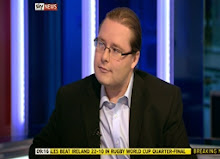
Having successfully ripped my Sky News appearance from a DVD and uploaded it to the YouTube, I was inspired to pluck another clip from my archive and stick that online for your enjoyment too.

Back in October 2006 I had just begun my journalism degree. I had been a James Brown fan throughout my teens and had seen him live three times. When I found out he was coming to the UK for a BBC concert, I decided to use my new 'student journalist' credentials to apply for an interview.

Most press officers would have simply ignored my email but Adam Dewhurst, who was looking after James Brown during his London trip, was kind enough to reply. He told me that Mr Brown wasn't doing any interviews while he was in the capital but that he was giving a press conference at Camden's Roundhouse a few hours before his concert there. If I wanted to go, he said, he'd put me on the list.

And so it came to be that on October 27th 2006 I found myself sitting in a small room upstairs at the Roundhouse - one of only two non-BBC journalists to be invited - waiting for an audience with my hero: the Godfather of Soul.

Mr Brown was late. I didn't much care. It gave my nerves time to settle. I was green; I'd never been to a press conference before; talk about a baptism of fire.

The other journalists seemed unphased - some actually seemed to view the press conference as an unwanted distraction from their other work. I couldn't understand it. How many people can say they've had the opportunity to pick the brain of the most influential musician of the last century? But their nonchalance subsided as soon as somebody whispered, "He's coming! He's coming!" There was a stunned silence.

Author Jonathan Lethem once wrote of James Brown:

"It is not merely that attention quickens in any room this human being inhabits. The phenomenon is more akin to a kind of grade-school physics experiment: Lines of force are suddenly visible in the air, rearranged, oriented. The band, the hangers-on, the very oxygen, every trace particle is charged in its relation to the gravitational field of James Brown...

"I'm also struck by the almost extraterrestrial quality of otherness incarnated in this human being... He's in his midseventies, yet, encountering him now in person, it occurs to me that James Brown is kept under wraps for so long at the outset of his own show, and is viewed primarily at a distance, or mediated through recordings or films, in order to buffer the unprepared spectator from the awesome strangeness and intensity of his person. He simply has more energy, is vibrating at a different rate, than anyone I've ever met, young or old. With every preparation I've made, he's still terrifying."

The description is an accurate one. A room full of cynical journalists, bemoaning James Brown's lateness and its impact on their deadlines, fell into a deferential hush as soon as he came into view down the corridor.

Mr Brown was in pain throughout his trip to the UK. In an article titled 'Jawedfather of Soul; James Brown ignores dental op agony at Scots gig', Glasgow's Daily Record reported that Brown had undergone dental implant surgery just days before flying to the UK and was "in so much pain he had to avoid talking and rinse his mouth with salt water just hours before going on stage."

Brown's cheeks looked sunken - the teeth he had in didn't fit properly. They were holding the fort until his final set were finished and inserted. It was when Brown attended a dental appointment two months later to have the final set put in that he was told he was too ill for surgery and sent to hospital with pneumonia, where he died shortly afterwards.

His voice was hushed, his speech difficult to decipher. It's not obvious in the below clip how quiet his voice was because he was speaking directly into a BBC microphone, but at 1m18s you'll notice a significant change in audio quality. This was because reporters were complaining that they couldn't hear Mr Brown's answers to their questions, so a door was closed.

The press conference was roughly fifteen minutes long, in which time Mr Brown discussed what to expect from his concert that night, the need to get children interested in playing instruments again and the negative impact that violent hip-hop imagery has on young people and on society in general.

Being as green as I was, I was too timid to shout my way through the other reporters and ask a question, so Mr Dewhurst kindly offered me the floor. I took the opportunity to ask Mr Brown about the album I knew he'd been working on, then known to fans as 'World Against The Grain' (it later turned out to be 'World Funk Against The Grain'). I got an answer I didn't expect.

During his lengthy response, Mr Brown spoke about the new track 'Gutbucket', in which he blasted hip-hop artists for their violent and misogynistic lyrics. This led to a discussion about the degradation of the music industry. Finally, though, he made some troubling comments. "Somebody's gonna have to die before we get that out," he muttered about the album. "I won't say much more than that."

He concluded, "We would love to get that out, but we need help." As he said the word 'help', his voice cracked - perhaps through emotion, perhaps because he was battling intense oral pain. Either way, to hear the notoriously proud James Brown publicly stating that he needed help was bizarre; as somewhat of a James Brown archivist, it is the only occasion I'm aware of on which Brown has ever publicly exhibited anything approaching weakness.

The comments prompted an uncomfortable silence and Mr Brown's personal manager, Charles Bobbit, leaned apologetically into the assorted microphones and said, "You should get that some time next year."

"I remember that press conference," Mr Bobbit would later tell me. "It was as if he had a premonition. I guess it came true, huh?"

Mr Brown's comments that night divide those who surrounded him. Some believe that those in charge of Brown's estate never intended the album to be released while he was alive and that his death was suspicious.

According to family sources, when Mr Brown's son-in-law told the National Enquirer he believed Brown had been murdered, he was shot dead days later and $500 was found in his pockets, ruling out robbery as a motive. Another family member told me last year that when they started asking questions, they were told, "that I could go missing and that there are a lot of swamps in Georgia."

Others, though, say the album simply wasn't finished and that Brown had a tendency to exaggerate, perhaps amplified on this occasion by pain medication he may have been taking to counter the agony caused by his dental surgery.

This month, former trustee of Brown's estate, David Cannon, is due to stand trial on numerous counts of mismanaging the James Brown estate both before and after Brown's death. Perhaps some answers will be provided by those proceedings.

The press conference was shot in full but never aired. The only footage broadcast on TV was the two-minute skit I have included below. My question was included but Mr Brown's answer, unsurprisingly, was not.

I didn't take many notes - I wasn't sure about the etiquette of breaking eye contact with James Brown as he spoke to me, so I maintained eye contact for the duration of his answer and scribbled down what I could when he finished. Those notes have long since been lost.

A few years ago I tried to obtain the unedited footage of the press conference but was told by the BBC that this skit was all they could find.

Although Mr Brown seemed troubled, I remain grateful to Mr Dewhurst for inviting me to that press conference. As it turned out, I would never have had another chance to speak to Mr Brown. He died less than two months later, on Christmas Day 2006.

My encounter with James Brown prompted my research into his final album, which produced my Guardian Award-winning article, 'James Brown: The Lost Album'. James Brown book-ended my career as a student journalist. In my first month of studies, I attended that press conference. Just over three years later, shortly after I graduated, I was handed my Guardian Award.

Though this footage is brief, and my own on-screen appearance amounts to about two seconds, this is a video I will treasure forever - and I'm glad to finally be able to share it with you all.


Tuesday, 15 December 2009

PCC rules in favour of columnist who portrayed Jackson as a paedophile

The Press Complaints Commission last week responded to ten complaints made about a Guardian article in which writer Tanya Gold strongly insinuated that Michael Jackson was a paedophile.

Perplexingly, the PCC ruled in favour of the Guardian.

The PCC listed two main reasons as to why they had not ruled against the offending article. First, that Michael Jackson's family had not complained directly. The PCC said:

"Many of the concerns raised rested on the impact of the coverage on the Jackson family and the singer's memory. Two complainants were concerned that Clause 4 (Harrassment) had been breached and two individuals argued that the article was discriminatory. In this instance, the Commission felt that it must be for the Jackson family to guage such issues as this and to make clear whether they have found that there has been an incidence of harrassment or discrimination, as alleged by complainants. They had not done so."

So in other words, it is perfectly acceptable for a newspaper to strongly insinuate that an innocent man is a paedophile, unless his family complains directly to the PCC.

How and why, exactly, would the Jackson family - who live in Los Angeles - be reading the Guardian? The newspaper is published on the other side of the planet.

This rule is absurd, placing the onus on the families of well known figures to scour thousands of newspapers on a daily basis in case a libelous comment has been printed about their loved one. It is ludicrous to expect the Jackson family to dissect the world's media on a daily basis in case somebody has called their son/brother/father a paedophile. What kind of rule is that? The onus should clearly be on the newspapers not to print the libelous comments in the first place.

The family is essentially left in a catch-22 situation; either spend their entire lives scrutinising national and international newspapers on a daily basis, or simply turn a blind eye to the systematic portrayal of their loved one as a predatory paedophile. The ruling is utter nonsense.

The second get-out clause that the PCC pointed to was that the article was an opinion piece, not a news article. The PCC ruling states:

"The Commission noted that the article was an opinion piece clearly identified as such in the 'Comment is Free' section of the newspaper in line with the erms of Clause 1 (iii). The piece contained the journalist's personal impression of Michael Jackson's lifestyle and talents."

This section of the ruling is totally irrelevant. Complaints relating to Tanya Gold's editorial did not pertain to her opinion. In my own blog on the subject I stated that Ms Gold clearly has the right to an opinion. But the article did not only contain Gold's opinion. It contained a number of factually inaccurate statements.

While a writer of course has the right to his or her opinion, they do not have the right to misstate crucial information or twist facts in order to suit their agenda. Gold used numerous inaccurate statements to support her opinion.

The publication of inaccurate information most certainly is within the PCC's remit. However, in a lazy attempt to dismiss the complaint as quickly and easily as possible, the Commission has skirted around the issue of factual inaccuracies entirely.

The PCC ruling in this matter is a joke. The Commission purports to protect the victims of inaccurate reporting but in this instance it has condoned the publication of a bigoted editorial which used inaccurate statements to support the notion that Michael Jackson was a paedophile.

The PCC has ruled and it isn't pretty. Let it be known; It is perfectly acceptable to use inaccurate information to portray an innocent black man as a paedophile. The onus is on his elderly mother, as trustee of his estate, to scour newspapers on a daily basis looking for allegations that her son molested children. That the article was printed on the other side of the planet is irrelevant; it's still her responsibility.

Nice.

Friday, 27 November 2009

How the Godfather of Soul won me a Guardian Award

Charles Thomson, award winning writer. That's how I shall be billing myself from now on.

On Wednesday evening I received a prestigious Guardian Award for my work on the late, great Godfather of Soul, James Brown.

The Guardian ceremony is the biggest and the most respected awards bash for young journalists in Britain. I was nominated back in September for 'Feature Writer of the Year'. The ceremony took place on Wednesday evening at the Proud Gallery in Camden.

At first I was disheartened. The runner up in my category was announced - it wasn't me. The winner was announced - that wasn't me either. 'That's it', I thought. 'I lost.'

But then something unexpected happened. Colin Murray, our host for the evening, announced that this year the judges had changed the format of the feature writing category. There was one particular article that the judges felt needed to be recognised, he continued. The room was abuzz with chatter. Over the noise, I heard Murray say something about James Brown - and almost fell off of my chair.

In what has now become a blur, I was presented with the special commendation award for feature writing. As such, I shall be swanning up to London at some point in the near future for a week of shifts at the Guardian.

It was an honour to receive my first journalistic award for a piece about James Brown. When I was 18 years old and just starting out, James Brown was the first artist who gave me a chance. He allowed me backstage at what would become his final concert on British soil. He let me put a question to him during his pre-show press conference and he put me on his personal guestlist for the concert.


Two months later he died. My question to him in London had been about an album he was working on. As time went by, I began wondering what had happened to it and why it was never released.

So I decided to find out. I tracked down everybody I could who was involved in the recording process; band members, session musicians, studio owners and engineers, backing vocalists, songwriters and managers. What emerged was an insight into the final two years of James Brown's life; the recording, the touring, the ill health and ultimately, his death.

To say that the article was a labour of love would be an understatement. From my first interview - which took place in London with the legendary Fred Wesley - to the article's eventual publication, the process took over a year. My work on the piece during that year was stop-start; sources had to be tracked down and then interviews had to be scheduled. Investigating the final two years of James Brown's life proved an expensive hobby too, what with all the lengthy transatlantic telephone interviews.

I would like to take this opportunity to thank all of those who consented to interview - this is your story and I am privileged that you allowed me to tell it. Thank you to the judges - this article is the most significant that I have written and to have it acknowledged by the Guardian Awards is surreal.

And thank you to Mr Brown, who has book-ended this first chapter in my journalistic career. At 18, just weeks into my journalism degree, Mr Brown became my first high profile interviewee. At 21, the award which drew a line under my academic career was presented to me for an article inspired by that meeting with James Brown.


Me (centre) accepting my award from Guardian writer Hannah Pool and Radio 5 DJ Colin Murray. Photographer: Teri Pengilley

Tuesday, 27 October 2009

Guardian columnist insinuates that Michael Jackson was a paedophile; Charles Thomson explodes the myths behind the 1993 case

The Guardian was today forced to disable the 'comments' function on an editorial about Michael Jackson after hundreds of readers voiced their disgust at the irresponsible factual inaccuracies that it contained.

Tanya Gold's bemusing rant about Michael Jackson provoked outrage as she lambasted the King of Pop, claiming that he couldn't write hits, wasn't a great dancer and that his innovation of the music video was meaningless.

Most shocking, however, was her strong insinuation that Jackson was a paedophile, which supported with a number of incorrect 'facts'.

Gold's editorial wrongly claimed that during Jackson's 1993 child abuse storm, Jordan Chandler had accurately described the star's genitals to police officers.

This is a fiction.

The myth that Chandler accurately described Jackson's genitals is one that has been perpetuated by hack writers for over one and a half decades.

In 2007 Jacques Peretti - also a Guardian contributor - faced a barrage of OFCOM complaints after his pseudo-documentary 'Michael Jackson - What Really Happened' also rehashed this myth.

It is well documented that Jordan Chandler did not accurately describe Michael Jackson's genitals. Among other inaccuracies, he claimed that Jackson was circumcised, whilst police photographs proved that he was not.

Here is Chandler's drawing of Jackson's penis, which he gave to police officers 1993:


Damning, I'm sure you will agree.

Chandler's failure to corroborate his allegations - including his inability to accurately describe Jackson's genitals - was the reason Jackson never faced charges in 1993.

The media would have you believe that the reason Jackson never faced trial in 1993 was because he paid off the boy's family.

This is also bogus.

The investigation into Jackson's conduct began in 1993 and lasted long into 1994. During this prolonged period - long before the financial settlement was reached - Jackson was never arrested and he was never charged. This was due to a complete lack of corroborative evidence. DA Tom Sneddon took his 'case' against Jackson to three separate grand juries - all three refused to let him bring charges against the star.

But the media won't tell you that.

Ergo, the media's widespread claim that Jackson bought his way out of a criminal trial is a myth - he was never going to stand criminal trial in the first place. When Jackson settled with the Chandler family, he was not being prosecuted. He was being sued.

To claim that Jackson settled the case at all is also a myth, although that's not the way the mainstream media tells it.

Jackson never paid the Chandlers a cent in the 1994 financial settlement. It was the the star's insurance company which covered the costs, not the Jackson himself. Furthermore, documents prove that the settlement was arranged against the star's wishes.

Court documents which came to light in 2005 stated: "The settlement agreement was for global claims of negligence and the lawsuit was defended by Mr Jackson's insurance carrier. The insurance carrier negotiated and paid the settlement over the protests of Mr Jackson and his personal legal counsel."

All of this, Tanya Gold fails to include in her editorial.

It seems to have escaped Tanya Gold's notice that Jackson was acquitted and vindicated in his 2005 trial - a trial that included testimony about the 1993 case. As such, Jackson died an innocent man, and no person has the right to insinuate otherwise.

Interestingly, Gold - who never attended a single day of Jackson's trial - seems to believe that she knows better than the 12 jurors who sat through every nanosecond of testimony.

Such breathtaking arrogance is a problem that dogged Jackson for much of his career. The media has a habit of hiring clueless laypersons to offer 'expert analysis' on subjects they don't understand and Jackson fell prey to this trend more than his fair share of times.
The problem hit fever pitch during Jackson's trial. On weekday evenings in spring/summer 2005, shows like 'Richard and Judy' would regularly invite assorted columnists to offer 'expert opinion' on the star's trial. Presumably, none of these journalists had actually attended Jackson's trial, given that it was often in session in Santa Maria at the very moment that they were discussing it on 'Richard and Judy'.

Gold is another in a long line of non-experts masquerading as an expert. Her 'facts' have no basis in reality. She claims that Chandler accurately described Jackson's genitals - he didn't. She claims that Jackson bought off the boy's family - he didn't.

Gold's pathetic editorial is indicative of the systemic failure of the British media to report accurately on black celebrities. Rather than physically check whether Chandler accurately described Jackson's private parts, Gold vaguely recalls hearing some other hack claiming that he did and assumes that this is proof enough. And if it isn't - who cares? You can't libel the dead anyway.

Another half hour of online research - which isn't too much to expect from a professional journalist - would have produced further evidence that the 1993 allegations were a crock.

In the wake of the 1993 scandal journalist Mary A Fischer penned an article entitled 'Was Michael Jackson Framed?' The investigation appeared in GQ magazine and contained compelling evidence that the star had been set-up, including transcripts of tape recorded telephone calls in which the boy's father, Evan Chandler, was heard discussing his plans to extort money from Michael Jackson.
In 2004 Geraldine Hughes, legal secretary to Jordan Chandler's lawyer during the 1993 allegations, wrote a book called 'Redemption'. In the book Hughes detailed how she had witnessed, from the inside, the boy's father and his lawyer masterminding the plot to extort money from Michael Jackson, or destroy him if he didn't comply.

During Jackson's 2005 trial Jordan Chandler was called by the prosecution, but failed to show up to court. Instead his mother, June Chandler, took the stand. During her testimony she admitted that Jordan had legally divorced both of his parents and no longer spoke to either of them.

During a subsequent Q+A at Harvard University, Jackson's lawyer Thomas Mesereau revealed that the reason Chandler divorced his parents was allegedly because he was incensed that they had forced him to lie to the police and in doing so had destroyed his friendship with Jackson.

Mesereau also stated that had Chandler taken the stand, the defence had numerous witnesses lined up who were willing to testify that Chandler repeatedly told them he was never molested by Jackson and that his parents, particularly his father, had concocted the entire story.

The evidence that Jackson abused Jordy Chandler is zero. That is why the star was never arrested and never charged. Conversely, the evidence that Jackson was innocent is overwhelming.

Tanya Gold, like many journalists, would do well to research her subjects in future, rather than arrogantly concluding that her own ill-informed assumptions trump the proven facts. Of course, every columnist has the right to his or her opinion. However, what they do not have is the right to misrepresent facts - and they certainly do not have the right to label innocent men paedophiles.
Put simply - it is irresponsible. In the digital age, the Guardian has a worldwide internet readership. This means that a potential audience of millions could happen upon Tanya Gold's nonsense editorial, consume it and retain her bogus factual information. Similarly, Jacques Peretti's 2007 show was watched by millions and has been repeated incessantly ever since.
Writers - be they journalists or columnists - have a responsibility to their audiences. This is why research is of the upmost importance.
Tanya Gold has failed in her responsibilities. Readers put trust in journalists, particularly broadsheet journalists. Gold's editorial was teeming with factual inaccuracies.
Rarely have I seen such irresponsibility, particularly in a newspaper such as the Guardian.

Sunday, 13 September 2009

I have been shortlisted....


Just a quick note to say that I have been shortlisted by the Guardian Student Media Awards in the Feature Writer of the Year category.

I have been shortlisted for my article 'James Brown: The Lost Album', which can be read on my website.

Winners are announced in November.

I realise that I have been neglecting the blog again. I am currently collaborating with American writer Tony Best on an article about the groundbreaking 1981 music video 'Can You Feel It'.

More on that as it develops.