Sunday, 19 March 2017

Remembering Chuck Berry

I saw Chuck Berry live twice – both times in the same year. The first time was at London’s Hackney Empire in July 2008. I almost never made it, having initially ordered my tickets through a hotline I saw advertised in a newspaper, which turned out to be a scam. I realised my blunder in time to halt the transaction but by then the show was largely sold out and only the very worst seats remained. I went to and fro over whether I wanted to watch Chuck from the nosebleed seats but eventually decided that I did and persuaded my friend Graham to come with me.

When I telephoned the theatre to book tickets, the lady in the box office was just about to reserve me some seats in the gallery when she paused. She said the system was showing that the theatre had just released some seats that morning, which it had previously been holding back. They were in the front row. Did I want those instead, she wondered. I didn’t need to be asked twice.

Graham and I caught a train and then a bus to Hackney for the show and took our seats in the front row, just right of the aisle, not really knowing what to expect from Chuck, now well into his old age. The theatre was beautiful and the audience filled with ageing Teddy Boys sporting elaborate hairdos.

The band kicked in a few seconds before the curtain rose to reveal Chuck already on stage, decked out in a glittery shirt and a white sailor’s cap. He launched straight into Roll Over Beethoven and, almost immediately, did his famous duck walk from one end of the stage to the other. He was fast and nimble. It was hard to believe this was a man of 81 and even harder to believe that the Chuck Berry was performing Roll Over Beethoven just a few metres away from us.
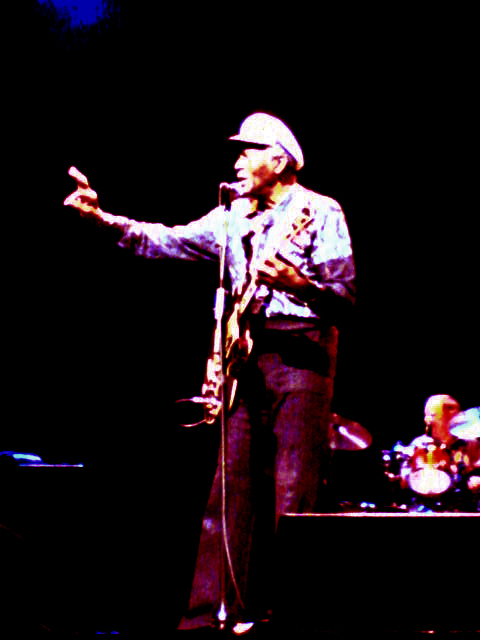
A grainy cellphone shot of Chuck Berry at the Hackney Empire (Charles Thomson).

In an hour-long set he blasted through hit after hit, from School Day (Ring Ring Goes The Bell) to Memphis Tennessee and Sweet Little Sixteen. He got the whole audience singing and laughing along with My Ding A Ling and invited some lucky women on stage to dance during Johnny B Goode. He had many more dancing in the aisles, too. Sadly, security were very heavy-handed and kept instructing people to sit back down, despite Chuck repeatedly shouting from the stage to let them dance.

Chuck was was so good that night that when, a few months later, Camden’s Jazz Café announced he was returning to London to play two shows at the venue, I told my friend James that we had to go. The Jazz Café was a favourite venue of mine at the time – small and incredibly intimate.

The choice of venue got me thinking. I had been to the Jazz Café enough times to know the artists usually entered through the same door as the ticketholders. I checked with a promoter friend who had booked artists into the venue and he confirmed the front door was also the artist entrance. James and I hatched a plan to get to the venue early and see if we could collar Chuck for an autograph on the way in.

Chuck, despite his many positive qualities, was not famed for his kindness towards fans. Musician Brian Johnson wrote in his autobiography that after Chuck toured with Johnson’s band Geordie for a week in 1975, using all their equipment for free, Johnson asked him: “Mr Berry, can I have your autograph?” Chuck replied: “I only sign one a day and I’ve already done it.”

If James and I were to get an autograph, we would have to be the first to ask that day. And so we arrived at the Jazz Café’s front doors at about 2pm, to make sure we didn’t miss him. By the time the doors opened about five hours later there was no sign of Chuck – we concluded he must have arrived about 10 hours early just so he wouldn’t have to sign his daily autograph – and we were cold and wet and our feet were sore.

On the plus side, we were numbers one and two in the queue and bagged ourselves a spot in the standing area, right in front of the stage.  Literally. It’s a tiny venue with a low stage and no barrier. When Chuck descended the metal staircase to the stage a few hours later and took his spot behind the microphone, we were perhaps four feet away from him. He was playing his guitar right in front of our faces.  

But he wasn’t playing it very well. Chuck was unrecognisable as the performer I had witnessed months earlier at the Hackney Empire. He seemed at times hesitant and confused.

An early sign that Chuck wasn’t altogether himself came when he started playing his hit song Maybellene but ended it singing the lyrics to Johnny B Goode. Later in the show he started playing Maybellene again.

His guitar playing was wonky throughout. He faltered at the beginning of Sweet Little Sixteen and had to start again. During South of the Border, he lost his place and announced, “Damn, I can’t think of the next line.” Apologising for his confusion at one point, he said, “I’m 81 years old, I’ve got no business being on this stage.” He was actually now 82. 

Chuck Berry on stage at the Jazz Café (James Newman).

Partway through the show – just before he played Nadine – he decided his guitar was out of tune (it wasn't) and began twisting knobs back and forth with abandon. The ensuing, lengthy, ham-fisted attempt to re-tune his guitar prompted an array of comical facial expressions from his alarmed band members, including his son, who after a while tried to step in and stop his dad fiddling with the strings. 

But it was too late for intervention, for by that time Chuck had begun walking to the opposite end of the stage and yelping at his young pianist, “Give me an E! Give me an E!” Alas, the pianist’s efforts did not appear to aid Chuck, who played the rest of the show with his guitar sounding rather peculiar.

Chuck Berry with his son at the Jazz Café (James Newman).

None of this is intended a criticism of Chuck, of course. As he had said, he was in his 80s and he didn’t have to be up on stage. We were lucky he was there at all and only a fool would expect a man of 82 to perform to the same standard as his younger self. Chuck was simply acting his age. But nonetheless, it was in stark contrast to his effervescent performance months earlier at the Hackney Empire, where he had defied his years.

Who knows what the problem was; Perhaps he was jetlagged. Maybe he hadn’t had a night off that week. Perhaps I had just caught him on uncharacteristically good form in Hackney.

Whatever the reason, it certainly didn’t diminish Chuck in the eyes of the audience, who laughed and cheered throughout the show. His confusion was endearing and he handled the situation with great humour. James and I look back on that evening extremely fondly. We have relived it several times, in hysterics as we recalled the sheer horror on the band’s faces as Chuck started meddling with his guitar. There is some video of the tuning incident on YouTube, although sadly incomplete and recorded from the side, missing the band's brilliant reactions.

A year later I learned Chuck was returning to the UK to play a show at one of my local theatres and bought tickets. However, the tour was later cancelled – apparently due to a dispute with the promoter – and he never returned to the UK.

He may have been well into his old age by the time I got to see him but it was a privilege to witness the man up close, even on an off day. Chuck Berry was one of music’s great pioneers, not to mention a phenomenal songwriter with a gift for musical storytelling which will likely never be rivalled.

More than that, though, he was a survivor. The obstacles he had to overcome were many and enormous. The genre he innovated was hijacked. Rock & Roll's creation was attributed to its white thieves instead of its black pioneers. Meanwhile, Chuck was maligned and mistreated by a racist justice system.

But despite everything, he soldiered on. He survived touring segregated America, he survived the theft of his music, he survived prison and he reached 90. He died a hero and a legend.

I am grateful that for a few brief hours we occupied the same space. My friends and I clapped and bobbed as he played the songs that changed the world. We laughed together. He duck walked past me, within touching distance, playing Johnny B Goode. I couldn’t ask for more than that.

Rest in Peace, Chuck Berry. The true King of Rock and Roll. 

Here is a video I took on my cellphone of Chuck performing Johnny B Goode at the Jazz Café: 


Sunday, 10 April 2016

Inside the Shoebury 'sex ring' investigation

A little over a month ago, Essex Police made an announcement which prompted a news firestorm. Chief Constable Stephen Kavanagh and Police Commissioner Nick Alston issued a joint statement announcing a formal review of the force's investigations into alleged child abuse in the late 1980s and early 1990s. The review was launched after three whistleblowers met with senior police officers and detailed a catalogue of alleged failures by Essex Police and other local bodies.

The story immediately went national, picked up by outlets including the MailOnline, ITV and BBC, which also ran a 12-minute news package on its Essex radio station. But, as the BBC acknowledged, the review had been prompted by a year-long investigation by another media outlet - regional newspaper the Yellow Advertiser. The paper's work made headlines in the trade press, covered by HoldTheFrontPage and Press Gazette, which later ran a second piece on the 'mighty' Yellow Advertiser's 'dogged investigative journalism'. Mr Alston thanked the Yellow Advertiser for its key role in prompting the review. I was the reporter behind that Yellow Advertiser investigation and am continuing to run it weeks after the wider media seems to have forgotten about the whole affair.

In late 2014, I was browsing Essex Council's Freedom of Information webpage, where it publishes information in response to requests from the press and public. The database of recent releases is often overwhelmed by residents demanding details of pothole repairs and the council's part-night lighting scheme, but occasionally you stumble across a gem, such as that the council spent £30,000 trying to recover £50,000 in expenses which turned out to have been legitimately claimed, or that a child was paid £15,000 compensation after a school worker threw a DVD at their head, or that teachers who had sexual abuse complaints upheld against them were never reported to police.

In late 2014 I opened up what looked to be a fairly mundane spreadsheet - a member of the public had requested the release of some data from County Hall's accounts. What I found set in motion a chain of events which culminated in last month's announcement by Essex Police.

Sifting through a list of 600 compensation pay-outs, I came across one made for 'alleged abuse'. Then another one. Then another one. In total, I found 10 pay-outs in 2014 alone for abuse alleged to have occurred on Essex Council's watch in the 1970s and 1990s, nine of them relating to children's social care departments.

I immediately compiled a list of questions for Essex Council to answer in relation to each of the 10 cases. For each one, I requested details such as the gender of the complainant, their age at the time, whether they were in care, when the abuse had first been reported to County Hall, whether County Hall had alerted police, whether anybody had been charged and whether anybody had been convicted. The council's press office refused to answer the questions and forced me to submit them as a Freedom of Information request. On Christmas Eve 2014, I received an email from Essex Council's Freedom of Information department, saying it had refused to answer any of the questions because doing so could identify the victims - a plainly meritless claim.

To check I was on solid ground, I ran the dispute by child abuse charity NAPAC - the National Association for People Abused in Childhood - whose chief aim is to protect and embolden child abuse victims. Its founder Peter Saunders confirmed that as far as NAPAC was concerned, the information the Yellow Advertiser was asking for clearly did not present any threat to the anonymity of the complainants and, he continued, Essex Council's behaviour was 'tantamount to a cover-up'. NAPAC and the Taxpayers' Alliance joined our campaign to uncover the details, which we ran as our first news front of 2015.


That week, I spotted that since I had started asking questions about the 'alleged abuse' pay-outs in late 2014, a member of the public had filed a Freedom of Information request for some Essex Council accounts data which would have included those same 10 compensation claims. Wondering whether the council's response to that resident might contain further details, I downloaded the spreadsheet. I discovered it actually contained fewer details; there was no longer any mention of 'alleged abuse' anywhere in the compensation listings.

By matching up the figures, I could see the 'alleged abuse' pay-outs had been reclassified in the fresh release as 'personal injury' settlements, making them indistinguishable from people who had received money for cut fingers or back injuries. That became a second front page story.


Following our second report mentioning 'alleged abuse' at County Hall, a man walked into the Yellow Advertiser's office and asked to see me. His name was Robin Jamieson. Robin was a retired NHS manager - the former district psychologist for Southend - and he had some information on historic abuse in Essex that he thought I might be interested in.

Robin's information was of enormous public interest value but without corroboration there was little we could do with it. Essex Council's lack of transparency thus far made it highly unlikely, in my opinion, that it would cooperate unless circumstances dictated it had little choice.

We had to wait almost six months but in June those circumstances arose. Robin was invited to a 'whistleblowers event' in a committee room at the Houses of Parliament, organised by child abuse pressure group the WhiteFlowers Campaign. At the event, in front of an audience of MPs, barristers and campaigners, he gave a speech detailing a raft of alleged failures by police and Social Services to properly tackle child abuse in Essex in the 1980s and 1990s.

We sent a copy of Robin's speech to Essex Council's press office and alerted the authority that we would be running a story about it the following week. In actuality, this would have been near impossible without the qualified privilege that a response from County Hall would provide; if they had replied 'no comment', the story would have been effectively scuppered.

But our gamble paid off. The press office responded with a lengthy statement which admitted knowledge of 'some historical child abuse concerns in relation to individual members of staff employed by Essex County Council in the 1980s and early 1990s'. The revelation resulted in another front page story.


We forwarded the council's statement to Essex Police Commissioner Nick Alston and asked him whether he would ask officers to investigate. Describing the allegations as 'disturbing', he promised any alleged victims who contacted his force would be taken seriously. That became a further front page.


After securing this promise, the we continued working on the story behind the scenes. Acting as a go-between, we assisted in the early stages of arranging a meeting between Nick Alston and Robin Jamieson, then remained in touch with both parties as they began communicating directly. Mr Alston was so impressed by Robin's 'eminent credibility' at their meeting that he arranged a second, with the Chief Constable and a senior child abuse officer present. Two new whistleblowers, who had contacted Robin after the summer stories, were also invited. That meeting happened in early 2016, following which, a decision was made to launch a review.

By maintaining communication with Robin, Mr Alston's office and one of the two new whistleblowers - Rob West, a former charity worker turned probation officer - we learned that the focal point of the review would be an investigation into an alleged 'sex ring' which had targeted 'adolescent boys' in Shoebury in the late 1980s. Police had arrested two men - Dennis King and Brian Tanner - in 1989 and each had pleaded guilty and served jail time for child sex offences in 1990.

At their meeting in early 2016, Robin, Rob and the third whistleblower - former child abuse charity worker Jenny Grinstead - had told Mr Alston and Chief Constable Kavanagh that a number of boys who were known victims of King and Tanner had reported abuse by far more men.

Moreover, police had failed to interview a number of other boys who disclosed abuse by the ring to local charities, and even those who were interviewed had mostly not received any of the appropriate aftercare, such as counselling.

A number of the boys, with whom Rob had stayed in touch into their adulthoods, had since died of suicides and drug overdoses, while others were in prison or homeless. Many of the three whistleblowers' claims were supported by contemporaneous paperwork, including a report penned in 1990, which stated the 'active paedophile sex ring' may have had as many as 80 victims.

It took police several weeks to make arrangements with abuse helplines to field calls from anybody who came forward after the review was announced. With the helplines confirmed, the morning of March 8 was earmarked for the announcement. On March 7, deputy editor Steve Neale and I conducted an hour-long interview with Mr Alston. At just past midnight on March 8, we broke the story online. That week, we ran it across pages one, three, four and five of the paper.


The initial wider media interest has since dissipated but we continue to run weekly updates and revelations, including details of the 1990 report into the 'sex ring' and the original convictions, the emergence of a fourth whistleblower, tracked down by the Yellow Advertiser, and the fact that evidence and court records from the original prosecutions appear to be missing. We have plenty more ready to go and, with Essex Police's and our own investigations ongoing, this is a story which will run and run.

As for why we continue to pursue this issue when the wider interest has apparently fizzled out, this quote from Nick Alston probably sums it up quite well. During our March 7 interview, he told us: "Many of [the alleged victims] have gone on to have very troubled lives, and that, for me, is one of the great sadnesses in all of this - if there was a missed opportunity to provide safeguarding which might have helped. So there is an opportunity here to see whether any of those people are perhaps prepared to engage again, if not with police then a professional agency, to see whether there's anything, even at this stage, which can be done to help them."

Anybody with information can dial 101 and ask for the Essex Police Child Abuse Investigation Team.

Alternatively, call one of these specialist helplines:

NAPAC - 0808 801 0331.

SERICC (south and west Essex) - 01375 380609.

CARA (mid and north Essex) - 01206 769795.

SoSRC (Southend) - 01702 667590.

National Independent Inquiry into Child Sexual Abuse - 0808 800 5000.

Saturday, 29 August 2015

Harvey Proctor

Earlier this week I was sent to London to report on a mysterious press conference, announced by former MP Harvey Proctor. We knew he intended to comment on Operation Midland, a historic child abuse probe under which his home was searched in March this year, but did not know the substance of what he would say.

People sometimes say that being a journalist gives you a front row seat as history unfolds; in this case, it was true. I bagged a front row seat and what I witnessed could very well go down in history, although in what context remains to be seen.

Mr Proctor delivered a 40-minute speech in which he lambasted 'inept' police officers and described, in graphic detail, what he said were 'ludicrous' allegations against him, made by single, 'uncorroborated', anonymous accuser. He told the packed Marlborough Suite at St Ermine's Hotel, Westminster, that he stood accused of torturing and murdering children as part of a paedophile 'gang' that included former Prime Minister Ted Heath, at sex parties attended by Jimmy Savile. What he revealed would be shocking and disturbing both if it were true and if it were false.

I have published an eight-part special report, exploring different themes which arose during the press conference. Below are some of my exclusive pictures from the event, plus links to each part of the report.


Monday, 20 July 2015

Fighting bad reporting with worse reporting; Why I'm growing hacked off with supposed press reform campaigners

Generally speaking, I try to rise above things like Twitter spats. On various occasions over the years I have been attacked by trolls over things I've said or written - although more often over things I haven't - and mostly I have refrained from publicly commenting, beyond firing back a couple of rebuttal tweets. 

However, this weekend I have been the subject of a prolonged campaign of bullying and harassment by a group of individuals who present themselves as press reform campaigners. Although it seems insane even as I write it, I am sad to report that the reason they have bombarded me with this abuse is simply because I voiced my support for the most fundamental tenet of our justice system; that all people are innocent until proven guilty and convicted. My crime? I dared to suggest this principle should extend to journalists. The ferocity of the ensuing campaign - which has reached such childish extremes as the sabotaging of my Wikipedia entry - has alarmed and disturbed me to the extent that I feel compelled to respond at length. 

This bullying campaign has been especially upsetting to me because of my long history of challenging shoddy reporting. While I often disagree with press reform campaigners about the ways in which change should be affected, I agree with them that change is needed. 

But because I dared to speak briefly in favour of an innocent journalist who was being relentlessly and rudely interrogated on social media, I have this week been branded by Twitter trolls as a liar and a 'far right' activist. Not content with publishing such baseless defamations, they have also encouraged one another to file vexatious complaints about my Wikipedia entry in an effort to have it shut down. This juvenile behaviour amounts to nothing more than common trolling. It is ugly and despicable.

I became a persona non grata to many so-called press reform campaigners around a year ago, the first time I dared to suggest that journalists - like all other British citizens - were entitled to the presumption of innocence. I made myself a target when I informed some campaigners that they were committing defamation. 

The individuals concerned had described a journalist, in a blog and on social media, as a 'serial perjurer'. This journalist had never been charged with a single count of perjury, let alone convicted. It was a clear defamation and could have landed them in a lot of legal trouble, had the journalist somehow conjured the resources to fund a court action. I thought I was doing them a favour; giving them a chance to rewrite their careless commentary. No big deal. After all, I spotted the defamation because I was following them, and I was following them because of my own belief in the need for press reform.

However, instead of thanking me and rewording their comments, they insisted that describing somebody as a serial criminal when they had never been convicted was in fact not a defamation. They proceeded to tell me that I clearly knew nothing about journalism or about media law, and then bombarded me, en mass, with patronising abuse. 

I say 'patronising' because their chief complaint at that stage was my age. Despite having a degree in journalism and being a full-time newspaper journalist, they condescendingly insisted I was too young to understand the law and clearly had no idea what I was talking about.  

After abusing me for not being middle-aged, they ransacked my online profiles for other biographical details to grizzle about. First they discovered that I had written articles criticising poor media reporting on the Michael Jackson trial - something you'd think they would be sympathetic to, given their status as supposed media reform campaigners. Alas, no. Professional reporting should not have been extended to Michael Jackson, they informed me, because he was 'a paedo'. 

After they were done explaining why exemplary reporting should be applied to everybody in the world except journalists and Michael Jackson, they bizarrely claimed that because I had sold stories in the past to The Sun - among many other newspapers and magazines of diverse ownership and political leanings - I had obviously been hired by Rupert Murdoch specifically to criticise press reform campaigners on Twitter. 

I tried defending myself against this nutty gibberish for a day or so but quickly saw that these campaigners appeared to exist in a sycophantic echo chamber, in which they all brainlessly parroted and retweeted each other's rants and conspiracy theories, regardless of how harebrained or factually inaccurate they might be; so I just stopped responding and they soon found some other poor soul at whom to direct their ludicrous histrionics.

The argument briefly reignited once or twice in the ensuing months, but until this week there had been no further exchanges since New Year. Then, a few days ago, I noticed that the journalist Neil Wallis - recently vindicated by a jury after being wrongly accused of complicity in phone-hacking - was doing battle with some of the same supposed press reform campaigners, alongside some new ones. 

The tweeters were heavily implying, by constantly pestering him with snide, leading, public questions, that despite his complete acquittal he may still have been complicit in phone hacking.  He voiced his opinion that this amounted to defamation and I sent him a few supportive tweets, explaining that I had been subject to similar harassment and cluelessness over defamation by the so-called campaigners last year. Mr Wallis retweeted my comments and I found myself on the receiving end of the campaigners' tedious drivel all over again - which, with hindsight, I should have antcipated. Soon, though, the trolling had been ramped up to a frankly extreme and disturbing level, far beyond anything I'd seen from them before.

It all started harmlessly enough, with more of their silly conspiracy theories - this time that my CV had been bolstered by what they claimed were several dubious awards.  I have, since 2012, taken home two commendations and one trophy at the EDF Regional Media Awards. In 2012 I received a 'highly commended' award in the 'Newcomer of the Year' category. In 2014 I was named Weekly Print Journalist of the Year and that same year a campaign I ran received a 'highly commended' award in the 'Community Campaign of the Year' category. 

The ceremony in question is well-established, well-respected and is run by a journalism organisation called HoldTheFrontPage. The entries are judged by a large panel of experienced journalists and editors and to be commended by them is considered within the industry to be a real honour. It is one of the only journalism awards ceremonies where you don't have to pay to enter, so a rare prize you can't be accused of buying a nomination for. 

However, the so-called press reform campaigners started sending me peculiar tweets suggesting that because the ceremonies were sponsored by energy company EDF, they were somehow suspicious or bogus. This logic, I'm afraid, remains as baffling to me several days later as it did at the time. The Olivier Awards are sponsored by Mastercard. The BAFTAs are sponsored by EE. The Oscars are sponsored by several major companies. Since when does having a corporate sponsor for an expensive awards ceremony mean that the nominations and prizes - awarded by a panel of industry experts - are of no value? 

I thought the latest bout of objection had been confined to this sort of numbskullery until I logged into Twitter today and discovered things had taken an altogether more sinister turn, which involved interference with a Wikipedia page about my career, and the publication of lies about its content. 

A blogger called Tim Fenton had branded me a 'wannabe' (a 'wannabe' what; I don't know) and accused me of 'misusing' Wikipedia as a marketing tool. He published allegations I had created and edited the entry, then proudly tweeted them to me, copying in a number of his supporters and, for reasons I can't even begin to fathom, Graham Linehan - the genius writer of classic British comedies such as Father Ted, Black Books and the IT Crowd - who soon complained about having been copied into the diatribe and asked to be untagged. 

In the blog, Fenton implied the Wikipedia entry was in some way fabricated, describing it as a piece of 'creative writing'. At the end he incited people to complain to Wikipedia and ask for the entry to be removed. 

During the rant, in which he spelled my name at least two different ways, he said somebody had already complained the entry was too long and that it had now been edited. I visited the page after reading his blog and observed that lots of factual, sourced information had indeed been removed - including the three awards his cronies had earlier questioned on Twitter. 

Fenton was at pains to insist he had not personally complained about the page. However, his followers had tweeted the Wiki link during their bizarre whining fit about the apparent impropriety of an awards ceremony having a sponsor - so it was clear the complaint had emanated from that particular group of trolls.

Fenton's initial blog entry was fundamentally inaccurate - ironic, seeing as it was penned by a supposed campaigner for quality journalism. To my best recollection, that Wikipedia page was created in 2011. It was created by a Michael Jackson fan and centered almost exclusively on my articles about Michael Jackson. While I provided the creator with sources, on request, for certain pieces of information stated on my website, I did not create the page and I have never edited the page in the roughly four years since it was uploaded. In the intermittent years it had been updated - but never by me. 

While I have never edited any Wikipedia page, I do of course try to keep an eye on what is being written about me on Wikipedia. I can therefore attest to the fact that everything on the page last time I saw it, which was when the alleged press reformers started tweeting it a few days ago, was factually accurate. 

However, as a direct result of the interference by the campaigners, a significant amount of that factual information is now gone, leaving some sections incomplete and misleading; so hardly a victory for responsible reporting. Why would these supposed campaigners for honest, accurate journalism celebrate the removal of factual information from a public platform? 

After I forcefully denied Fenton's claim that I had ever created or edited any Wikipedia page, he removed it from his blog. Childishly, however, he replaced it with a new line describing me as a 'Walter Mitty'. Walter Mitty is a fictional character  known for inventing fantastical stories about his life. Thus, Fenton was calling me a liar - a clear defamation, especially when coupled with the continued description of the Wikipedia bio as a piece of 'creative writing'.

I publicly questioned him about his claim I was a 'Walter Mitty', asking him to provide a specific example of something from the Wikipedia page which he felt had been untrue. Thus far, he has ignored this question and continued to frequently tweet out the blog link with the comment still on display. As ever, the supposed press reformers have dutifully retweeted it again and again, apparently uninterested in whether there is any factual basis for his defamation. 

Just to reiterate; these people claim to be campaigning on all of our behalf for greater accuracy and accountability in the media. 

You couldn't make it up.

A cowardly, anonymous supporter wrote underneath Fenton's blog that I was a 'far right' activist. Fenton, as the publisher responsible for approving comments before they can be displayed, did not challenge or delete this blatant defamation. I posted a comment under the blog asking for some evidence of my alleged 'far right' leanings. Neither Fenton nor the anonymous coward has yet provided any such proof. But Fenton and his disciples have repeatedly tweeted a link to the comments section of the blog, claiming that my asking the question is evidence of 'terminal stupidity'.

Right.

My complaint is not really about the editing of the Wikipedia page, which I did not control and whose editing I probably wouldn't have noticed for weeks had Fenton not crowed about the sabotage and copied me (and Graham Linehan?) in on it. Naturally, it is a bit irritating to have three quarters of one's awards mantelpiece wiped out on the whim of some whingers who are offended by the suggestion that journalists should be innocent until proven guilty like everybody else. But what is disturbing to me is the fact that these people, who claim to be campaigning for all of us for greater accountability and accuracy in media, are so quick to abandon their supposed principles and engage in the very behaviour they purport to oppose.

Like some less savoury sections of the media, these trolls do not think twice about ganging up on and harassing people; bombarding them with abuse and mockery, snide questions and outright lies. With no evidence whatsoever, one of their number will happily accuse me of creating and editing a Wikipedia page I've never touched, and the rest of them will happily retweet it all over the place with not a care for the responsible and accurate reporting they supposedly crave. Even when one defamation is removed, it is replaced with another one - this time juvenile, personal name-calling and an overt insinuation that I am a liar. 

These are the very worst aspects of the very poorest sort of tabloid journalism, exhibited by the very campaigners who say they seek to stamp them out. 

Imagine a group of anti-death penalty campaigners announcing that they will murder an innocent hostage every hour until the law is repealed; the hypocrisy of it. But these supposed press reform campaigners are no less hypocritical - claiming to represent the public appetite for more honesty and more accountability, but fighting their campaign on the principle of carelessly defaming people without any evidence; publicly suggesting that journalists, proven innocent in court, are criminals; and setting online lynch mobs on their critics, bullying and trolling them for days, smearing their characters with baseless insults and accusations. 

If anything, they are more dangerous and unaccountable than the people they seek to regulate.

If you are defamed by a newspaper or a magazine, you can complain to IPSO, which will then investigate your case and represent your interests for free. The internet, by comparison, is like the Wild West. Fenton repeatedly defamed me on a free blogging account, and he and his cronies did the same on Twitter. If I wanted those baseless comments removed, it would be a near impossibility unless I had vast reserves of disposable income to splash out on hours and hours worth of solicitor fees. An online defamation is infinitely easier for a reader to stumble across and infinitely harder the victim to challenge. To moan about the press while engaging in the sort of behaviour these so-called campaigners have displayed in the last few days is a ludicrous hypocrisy.

As I mentioned earlier, in one of my first interactions with some supposed press reform campaigners I was bizarrely told that poor reporting on Michael Jackson was fine because he was 'a paedo'. It was a pathetic comment which provided a window on the infantile reality that lurked behind the big words and elitist mockery which characterised those particular campaigners' online personas. But if press reform campaigners want to retain any sort of credibility going forward, they would do well to heed the singer's words and start by looking at the man in the mirror. 

People in glass houses, and all that. 

Saturday, 13 June 2015

Reflections on the Michael Jackson Trial - Thomas Mesereau, 10 Years On

I was recently contacted by my friends Jamon and Q, who run a Michael Jackson podcast from Australia - The MJCast. Launched this year, the show has already amassed a sizable fanbase, which includes former Savage Garden singer Darren Hayes, who recently volunteered his services as a guest, in an episode to be released in the coming weeks.

Jamon and Q wanted to record a special edition of the show to mark the 10th anniversary of the unanimous not guilty verdicts in the Michael Jackson trial and they knew exactly who they wanted to interview - Tom Mesereau.

Even before the Michael Jackson trial, Tom Mesereau was one of the most respected and decorated lawyers in America, known for his dedication to pro bono work - running free legal clinics and trying death penalty cases in the Deep South for no fee - as well as his skillful defences of high profile clients. Of course, the Michael Jackson trial - the most widely covered trial in world history - catapulted him to a whole new level of prominence and prestige.

He remains a busy and successful advocate, having so far this year secured an acquittal in a mortgage fraud case (his third consecutive victory in federal court) and hung the jury in a pro bono capital murder case in Alabama. Since then he has signed up to represent Suge Knight, who stands accused of murder and robbery.

 A quasi-successful attempted selfie by Tom and I in Hollywood, November 2014.

Jamon and Q invited me to guest host the show, which I was honoured to do, and I set about trying to secure Tom's involvement. I was able to schedule a conference (not easy, coordinating mutually agreeable times in British, American and two Australian time zones!)  and to our delight, Tom told us when he came on the line that he would stay for as long as we wanted and answer anything we asked.

That show was uploaded today, with no prior announcement, as a surprise gift for the MJCast's listeners, 10 years exactly since Michael Jackson was exonerated. In it, Tom discusses his background, how he came to be involved in the Jackson trial, the tactics he used to win it, and how he thinks it is remembered today and will be remembered in the future.

It was a pleasure to take part and I hope you all enjoy it. 

Sunday, 22 March 2015

Xscape Origins: Book Review

Earlier this week I posted the world exclusive first review of new book Xscape Origins. The book, by Australian journalist Damien Shields, tells the story of the eight Michael Jackson tracks which were remixed and released on the posthumous album Xscape.

Damien wrote the book after feeling aggrieved by the way Sony and the Michael Jackson Estate treated the artist's unreleased work. Instead of putting the songs out as Jackson created them, the companies hired outside producers to 'contemporise' them first. Then they prominently released the remixes and relegated Jackson's own work to a more expensive, expanded version of the album.

When it came time to promote the album, a lengthy documentary was created about how the outside producers had altered Jackson's compositions. Shields felt the album was presented as theirs, while Jackson's own creative process and visions for each song were barely discussed at all - a particular insult given that Jackson's own versions were universally superior to the remixes.

So Shields traveled to America to interview as many of Jackson's collaborators on the original songs as he could track down. In his introduction he makes clear that this is not a book about the Xscape album. It is a book about eight disparate songs from all different eras in Michael Jackson's career, which happened to be gathered together after he died and released on the same CD.


Upon the album's release last year I published an article on the Huffington Post, in which I drew on Jackson's own interviews and writings to present an argument as to why he would not have endorsed such a release.

Some fans who took issue with Jackson's philosophies, claiming he must have accidentally said the exact opposite of what he actually meant in each instance I referred to, have seized upon my book review as evidence of 'hypocrisy', saying I appear to now like the Xscape album. Perhaps they should have read the review before critiquing it. In it, I refer to Xscape as 'muddled' and 'uninspired'. I describe the remixing of Jackson's work as 'vandalism' and say the album was 'irredeemable'.

For those who do not understand my review - although I believe that their misinterpretation is largely willful - let me summarise: The album was bad; the book about Michael Jackson's creative process is good.

Saturday, 28 February 2015

Video: Awards Presentation

A short video has been released to me by EDF, sponsor of the Regional Media Awards, of me collecting my award this week.

Thursday, 26 February 2015

'Weekly Print Journalist of the Year'

I am very proud and honoured to report that today I was named 'Weekly Print Journalist of the Year' at the Regional Media Awards.


As I reported a few weeks ago, I was nominated for a portfolio of work which included a long-running road safety campaign after the death of a 23-year-old man, and two one-off investigative articles.

The first investigative piece revealed that hundreds of teachers accused of sexual abuse had never been reported to police by the education authority, despite dozens of them having the complaints upheld and receiving professional sanctions. I obtained the data by taking legal action against the Government.


The second told how a Government Jobcentre had unwittingly signed up an escaped life sentence prisoner, fleeing a jail term imposed for a brutal attack with an iron bar, and sent him to work for a local company. Despite using a known alias, his identity was only discovered when he threatened to murder his new boss over a pay dispute, at which his boss Googled his name and discovered him on a Crimestoppers 'Most Wanted' list. Jobcentre staff then refused to give police the dangerous criminal's address, claiming it was 'personal information'.


I was surprised and humbled to win, and must thank my editor Mick Ferris and my mentor and news editor Steve Neale, as well as the whole team at the Yellow Advertiser and all those who have supported me in my career to date.

Wednesday, 18 February 2015

Wilko Johnson Interview

Two years ago, rock legend Wilko Johnson had just been told he had 10 months to live. Doctors had diagnosed the Dr Feelgood guitarist with terminal pancreatic cancer. Refusing treatment, which would have scarcely extended his life, he announced a 'farewell tour' and embarked on one of the wildest years of his career, playing to enormous festival crowds and recording an album with The Who front man Roger Daltrey. Comprised of his own material, it was Wilko's biggest hit since his number one album Stupidity with Dr Feelgood in 1976. He never expected to live long enough to see it released.

(Click to enlarge.)
Wilko on stage in 2013. 
Picture by Charles Thomson.

But last week I enjoyed a frank and funny hour-long interview with Wilko, who is still very much alive. More than a year after receiving his bleak diagnosis, when experts started to wonder why he wasn't dead yet, he underwent further tests. On closer inspection, doctors told him his cancer had not been terminal after all - only now, after having left it untreated for over a year, it had grown into a three kilogram, football-sized tumour, which had spread to his spleen and part of his stomach. Last summer he underwent a pioneering, experimental operation. Amazingly, doctors removed every trace of cancer - albeit along with his pancreas, leaving him diabetic - and now Wilko is taking his first tentative steps back into the music industry.

Ahead of a comeback tour and a raft of summer festival dates, Wilko was friendly, candid and extremely funny - as he always is. It was not the first time I have interviewed him. In September 2013 I was the first journalist in the world to reveal he was working on a project with Roger Daltrey. At the time, he was expected to die within weeks.

(Click to enlarge.)
Wilko on stage in 2013.
Picture by Charles Thomson

During our conversation, we covered everything from how he writes songs to his nerves about returning to the stage after the longest absence of his adult life. We discussed his time in hospital, including how the mind-altering after-effects of the massive dose of anaesthetic needed for his 12-hour operation led him to stage a dangerous, if amusing, escape attempt when he woke up. Along the way we also discussed his charitable efforts for the hospital which saved his life, and why he isn't angry at the doctors who wrongly told him he was terminally ill.

Wilko also revealed that he is the subject of a new documentary, directed by Julien Temple, who has made music videos for Janet Jackson, Whitney Houston and Davie Bowie. Temple also directed Oil City Confidential, the hugely popular documentary about the origins of Dr Feelgood.

Oil City Confidential Trailer.

It was wonderful to find Wilko on such good form. The last time I spoke to him, 'knowing' - so we all thought - that he'd be dead by Christmas, was extremely sad, not least because he's such a friendly, funny and vibrant man. I look forward to catching one of his comeback concerts.

To listen to the extended interview, including all the bits that simply did not fit in the newspaper, click here

To read my interview feature with Wilko, click here

To read about the new documentary, click here

Awards Nominations

A short note to say I am extremely flattered and grateful to have been nominated for two Regional Media Awards.

I have been nominated for 'Print Journalist of the Year' on a weekly newspaper, and a road safety campaign I ran following the death of a young musician has been shortlisted for 'Community Campaign of the Year'.

Among the articles for which my 'Print Journalist' nomination was awarded were two investigative pieces and one campaigning piece about the above road death.

The first investigative piece was the revelation that hundreds of teachers accused of sexual abuse had never been reported to police by the education authority, despite dozens of them having the complaints upheld and receiving professional sanctions.


The second told how a Government Jobcentre had unwittingly signed up an escaped con, fleeing a life sentence for a brutal attack with an iron bar, and sent him to work for a local company. Despite using a known alias, his identity was only discovered when he threatened to murder his new boss over a pay dispute, at which his boss Googled his name and discovered him on a Crimestoppers 'Most Wanted' list. Jobcentre staff then refused to give police the dangerous criminal's address, claiming it was 'personal information'.


I will find out whether I have won at a ceremony in late February, although just to be nominated is very rewarding, as the shortlist is selected by a panel of experienced journalists.

Thursday, 15 January 2015

'Play Virtual, Live Real'; The Murder of Breck Bednar

This week I covered the court case of Lewis Daynes, who was convicted of murdering 14-year-old schoolboy Breck Bednar. This was one of the most harrowing cases I have ever sat in. Some of the details were so distressing they could not be included in my newspaper coverage.

I will upload the full text of my five-page special report as soon as I am able. As far as I can ascertain, this is the most in-depth report which has been filed from the courtroom.

Click the below images, of the report as it appeared in the newspaper, to enlarge. 


Tuesday, 11 November 2014

On Tom Sneddon

The death of former Santa Barbara District Attorney Tom Sneddon sparked jubilation among the Michael Jackson fan community. The DA who twice failed to convict the star on child abuse charges died on Saturday, November 1, with his family at his side, from complications following a cancer diagnosis.

It was Tom Sneddon who pursued Jackson in 1993 over the Chandler family’s sexual abuse accusations – a case which fell apart when the accusers solicited a pay-out and stopped cooperating with the authorities. Then, it was Sneddon who charged and personally prosecuted Jackson a decade later when Gavin Arvizo, who famously appeared alongside the singer in a Martin Bashir documentary, made similar accusations.

For many Jackson fans, Sneddon was evil personified; a larger-than-life boogieman who masterminded a conspiracy to destroy their idol’s career. Undeniably, his professional conduct was extremely poor in the Jackson trial. But just as images of Jackson’s bereft children after his death reminded us that despite his superstardom, he was a man with a family like anybody else, so too the thought of Tom Sneddon surrounded by loved ones on his deathbed should remind us of the same. Fans' remarks about the prosecutor ‘rotting in hell’ will not affect Tom Sneddon. He’s not here to read them. It is his loved ones who are left behind to cope with them – and there is no reason why they should have to. Such comments are tasteless in the extreme and do not reflect well on Jackson’s followers.

Of course, those followers would likely argue that it was Sneddon who made things personal. They would have a point, too. Sneddon seemed to relish persecuting the musician. In a series of gleeful media appearances in November 2003, to reveal the Arvizo accusations, he cracked jokes, mocked Jackson’s art and referred to him as ‘Jacko Wacko’ – behaviour for which he was later forced to apologise.

But there was more to it than that. Sneddon didn’t just seem to enjoy prosecuting Jackson; he appeared obsessed by it – so much so that he repeatedly acted beyond his brief in his zeal to bring down the star. He removed clearly-labelled, privileged defence documents from the home of Jackson’s personal assistant. He made ‘factual’ assertions in front of grand jurors when he shouldn’t have done. He tampered with his case to circumvent exculpatory evidence. He even seemingly tried to plant fingerprint evidence. He over-stepped the mark, time and again.

Jackson’s fans largely believe Sneddon knew Jackson was innocent all along; that he had a personal grudge against Jackson and fabricated the cases against him. I’ve never been totally convinced of his supposed motives. The fans' theory tends to be that Sneddon was desperate for prestige; that the prospect of convicting the world’s most famous musician became an egomaniacal obsession.

Admittedly, there is some evidence which supports that theory. In November 2003, Sneddon raided Jackson’s Neverland Ranch with a reported 70 sheriffs and multiple helicopters. What use is a helicopter when searching for evidence of child molestation? It was an obvious stunt. Reporters were on the scene before police even arrived. The entire operation was designed to generate attention. Sneddon’s behaviour in front of TV cameras at the time suggested he enjoyed the press attention, too; he seemed intoxicated by it. But was he basking in the limelight, or just displaying very poor judgement, as he later claimed?

What's certain is that poor judgement became a feature of the prosecution. The decision to proceed to trial was in itself highly questionable. In one of many troubling incidents, Sneddon and his team learned after Jackson was arraigned in January 2004 that he had an alibi for all the dates on the charge sheet. Realising the family’s current story could not be true, Sneddon - rather than reconsidering the validity of the prosecution - simply changed the dates on all the charges, even though it threw out the whole timeline. His case no longer made any sense, but he bullishly pursued it anyway.

The holes were gaping and plentiful. The accuser initially claimed he’d been molested up to six times, but later said it was ‘one or two’. He originally said Jackson instigated the molestation by telling him boys had to masturbate, or else they’d become rapists. He later conceded it was actually his grandmother who told him that.

The boy’s brother, who claimed to have witnessed the molestation, gave contradictory accounts. Originally, he claimed Jackson and the boy had laid on their sides as Jackson rubbed his penis on the boy’s buttocks. Later, he said they’d been side-by-side as Jackson fondled the boy’s genitals. By the time their mother took the stand and made a number of increasingly wild assertions about hot air balloon kidnap plots, Sneddon was reportedly seen with his head in his hands.

As the trial progressed, it is therefore unsurprising that Sneddon appeared to become less enamoured with the spotlight. The obvious assumption was that this was connected to his crumbling case, but others felt accusations of glory-hunting were untrue from the off. Rather, they contended aggressive prosecutions were simply his modus operandi – hence his nickname: ‘Mad Dog’.

In a November 2003 profile by Associated Press, acquaintances said Sneddon was always relentless in his pursuit of justice. The piece said he was ‘tenacious and tough, particularly when he has made up his mind about a case – sometimes to a fault’. Superior Court Judge James Slater supported that allegation, commenting, “There were times, and there still are, where his tenaciousness gets in the way of his better judgement and he has to step back.”

Jerry Roberts, editor of the Santa Barbara News Press, told CBS: “He’s a law-and-order guy who sees the world in black and white. There’s bad guys and good guys, and he sees himself as the good guy.”

But Jackson was not a ‘bad guy’, according to the jurors who heard all Sneddon’s evidence and then acquitted him unanimously on all charges. And therein lies the problem with prosecutors like Tom Sneddon.

Cop shows are obsessed with authority figures who don’t play by the rules. Due process is routinely depicted as an irritant; a bureaucratic box-ticking exercise. As viewers, we are manipulated into rooting for cops who play dirty to nail people they ‘know’ are guilty. We come to despair of laws which prevent the Government locking people up on the ‘technicality’ there there’s no evidence against them.

To achieve this blind trust of authority figures, the shows tend to portray the ‘baddies’ as cartoonish master-villians, sneering at the prosecutors and mocking their professional impotence. The writers place us in the shoes of the victim or their relatives, making it all too easy to fall into the trap of sympathising with the corrupt officials. We are less often encouraged to sympathise with the accused – ‘How would I feel if it was me, or my brother, that they were planting evidence against, or entrapping?’

Due process exists to protect the innocent, not the guilty. If we allow investigators to break the rules for a supposedly ‘good cause’, we set a precedent which will inevitably make it easier to lock up the innocent. Actions like Sneddon's - like stealing defence information, and tailoring a prosecution to circumvent objective evidence undermining the charges - compromise the integrity of the entire system.

After his death, current Santa Barbara DA Joyce Dudley called Sneddon ‘a pioneer in many areas of prosecution, especially crimes against vulnerable victims’. She added that he founded Santa Barbara’s Sexual Assault Response Team.  

I don’t doubt that’s true. Unquestionably, in his more than 20 years as DA, Sneddon will have secured justice for many victims.  It is unfortunate, therefore, that he persisted in his quest to convict Jackson. A case of that magnitude was destined to define his career – and it will stand forevermore as a monument to the very worst aspects of his professional conduct.

Less than 10 years after the trial concluded, both men are dead. In the eyes of many Jackson fans, Sneddon contributed significantly to Jackson’s demise. So traumatised he could not rest without the assistance of hospital grade anaesthetic, the singer was accidentally killed by his doctor in 2009. Now Sneddon is gone too. May they both rest in peace – but may Sneddon’s catalogue of misconduct be a lesson to all, in how not to spend taxpayers’ money. 

Monday, 27 October 2014

Life on the Road with Mr Dynamite

Tonight, HBO will premiere its new James Brown documentary 'Mr Dynamite', directed by Oscar-winner Alex Gibney. The movie charts the rise of the Godfather of Soul as he revolutionised the music industry and became a prominent philanthropist and civil rights campaigner.

James Brown at the Harlem Apollo.
Photo: Emilio Grossi. Permission: HBO.

About 10 days ago I was contacted by HBO and asked if I would like to interview Clyde Stubblefield and Jabo Starks, the drummers who played on many of Mr Brown's most important songs. Of course, I leapt at the chance. The pair told me many hilarious stories about life on the road with the famously tempestuous star.

In a new Huffington Post article I have published, alongside extracts of my existing unpublished interviews with saxophonist Pee Wee Ellis and trombonist Levi Rasbury, some of what they had to say.

London Film Festival: Fury Press Conference

I thought I'd round off my London Film Festival blogs with some exclusive pictures from the press conference for new Brad Pitt-starring WWII film Fury.


London Film Festival: Ed Snowden documentary is more gripping than any thriller.

The London Film Festival was book-ended by thrillers. It opened with The Imitation Game, about Alan Turing's race against time to crack the Enigma code. It closed with Fury, following a WWII tank crew through a series of bloody skirmishes in Germany. But more gripping than either was CITIZENFOUR, which told the story of US whistleblower Ed Snowden as he revealed the US Government's industrial scale spying on its own innocent citizens...