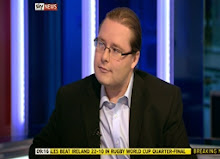
The bulk of my KPFA radio interview with Jane Heaven is now available to stream online.
CLICK HERE to listen.
I come in at 2hrs 06mins. The interview cuts off abruptly as we went over time but I may be able to upload my own MP3 version at a later date.
Monday, 15 March 2010
Sunday, 14 March 2010
Radio Interview Tonight - KPFA 94.1FM, California
I will be live tonight (Sunday night) on KPFA 94.1FM, starting at around midnight (PST) [that's 7am Monday, GMT], to discuss Michael Jackson, James Brown and more.
I am scheduled for an hour-long interview with Jane Heaven.
The station broadcasts to central and northern California but streams worldwide via the website. The show is also available afterwards as a podcast, I am told.
I am scheduled for an hour-long interview with Jane Heaven.
The station broadcasts to central and northern California but streams worldwide via the website. The show is also available afterwards as a podcast, I am told.

Saturday, 27 February 2010
Jackson Guitarist: 'No Truth' to Simmons Claims
Michael Jackson's long-serving tour guitarist Jennifer Batten has slammed Gene Simmons' recent allegations against the King of Pop.
Last week I sat down for an hour-long interview with Batten, who accompanied Jackson on all three of his world tours. During her decade of service she was also seen in the Dirty Diana music video, Jackson's feature film Moonwalker and the star's record breaking Superbowl performance, which was watched by more than a billion people.
Last week I sat down for an hour-long interview with Batten, who accompanied Jackson on all three of his world tours. During her decade of service she was also seen in the Dirty Diana music video, Jackson's feature film Moonwalker and the star's record breaking Superbowl performance, which was watched by more than a billion people.

Batten performs Dirty Diana with Jackson on the Bad Tour, 1988.
During our interview, I took the opportunity to quiz Batten over allegations recently made by aging glam rocker Gene Simmons, who claimed in a Classic Rock interview that a musician friend of his had quit a Michael Jackson tour after 'seeing boys coming out of the hotel rooms'.
Was it true, I asked her, that a musician had quit one of Jackson's tours while on the road?
"Number one," said Batten, "there's no truth to it. Number two, I would guess that it was somebody who got fired. Somebody who was embarrassed that they got fired and made-up a story."
But did any musicians ever get fired mid-way through a tour?
"No. Nuh-uh. No, there were a couple of people who got fired like a week before we took out on the road."
So there you have it, folks. No musician ever left a Michael Jackson tour mid-way through. Some musicians were fired but before the tour even hit the road, meaning that they couldn't have seen anything going on inside any hotels.
Yet again, Simmons' ravings about Jackson have been entirely debunked.
Sunday, 21 February 2010
'Take Me Out' Contestants are Actors, Models and Dancers

Ever wondered why the girls on ITV1 Blind Date-a-like 'Take Me Out' are so quick to turn their lights off? Their motivation is sometimes unfathomable. 'We interviewed Simon's mum' says Paddy McGuinness - and four lights go out. Why? Because he has a mother?! What is going on here?
I think I may have cracked it.
A shocking number of the contestants on Take Me Out are actually entertainment industry professionals; actors, singers, dancers and models. So their compulsive light switching is apparently nothing to do with their compatibility with each potential suitor, and everything to do with keeping their mugs on the telly for as long as possible.
Roz is an 'experienced video model and dancer'. Here's her StarNow profile. Caroline, another model/actress, is also a StarNow client. So is Louisa. And Maria.
Elisha is registered to Solomon Artistes casting agency (you'll have to hit F3 and type her name in).
Natasha's facebook directs you to Summer Star Entertainment's website. Tabitha's facebook says she's a singer, dancer, actor and model. Jayne's facebook includes pro-shot pole dancing photos and she writes on her wall about upcoming photoshoots.
Siobhan's facebook states, simply, 'I'm going to be a star'.
According to Wales Online, Charlene is a model, while the Accrington Observer reveals that the show's infamous twins are budding actresses.
Georgee is a gigging singer/songwriter. Tandie is a 'singer, songwriter, actress and dancer'. Laura's myspace page lists her as a singer and actress and reveals that she's appeared in 'Skins'.
Meanwhile, this facebook page reveals that Rihanna appeared under the name Taniesha in a film called 'One Day'.
I think I may have cracked it.
A shocking number of the contestants on Take Me Out are actually entertainment industry professionals; actors, singers, dancers and models. So their compulsive light switching is apparently nothing to do with their compatibility with each potential suitor, and everything to do with keeping their mugs on the telly for as long as possible.
Roz is an 'experienced video model and dancer'. Here's her StarNow profile. Caroline, another model/actress, is also a StarNow client. So is Louisa. And Maria.
Elisha is registered to Solomon Artistes casting agency (you'll have to hit F3 and type her name in).
Natasha's facebook directs you to Summer Star Entertainment's website. Tabitha's facebook says she's a singer, dancer, actor and model. Jayne's facebook includes pro-shot pole dancing photos and she writes on her wall about upcoming photoshoots.
Siobhan's facebook states, simply, 'I'm going to be a star'.
According to Wales Online, Charlene is a model, while the Accrington Observer reveals that the show's infamous twins are budding actresses.
Georgee is a gigging singer/songwriter. Tandie is a 'singer, songwriter, actress and dancer'. Laura's myspace page lists her as a singer and actress and reveals that she's appeared in 'Skins'.
Meanwhile, this facebook page reveals that Rihanna appeared under the name Taniesha in a film called 'One Day'.

But it's not just the girls who are at it. A hefty number of the boys also seem to have ulterior motives.
Scottish hunk Tony Pang said he was a humble waiter, but here's his StarNow profile touting him as an actor and model. He's also the cover boy for PhD Nutrition, whatever that may be.
Tom Chilton has modelled for Cosmopolitan.
Adam Fothergill turns out to be a professional singer represented by Talent Lounge (here he is on the Talent Lounge YouTube page).
Rob Kilburn's facebook page reveals that he attended the Italia Conti Theatre School and runs a company called Limelite Events.
Perhaps most bizarrely, one of the batchelors in episode two was Alan Whitehead, former member of 60s pop band Marmalade, who had a British number one with a cover of Obla Di, Obla Da.
So just how real is 'Take Me Out'? At least five of the contestants are represented by the same talent agency and upwards of 15 others are professional actors, models, dancers or musicians.
And those are just the ones I've managed to track down in an hour-long research window.
Wednesday, 10 February 2010
FreelanceUK Spotlight Interview + Your Chance to Ask Me A Question
I've been chosen as the subject of this month's FreelanceUK Spotlight Feature.
The monthly interview focuses on the peaks and pitfalls of life as a freelancer, offering advice and annecdotes from self-employed professionals in various industries.
This month I have been selected to speak about my experiences as a freelance writer. During my interview I discussed my work on James Brown and Michael Jackson, offered tips on how to earn money as a writer and recalled how I had been ripped off early in my career - plus more.
To read the interview, click here. Comments can be left on this page.
Given the volume of emails I have been receiving from supporters in recent months, I have decided to take some questions from my readers. They can be about anything to do with my work - how to get into writing, how to get published - or my specialist subjects such as Michael Jackson, James Brown and so on.
I have set up a dedicated email address for this Q+A and any others I might do in the future. Readers can send one question plus their first name and country to cethomson@live.co.uk. Put your email subject as 'BLOG INTERVIEW'. I will answer the first ten questions I receive in another blog entry in the near future.
The monthly interview focuses on the peaks and pitfalls of life as a freelancer, offering advice and annecdotes from self-employed professionals in various industries.
This month I have been selected to speak about my experiences as a freelance writer. During my interview I discussed my work on James Brown and Michael Jackson, offered tips on how to earn money as a writer and recalled how I had been ripped off early in my career - plus more.
To read the interview, click here. Comments can be left on this page.
Given the volume of emails I have been receiving from supporters in recent months, I have decided to take some questions from my readers. They can be about anything to do with my work - how to get into writing, how to get published - or my specialist subjects such as Michael Jackson, James Brown and so on.
I have set up a dedicated email address for this Q+A and any others I might do in the future. Readers can send one question plus their first name and country to cethomson@live.co.uk. Put your email subject as 'BLOG INTERVIEW'. I will answer the first ten questions I receive in another blog entry in the near future.
Friday, 5 February 2010
Gene Simmons In Bonkers Jackson Rant
It seems that the lead in Gene Simmons' make-up has gone to his brain.
In a bizarre rant during a Classic Rock interview, Simmons accused Michael Jackson of child molestation, citing several completely fictitious pieces of evidence.
The aging glam-rock star claimed that he knew a musician who quit a Michael Jackson tour because of 'what he saw' on the road. I am frequently paid as a Jackson expert and I can state with certainty that I am unaware of any musician ever quitting a Michael Jackson tour mid-way through. In fact, Jackson used the same musicians every time he toured, with minor alterations on a tour by tour basis, but never mid-way through.
Elsewhere, Simmons claimed that Michael Jackson was on tape ordering 'Jesus Juice' for children. This is a fiction.
It was alleged during Jackson's trial that he served alcohol to the Gavin Arvizo and his siblings, but they each gave contradictory accounts of the incident. Staff accused by the children of serving them booze all denied having ever done so, but did reveal that the children had been caught stealing alcohol behind Jackson's back.
No audio tape of Jackson ordering alcohol for children was ever brought forward and the star was acquitted on multiple counts of serving alcohol to a minor. Simmons' claim that Jackson was on tape ordering alcohol for children is pure fantasy.
By far, Simmons' most outrageous claim was that during Jackson's trial a travel agent testified that the star had hired them to fly to Brazil and fetch young boys for him. This allegation is a total figment of Gene Simmons' imagination. No such testimony ever occurred during Jackson's trial.
Growing up, I was always taught that if you don't know what you're talking about, you shouldn't say anything. Evidently Gene's parents didn't instill in him the same belief. That, or he's just going senile.
It is completely irresponsible to pass comment on a criminal investigation that you know nothing about and even more irresponsible to make a criminal accusation and then support it with non-existent evidence. Simmons has heard fragments of reported speech from Jackson's trial and then assigned them entirely new meaning as the years have passed, building up an arsenal of evidence against Jackson which never actually existed.
However, the blame doesn't lie solely at Simmons' door. Classic Rock should do their research before regurgitating such drivel. Yes, it is reported speech, but it is still irresponsible for any publication to perpetuate baseless myths which indicate that an innocent man is a paedophile.
Thanks to Google News, this story has now gone global. All over the world people are reading it and many will believe Simmons' comments, partially because he's in the music business and there is an element of presumed insider knowledge, but mostly because the initial reporting on Jackson's trial was so inept.
Simmons' comments have no basis in reality. Jackson is categorically not on tape ordering children alcohol. There was categorically not any testimony at his trial about flying boys in from Brazil. These two allegations are without any evidencial basis whatsoever, and for Simmons to state them as fact is despicable.
In future, Simmons should either do his research or shut his trap. His irresponsible and unfounded allegations have now entered the homes of millions around the globe and you can bet your bottom dollar that nobody is going to print a rebuttal or a retraction.
In a bizarre rant during a Classic Rock interview, Simmons accused Michael Jackson of child molestation, citing several completely fictitious pieces of evidence.
The aging glam-rock star claimed that he knew a musician who quit a Michael Jackson tour because of 'what he saw' on the road. I am frequently paid as a Jackson expert and I can state with certainty that I am unaware of any musician ever quitting a Michael Jackson tour mid-way through. In fact, Jackson used the same musicians every time he toured, with minor alterations on a tour by tour basis, but never mid-way through.
Elsewhere, Simmons claimed that Michael Jackson was on tape ordering 'Jesus Juice' for children. This is a fiction.
It was alleged during Jackson's trial that he served alcohol to the Gavin Arvizo and his siblings, but they each gave contradictory accounts of the incident. Staff accused by the children of serving them booze all denied having ever done so, but did reveal that the children had been caught stealing alcohol behind Jackson's back.
No audio tape of Jackson ordering alcohol for children was ever brought forward and the star was acquitted on multiple counts of serving alcohol to a minor. Simmons' claim that Jackson was on tape ordering alcohol for children is pure fantasy.
By far, Simmons' most outrageous claim was that during Jackson's trial a travel agent testified that the star had hired them to fly to Brazil and fetch young boys for him. This allegation is a total figment of Gene Simmons' imagination. No such testimony ever occurred during Jackson's trial.
Growing up, I was always taught that if you don't know what you're talking about, you shouldn't say anything. Evidently Gene's parents didn't instill in him the same belief. That, or he's just going senile.
It is completely irresponsible to pass comment on a criminal investigation that you know nothing about and even more irresponsible to make a criminal accusation and then support it with non-existent evidence. Simmons has heard fragments of reported speech from Jackson's trial and then assigned them entirely new meaning as the years have passed, building up an arsenal of evidence against Jackson which never actually existed.
However, the blame doesn't lie solely at Simmons' door. Classic Rock should do their research before regurgitating such drivel. Yes, it is reported speech, but it is still irresponsible for any publication to perpetuate baseless myths which indicate that an innocent man is a paedophile.
Thanks to Google News, this story has now gone global. All over the world people are reading it and many will believe Simmons' comments, partially because he's in the music business and there is an element of presumed insider knowledge, but mostly because the initial reporting on Jackson's trial was so inept.
Simmons' comments have no basis in reality. Jackson is categorically not on tape ordering children alcohol. There was categorically not any testimony at his trial about flying boys in from Brazil. These two allegations are without any evidencial basis whatsoever, and for Simmons to state them as fact is despicable.
In future, Simmons should either do his research or shut his trap. His irresponsible and unfounded allegations have now entered the homes of millions around the globe and you can bet your bottom dollar that nobody is going to print a rebuttal or a retraction.
Sunday, 3 January 2010
2009: A Year in Review
It is difficult to know where to begin in my summary of 2009. It has been action-packed, for sure.
2009 has seen me make the surprisingly speedy transition from college student to award winning writer. Within months I made the leap from writing essays and attending lectures to penning stories for the country's biggest newspaper, being interviewed on several news channels and even contributing to a bestselling book.
It has all been a bit of a blur but in hindsight I have squeezed a lot into the last 12 months.
I have stood metres from Michael Jackson as he annouced his comeback concerts inside the O2 arena and later stood outside the arena in the rain, watching his memorial service on a giant screen. I have interviewed rappers, filmmakers and jazz musicians, then published the stories in my own magazine. I have trodden the red carpet at a London film premiere and shared a stage with Motown legends.
It has been a year of extraordinary highs and lows, the highs understandably including my press accreditation for Michael Jackson's concert announcement. Other highs included completing my graduation ceremony without falling over, walking down the red carpet at a film premiere without falling over and accepting my Guardian award without falling over.
The lowest low, of course, was the death of Michael Jackson just weeks before I was due to see him live at the O2. In a way I had never quite believed that those concerts would go ahead, but I certainly didn't think he was going to die. I remember receiving a text message from my friend James, a jovial comment along the lines of 'What has Michael gone and done now?'
As I watched the news unfold I was initially not too concerned. I suspected he had manufactured some illness or injury in an attempt to postpone or cancel his comeback shows. Behind the scenes, Jackson insiders had been speculating all along that he would 'do anything' to get out of them.
When TMZ first announced Jackson's death I was again largely dismissive, partly because blog sites had inaccurately reported his death in the past and partly because it seemed like an impossibility that Michael Jackson could be dead. For Jackson at 50 years old to join the ranks of deceased icons like Elvis Presley, James Brown and Ray Charles - it seemed implausible; far too soon.
When BBC confirmed the news, I wilted.
Less than three years previously I had seen Michael Jackson and James Brown within weeks of one another. I had seen James Brown deliver what would become his last concert on British soil in late October 2006 and I saw Michael Jackson appear at the World Music Awards in November. I never dreamed that so soon afterwards we would have lost them both.
Speaking of Mr Brown, he figured into my year quite prominently for a man who had been deceased for the best part of three years. Before that concert in October 2006 I had been invited to Brown's pre-show press conference, where he spoke to me about an album he had been recording. In the wake of his death I wondered what had become of that album; surely that was the smartest time to release it? In the aftermath of Ray Charles's death his new album posthumously soared to the top of the charts. The same happened to Luther Vandross.
As time passed, I forget about the album. Then, in early 2008 I was dispatched by the US magazine 'Wax Poetics' to interview Brown's former sideman Fred Wesley. Knowing that Wesley had contributed to Brown's lost album I asked him about it and got to thinking that there could be a story in there somewhere.
I emailed a music magazine contact, who said they were interested in a piece about the album, so I set about researching it. I contacted and interviewed everybody I could who was involved in the recording - songwriters, session musicians, core band members, backing vocalists, studio engineers, managers and more. Then I got back in touch with my music magazine source and was discovered that they had lost interest in the project. Saddled with tens of thousands of words' worth of interview transcripts, a hefty transatlantic phonebill and no outlet, my research began gathering dust.
By early 2009 I had decided that if nobody else had the imagination to publish the article, I would do it myself. I believed in the piece. I knew it was a good story and I knew it was significant; Brown is widely considered to be the most influential musician of the 20th century and my research documented a significant milestone in his recording career; his final work. I set about whittling my interview material into a coherent piece - James Brown: The Lost Album - and published it in my own magazine; JIVE.

JIVE launched in May 2009. A one-off publication, I saw it as a reduced prototype for a British answer to VIBE or Wax Poetics, covering the areas of black music ignored by the UK's mainstream music press. With Brown as its cover star, the magazine also boasted in-depth interviews with rapper Sway DaSafo and calypso legend Eddy Grant, as well as an advance preview of Zaire '74 documentary 'Soul Power' and a candid chat with jazz stalwart Digby Fairweather, who mused on why musicians so frequently fall victim to addiction and detailed his own battle with the booze.
The magazine launch was attended by none other than the legendary, Grammy Award winning music writer Cliff White, with whom I chatted at length about his memories of James Brown, George Clinton, Bernie Worrell and others.
Creatively, the magazine was a success (apart from a few typos, inexplicably undetected by the countless spellchecks I carried out - curse you, Adobe InDesign!!). Financially, however, was another story.
The magazine, like the Brown article, was a labour of love. I conducted all of the interviews, I wrote all of the articles and I undertook the vast majority of the design work. I even included some of my own photography. However, I also footed the printing costs. The magazine was distributed for free apart from a handful sold over the internet, meaning that I made a net loss somewhere in the region of £900.
Taking home a prestigious Guardian Award for my James Brown article went a long way towards cushioning the blow of the £900 deficit. I had felt disheartened when I couldn't place the James Brown piece. At the time I had felt angry that the article was overlooked - that nobody saw the same potential in the story as I did. When members of the Guardian judging panel told me it was possibly the best piece they'd ever seen, I felt vindicated in my decision to pour so much time, effort and money into researching and publishing it. I had always believed in it and it was nice to know that I wasn't the only one.
In spite of Michael Jackson's passing, 2009 was a good year for live music. A mid-summer evening spent in the company of BB King was a highlight. The aging blues man's vocals and guitar work don't betray his age whatsoever; his rendition of 'Thrill Is Gone' sounded no different to the original 1970 recording. At 83 (now 84) he seemed to have years left in him.
October offered a double helping of Motown magic. First, Gladys Knight enchanted Wembley Arena, ably supported by Tito Jackson. The pair played to an audience which included Jackson family matriarch Katherine and British pop sensation Boy George. Tito Jackson and his Bowler Boys delivered funky renditions of Jacksons classics such as Dancing Machine, Shake Your Body and This Place Hotel. Gladys Knight's followed with a plethora of hits including a gutsy delivery on Licence to Kill, performed to a backdrop of Bond title-esque flames.
Three weeks later Smokey Robinson breezed into town for the BBC's Electric Proms. I watched from the front row of the Roundhouse's standing pit as Smokey crooned his way through hits from his own back catalogue as well as songs he penned for other acts, such as the Temptations' Get Ready and My Girl. Like Ms Knight, Smokey remains on fantastic vocal form and his unique performance style sucks the audience in. During ballads such as 'Ohh Baby Baby' and 'Tracks of My Tears' Robinson paced the stage, holding eye contact with what seemed like each individual member of the front row at one time or another. As his piercing blue eyes lock onto your own, he holds you captive and his syrupy falsetto digs deep into your soul.

November saw a roster of Motown legends perform a week of engagements in London. Described by the Jazz Cafe's Chris Steele as 'a week of real Motown, true Motown', the line-up included several significant figures from Motown history; Mable John - the first female act signed to Motown, Chris Clark - the first white artist signed to Motown, and Thelma Houston, the first Motown artist to win a Grammy.
Supporting the line-up was none other than Jack Ashford, the legendary percussionist and last surviving member of the original Motown Rhythm Section. I interviewed Jack in January 2008 for Wax Poetics and we have remained in touch. He kindly invited me backstage during rehearsals for the Hammersmith Apollo DVD recording. As it turned out, backstage meant onstage. My friend Angela stood to the side of the stage as we watched the Supremes rehearse their set before they were joined by Mabel John, Thelma Houston, Chris Clark and Brenda Holloway. Then we watched Jack put his Funk Brothers through their paces as they rehearsed songs including Dancing In The Street.

2009 has seen me make the surprisingly speedy transition from college student to award winning writer. Within months I made the leap from writing essays and attending lectures to penning stories for the country's biggest newspaper, being interviewed on several news channels and even contributing to a bestselling book.
It has all been a bit of a blur but in hindsight I have squeezed a lot into the last 12 months.
I have stood metres from Michael Jackson as he annouced his comeback concerts inside the O2 arena and later stood outside the arena in the rain, watching his memorial service on a giant screen. I have interviewed rappers, filmmakers and jazz musicians, then published the stories in my own magazine. I have trodden the red carpet at a London film premiere and shared a stage with Motown legends.
It has been a year of extraordinary highs and lows, the highs understandably including my press accreditation for Michael Jackson's concert announcement. Other highs included completing my graduation ceremony without falling over, walking down the red carpet at a film premiere without falling over and accepting my Guardian award without falling over.
The lowest low, of course, was the death of Michael Jackson just weeks before I was due to see him live at the O2. In a way I had never quite believed that those concerts would go ahead, but I certainly didn't think he was going to die. I remember receiving a text message from my friend James, a jovial comment along the lines of 'What has Michael gone and done now?'
As I watched the news unfold I was initially not too concerned. I suspected he had manufactured some illness or injury in an attempt to postpone or cancel his comeback shows. Behind the scenes, Jackson insiders had been speculating all along that he would 'do anything' to get out of them.
When TMZ first announced Jackson's death I was again largely dismissive, partly because blog sites had inaccurately reported his death in the past and partly because it seemed like an impossibility that Michael Jackson could be dead. For Jackson at 50 years old to join the ranks of deceased icons like Elvis Presley, James Brown and Ray Charles - it seemed implausible; far too soon.
When BBC confirmed the news, I wilted.
Less than three years previously I had seen Michael Jackson and James Brown within weeks of one another. I had seen James Brown deliver what would become his last concert on British soil in late October 2006 and I saw Michael Jackson appear at the World Music Awards in November. I never dreamed that so soon afterwards we would have lost them both.
Speaking of Mr Brown, he figured into my year quite prominently for a man who had been deceased for the best part of three years. Before that concert in October 2006 I had been invited to Brown's pre-show press conference, where he spoke to me about an album he had been recording. In the wake of his death I wondered what had become of that album; surely that was the smartest time to release it? In the aftermath of Ray Charles's death his new album posthumously soared to the top of the charts. The same happened to Luther Vandross.
As time passed, I forget about the album. Then, in early 2008 I was dispatched by the US magazine 'Wax Poetics' to interview Brown's former sideman Fred Wesley. Knowing that Wesley had contributed to Brown's lost album I asked him about it and got to thinking that there could be a story in there somewhere.
I emailed a music magazine contact, who said they were interested in a piece about the album, so I set about researching it. I contacted and interviewed everybody I could who was involved in the recording - songwriters, session musicians, core band members, backing vocalists, studio engineers, managers and more. Then I got back in touch with my music magazine source and was discovered that they had lost interest in the project. Saddled with tens of thousands of words' worth of interview transcripts, a hefty transatlantic phonebill and no outlet, my research began gathering dust.
By early 2009 I had decided that if nobody else had the imagination to publish the article, I would do it myself. I believed in the piece. I knew it was a good story and I knew it was significant; Brown is widely considered to be the most influential musician of the 20th century and my research documented a significant milestone in his recording career; his final work. I set about whittling my interview material into a coherent piece - James Brown: The Lost Album - and published it in my own magazine; JIVE.
JIVE launched in May 2009. A one-off publication, I saw it as a reduced prototype for a British answer to VIBE or Wax Poetics, covering the areas of black music ignored by the UK's mainstream music press. With Brown as its cover star, the magazine also boasted in-depth interviews with rapper Sway DaSafo and calypso legend Eddy Grant, as well as an advance preview of Zaire '74 documentary 'Soul Power' and a candid chat with jazz stalwart Digby Fairweather, who mused on why musicians so frequently fall victim to addiction and detailed his own battle with the booze.

The magazine launch was attended by none other than the legendary, Grammy Award winning music writer Cliff White, with whom I chatted at length about his memories of James Brown, George Clinton, Bernie Worrell and others.
Creatively, the magazine was a success (apart from a few typos, inexplicably undetected by the countless spellchecks I carried out - curse you, Adobe InDesign!!). Financially, however, was another story.
The magazine, like the Brown article, was a labour of love. I conducted all of the interviews, I wrote all of the articles and I undertook the vast majority of the design work. I even included some of my own photography. However, I also footed the printing costs. The magazine was distributed for free apart from a handful sold over the internet, meaning that I made a net loss somewhere in the region of £900.
Taking home a prestigious Guardian Award for my James Brown article went a long way towards cushioning the blow of the £900 deficit. I had felt disheartened when I couldn't place the James Brown piece. At the time I had felt angry that the article was overlooked - that nobody saw the same potential in the story as I did. When members of the Guardian judging panel told me it was possibly the best piece they'd ever seen, I felt vindicated in my decision to pour so much time, effort and money into researching and publishing it. I had always believed in it and it was nice to know that I wasn't the only one.
In spite of Michael Jackson's passing, 2009 was a good year for live music. A mid-summer evening spent in the company of BB King was a highlight. The aging blues man's vocals and guitar work don't betray his age whatsoever; his rendition of 'Thrill Is Gone' sounded no different to the original 1970 recording. At 83 (now 84) he seemed to have years left in him.
October offered a double helping of Motown magic. First, Gladys Knight enchanted Wembley Arena, ably supported by Tito Jackson. The pair played to an audience which included Jackson family matriarch Katherine and British pop sensation Boy George. Tito Jackson and his Bowler Boys delivered funky renditions of Jacksons classics such as Dancing Machine, Shake Your Body and This Place Hotel. Gladys Knight's followed with a plethora of hits including a gutsy delivery on Licence to Kill, performed to a backdrop of Bond title-esque flames.
Three weeks later Smokey Robinson breezed into town for the BBC's Electric Proms. I watched from the front row of the Roundhouse's standing pit as Smokey crooned his way through hits from his own back catalogue as well as songs he penned for other acts, such as the Temptations' Get Ready and My Girl. Like Ms Knight, Smokey remains on fantastic vocal form and his unique performance style sucks the audience in. During ballads such as 'Ohh Baby Baby' and 'Tracks of My Tears' Robinson paced the stage, holding eye contact with what seemed like each individual member of the front row at one time or another. As his piercing blue eyes lock onto your own, he holds you captive and his syrupy falsetto digs deep into your soul.
Smokey Robinson performs at the Camden Roundhouse
November saw a roster of Motown legends perform a week of engagements in London. Described by the Jazz Cafe's Chris Steele as 'a week of real Motown, true Motown', the line-up included several significant figures from Motown history; Mable John - the first female act signed to Motown, Chris Clark - the first white artist signed to Motown, and Thelma Houston, the first Motown artist to win a Grammy.
Supporting the line-up was none other than Jack Ashford, the legendary percussionist and last surviving member of the original Motown Rhythm Section. I interviewed Jack in January 2008 for Wax Poetics and we have remained in touch. He kindly invited me backstage during rehearsals for the Hammersmith Apollo DVD recording. As it turned out, backstage meant onstage. My friend Angela stood to the side of the stage as we watched the Supremes rehearse their set before they were joined by Mabel John, Thelma Houston, Chris Clark and Brenda Holloway. Then we watched Jack put his Funk Brothers through their paces as they rehearsed songs including Dancing In The Street.
Jack Ashford conducts his Funk Brothers during a rehearsal
Afterwards, we joined Jack in his dressing room as he was interviewed for the DVD extras and chatted with him briefly before making our way to the auditorium and taking our seats. For Motown enthusiasts there was much to enjoy; Mabel John looked and sounded sprightly at 79 as she prowled the stage during hits such as 'Same Time, Same Place', 'Able Mable' and 'Who Wouldn't Love A Man Like That'. Thelma Houston's performance of 'Don't Leave Me This Way' got the whole auditorium on its feet and Scherrie Payne's vocal performance on Supremes hit 'Stoned Love' ellicited a huge response.
I had intended to round off my live music year with Chuck Berry, but his tour was cancelled at the last minute. The official reason was that there wasn't enough preparation time, but the tour had been scheduled for months. I hear that the cancellation was actually due to a problem with the promoters.
While 2009 may have been a great year for live music, it wasn't such a great year for film. Highlights were few and far between. Much praise was heaped upon Michael Jackson's This Is It but while it was enjoyable and Jackson did seem to be on good form, the film is inherently untrustworthy. When I saw it I noticed immediately that old vocals had been dubbed into the film. The filmmakers had used obscure vocals in a bid to trick fans - for instance, using Jackson's 1991 demo version of Earth Song instead of the 1995 album track, and using a 1982 demo of Billie Jean instead of the version we all know and love. But it was dubbed nonetheless, a fact to which Sony admitted once the Sun hired audio experts to prove it.
This year's best music flick was actually 'Soul Power', Jeffrey Levy-Hinte's dazzling verite docmentary composed entirely of original footage from the Zaire '74 music festival, organised to coincide with Muhammad Ali's Rumble in the Jungle. Featuring stunning performances by artists including Bill Withers, BB King, James Brown, the Spinners and Miriam Makeba at the height of their powers, the film transports you back to 1974 and viewing it on a big screen almost felt like you were there watching it live. The film serves as a stark reminder of what soul and talent truly mean and proved a glorious antidote to today's depressing music scene.
I had intended to round off my live music year with Chuck Berry, but his tour was cancelled at the last minute. The official reason was that there wasn't enough preparation time, but the tour had been scheduled for months. I hear that the cancellation was actually due to a problem with the promoters.
While 2009 may have been a great year for live music, it wasn't such a great year for film. Highlights were few and far between. Much praise was heaped upon Michael Jackson's This Is It but while it was enjoyable and Jackson did seem to be on good form, the film is inherently untrustworthy. When I saw it I noticed immediately that old vocals had been dubbed into the film. The filmmakers had used obscure vocals in a bid to trick fans - for instance, using Jackson's 1991 demo version of Earth Song instead of the 1995 album track, and using a 1982 demo of Billie Jean instead of the version we all know and love. But it was dubbed nonetheless, a fact to which Sony admitted once the Sun hired audio experts to prove it.
This year's best music flick was actually 'Soul Power', Jeffrey Levy-Hinte's dazzling verite docmentary composed entirely of original footage from the Zaire '74 music festival, organised to coincide with Muhammad Ali's Rumble in the Jungle. Featuring stunning performances by artists including Bill Withers, BB King, James Brown, the Spinners and Miriam Makeba at the height of their powers, the film transports you back to 1974 and viewing it on a big screen almost felt like you were there watching it live. The film serves as a stark reminder of what soul and talent truly mean and proved a glorious antidote to today's depressing music scene.

My JIVE interview with Soul Power director Jeffrey Levy-Hinte
I was fortunate this year to find myself in possession of two tickets to the London premiere of 'The Men Who Stare at Goats', where I repeatedly walked past George Clooney but was more excited by the free popcorn and chocolate bar that awaited me in my seat. Despite a fairly poor critical reception I thought the film was solid. Brilliantly acted by a dream cast including Kevin Spacey and Jeff Bridges, the film was adapted by Jon Ronson's hilarious non-fiction book about the US Army's long obsession with teachng soldiers to harness psychic ability. Although not entirely faithful to Ronson's source material, Peter Straughan did a good job of weaving Ronson's research into a more linear narrative and I didn't feel the film was deserving of the harsh reviews that it received.
2009 will be most remembered for two major world events - the inauguration of America's first black president and the death of its biggest superstar. On a personal level, 2009 has been a good year. It hasn't been without its disappointments but on the whole it has been positive.
My new year's resolution? To make 2010 even better.
2009 will be most remembered for two major world events - the inauguration of America's first black president and the death of its biggest superstar. On a personal level, 2009 has been a good year. It hasn't been without its disappointments but on the whole it has been positive.
My new year's resolution? To make 2010 even better.
Subscribe to:
Posts (Atom)